
9th Standard CBSE Syllabus & Materials
9th Standard CBSE
CBSE 9th Standard Mathematics Statistics Sample Question Papers Study Material - QB365 Set D
NEW9th Standard CBSE
CBSE 9th Standard Mathematics Statistics Sample Question Papers Study Material - QB365 Set C
NEW9th Standard CBSE
CBSE 9th Standard Mathematics Statistics Sample Question Papers Study Material - QB365 Set B
NEW9th Standard CBSE
CBSE 9th Standard Mathematics Statistics Sample Question Papers Study Material - QB365 Set A
NEW9th Standard CBSE
CBSE 9th Standard Mathematics Surface Areas and Volumes Sample Question Papers Study Material - QB365 Set D
NEW9th Standard CBSE
CBSE 9th Standard Mathematics Surface Areas and Volumes Sample Question Papers Study Material - QB365 Set C

Published on: 29/10/2025
Download CBSE Class 9th Standard CBSE Mathematics question papers, sample papers, important questions, and previous year solved papers in PDF format. Get free study materials, NCERT solutions, and exam preparation resources for Class 9th Standard CBSE Mathematics
Questions + Answers key
Take MCQ Mathematics Test
1.
If a+b+c=6 and ab+bc+ca=11, find the value of a3+b3+c3-3abc.
2.
Find the area of a rhombus whose perimeter is 200 m and one of the diagonals is 80 m.
3.
The perimeter of a triangle field is 300 cm and its sides are in the ratio 5:12:13.Find the length of the perpendicular from the opposite vertex to the side whose length is 130 cm.
4.
An isosceles triangle has perimeter 30 m and each of the equal sides is 12 cm.Find area of the triangle.
5.
Multiply \(9x^2+25y^2+15xy+12x-20y+16\quad by\quad3x-5y-4\) Using suitable identity.
6.
Find the value of \(x^3-8y^3-36xy-216\) when x=2y+6
7.
Find the values of a and b so that (x+1) and (x-1) are factors of \(x^4+ax^3-3x^2+2x+b\)
8.
If \(x=-2\) is the root of the equation \(\sqrt { 2 } (x+p)=0\) and is also the zero the zero of the polynomial \({ px }^{ 2 }+kx+2\sqrt { 2 } \) then find the value of k.
9.
Find the area of an equilateral triangle whose perimeter is 60 cm. (Using Heron's formula).
10.
Expand each of the following using suitable identities: \((3a-7b-c)^2\)
11.
Factorise \(x^3-3x^2-9x-5\)
12.
Find the remainder when \(x^3-ax^2+6-a\) is divided by \(x-a\)
13.
Find the remainder when \(x^3+3x^2+3x+1\) is divided by \(x+\pi\)
14.
Find the remainder when \(x^3+3x^2+3x+1\) is divided by \(x\)
1.
(a+b+c)2=a2+b2+c2+2(ab+bc+ca)
(6)2=a2+b2+c2+2\(\times\)11
a2+b2+c2=36-22=14
a3+b3+c3-3abc=(a+b+c)[a2+b2+c2-(ab+bc+ca)]
= 6 \(\times\) (14-11)=6\(\times\)3=18.
2.
Let each of the equal sides of the rhombus be a cm.
Then, Perimeter = a + a + a + a = 4a m
According to the question, 4a = 200
\(\Rightarrow \) a= \(\frac { 200 }{ 4 } \) = 50 m
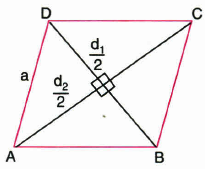
d1= 80 m
a2=\({ \left( \frac { { d }_{ 1 } }{ 2 } \right) }^{ 2 }+{ \left( \frac { { d }_{ 2 } }{ 2 } \right) }^{ 2 }\)
\(\Rightarrow \) (50)2 =( 40)2+\({ \left( \frac { { d }_{ 2 } }{ 2 } \right) }^{ 2 }\)
\(\Rightarrow \) \({ \left( \frac { { d }_{ 2 } }{ 2 } \right) }^{ 2 }\)= (50)2-(40)2 = 900= (30)2
\(\Rightarrow \) \(\frac { { d }_{ 2 } }{ 2 } \) = 30
\(\Rightarrow \) d2 = 60 m
\(\therefore \) Area of the rhombus = \(\frac { 1 }{ 2 } \) d1d2=\(\frac { 1 }{ 2 } \)\(\times \)80\(\times \)60 = 2400 m2
3.
a:b:c = 5:12:13
5+12+13 = 30
a+b+c = 300 cm
\(\therefore a=\frac { 5 }{ 30 } \times 300=50\) cm
\(b=\frac { 12 }{ 30 } \times 300=120\) cm
\(c=\frac { 13 }{ 30 } \times 300=130\)
\(\therefore s=\frac { a+b+c }{ 2 } =\frac { 50+120+130 }{ 2 } =150\) cm
\(\therefore \) Area of the triangular field \(=\sqrt { s(s-a)(s-b)(s-c) } \)
\(=\sqrt { 150(150-50)(150-120)(150-130) } \)
\(\\ =\sqrt { 150\times 100\times 30\times 20 } \)
= 3000 cm2 ----(1)
Let the length of the perpendicular from the opposite vertex to the side whose length is 130 cm be h cm.Then,
Area of the triangular field \(=\frac { 130\times h }{ 2 } \) = 65h cm2 ...(2)
From (1) and (2)
65h = 3000
\(\Rightarrow h=\frac { 3000 }{ 65 } =\frac { 600 }{ 13 } \) cm = 46.15 cm
4.
Let the third side be x cm. Then, 12 + 12 + x = 30
24 + x = 30
x = 6 cm
So, a = 12 cm, b = 12 cms, c = 6 cm
\(\therefore s=\frac { a+b+c }{ 2 } =\frac { 12+12+6 }{ 2 } \)
= 15 cm
\(\therefore \) Area \(=\sqrt { s(s-a)(s-b)(s-c) } \)
\(=\sqrt { 15(15-12)(15-12)(15-6) } \)
\(=9\sqrt { 15 } \) cm2
5.
\((3x-5y-4)(9x^2+25y^2+15xy+12x-20y+16)\)
\(=\left\{ (3x)+(-5y)+(-4)(3x)^{ 2 }+(-5y)^{ 2 }+(-4)^{ 2 }-(3x)(-5y)-(-5y)(-4)-(-4)(3x) \right\} \)
\(=(3x)^2+(-5y)^3+(-4)^3-3(3x)(-5y)(-4)\)
\(=27x^3-125y^3-64-180xy\)
6.
We have x=2y+6
\(\Rightarrow +(-2y)+(-6)=0\)
\(\therefore\) \(x^3+(-2y)^3+(-6)^3=3x(-2y)(-6)\)
\(\Rightarrow x^3-8y^3-216=36xy\)
\(\therefore\) \(x^3-8y^3-36xy-216=0\)
7.
Let \(p(x)=x^{ 4 }+ax^{ 3 }-3x^{ 2 }+2x+b\)
If (x+1) and (x-1) are factors of p(x), then by factor theorem,
\(p(-1)=0 \ \ .......(1)\ x+1=0\ \ \ \Rightarrow \ x=-1\)
and \(p(1)=0\ \ \ .......(2)|\ -1=0\Rightarrow x=1\)
Now, \(p(-1)=0\)
\(\Rightarrow (-1)^{ 4 }+a(-1)^{ 3 }-3(-1)^{ 2 }+2(-1)+b=0\)
\(\Rightarrow 1-a-3-2+b=0\)
\(\Rightarrow -a+b=4\ \ .......(3)\)
and \(p(1)=0\)
\(\Rightarrow (1)^{ 4 }+a(1)^{ 3 }-3(1)^{ 2 }+2(1)+b=0\)
\(\Rightarrow 1+a-3+2+b=0\)
\(\Rightarrow a+b=0\ .......(4)\)
Solving (3) from (2), we get
a = -2,b = 2
8.
\(\sqrt { 2 } (x+p)=0\)
\(\Rightarrow x+p=0\)
\(\Rightarrow x=-p\)
According to the question,
\(-p=-2\)
\(\Rightarrow \ p=2\)
Let \(f(x)={ px }^{ 2 }+kx+2\sqrt { 2 } \)
Then, \(f(x)={ 2x }^{ 2 }+kx+2\sqrt { 2 } \)
If \(x=-2\) is a zero of f(x) then
\(f(-2)=0\)
\(\Rightarrow \ 2{ (-2) }^{ 2 }+k(-2)+2\sqrt { 2 } =0\)
\(\Rightarrow 2k=8+2\sqrt { 2 }\)
\(\Rightarrow k=4+\sqrt { 2 } \)
9.
\(100\sqrt { 3 } \) cm2
10.
\((3a-7b-c)^2\)
\((3a-7b-c)^{ 2 }={ \{ 3a+(-7b)+(-c)\} }^{ 2 }\)
\(={ (3a) }^{ 2 }+{ (-7b) }^{ 2 }+{ (-c) }^{ 2 }+2(3a){ (-7b) }+2(-7b)(-c)+2(-c)(3a)\)
\(=9{ a }^{ 2 }+49{ b }^{ 2 }+{ c }^{ 2 }-42ab+14bc-6ca\)
11.
\(x^3-3x^2-9x-5\)
Let \(p(x)={ x }^{ 3 }-3{ x }^{ 2 }-9x-5\)
By trail, we find that
\(p(-1)={ (-1) }^{ 3 }-3{ (-1) }^{ 2 }-9(-1)-5\)
\(=-1-3+9-5=0\)
\(\therefore\) By Factor Theorem, x-(-x), i.e., (x+1) is a factor of p(x).
Now,
\({ x }^{ 3 }-3{ x }^{ 2 }-9x-5={ x }^{ 2 }(x+1)-4x(x+1)-5(x+1)\)
\(=(x+1)({ x }^{ 2 }-4x-5)\)
\(=(x+1)({ x }^{ 2 }-5x+x-5)\)
\(=(x+1)\{ x(x-5)+1(x-2)\} \)
\(=(x+1)(x-5)(x+1).\)
12.
Let \(p(x)=x^3-ax^2+6x-a\)
\(x-a=0\)
\(\Rightarrow x=a\)
\(\therefore\) Remainder = \((a)^3-a(a)^2+6(a)-a\)
= \(a^3-a^2+6a-a\)
= 5a
13.
\(x+\pi\)
\(x+\pi=0\ d\Rightarrow\ x=-\pi\)
\(\therefore\) Remainder \(= (-\pi)^3+3(-\pi)^2+3(-\pi)+1\)
\(= -\pi^3+3\pi^2+3\pi+1\)
14.
\(x\)
\(\therefore\) Remainder
\(= (0)^3+3(0)^2+3(0)+1=1\)

9th Standard CBSE Syllabus & Materials
9th Standard CBSE
CBSE 9th Standard Mathematics Surface Areas and Volumes Sample Question Papers Study Material - QB365 Set B
NEW9th Standard CBSE
CBSE 9th Standard Mathematics Surface Areas and Volumes Sample Question Papers Study Material - QB365 Set A
NEW9th Standard CBSE
CBSE 9th Standard Mathematics Heron's Formula Sample Question Papers Study Material - QB365 Set C



NCERT Books

Syllabus

Exam Pattern

Sample Question Papers

Previous year Question Papers

Important Notes

MCQ Practice test

NCERT Exemplers

Case study Questions

Image Based Questions

Passage based Questions

HOT Questions

Value Based Questions

Model Questions Papers
NCERT ( Book Back ) Questions

Assertion and Reason
Important Questions And Answers

CBSE 9th Standard CBSE Subjects
CBSE Standards