9th Standard CBSE Syllabus & Materials
9th Standard CBSE
CBSE 9th Standard Mathematics Statistics Sample Question Papers Study Material - QB365 Set D
NEW9th Standard CBSE
CBSE 9th Standard Mathematics Statistics Sample Question Papers Study Material - QB365 Set C
NEW9th Standard CBSE
CBSE 9th Standard Mathematics Statistics Sample Question Papers Study Material - QB365 Set B
NEW9th Standard CBSE
CBSE 9th Standard Mathematics Statistics Sample Question Papers Study Material - QB365 Set A
NEW9th Standard CBSE
CBSE 9th Standard Mathematics Surface Areas and Volumes Sample Question Papers Study Material - QB365 Set C
NEW9th Standard CBSE
CBSE 9th Standard Mathematics Surface Areas and Volumes Sample Question Papers Study Material - QB365 Set B

Published on: 29/10/2025
Download CBSE Class 9th Standard CBSE Mathematics question papers, sample papers, important questions, and previous year solved papers in PDF format. Get free study materials, NCERT solutions, and exam preparation resources for Class 9th Standard CBSE Mathematics
Questions + Answers key
Take MCQ Mathematics Test
1.
Find mean, median and mode of the following data: 15,17,16,14,17,16,11,15,17,14
2.
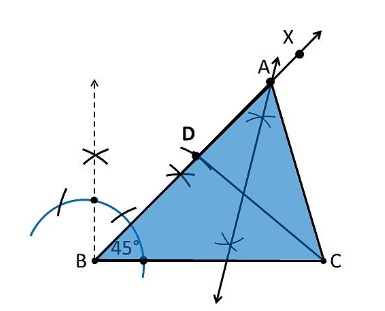
Construct a triangle ABC in which BC = 8 cm,ㄥB = 45o and AB - AC = 3.5 cm
3.
Given below is the frequency distribution of salary in Rs of 80 workers in a factory.
| Salary | No.of workers |
| 1000-2000 | 8 |
| 2000-3000 | 14 |
| 3000-4000 | 20 |
| 4000-5000 | 24 |
| 5000-6000 | 14 |
Find the probability that the salary of a worker selected at random is:
(i) Less than 4000
(ii) More than or equal to 3000
(iii) More than or equal to 2000 but less than 5000
4.
The blood groups of 30 students of Class VIII are recorded as follows:
A,B,O,O,AB,O,A,O,B,A,O,B, A,O,O,
A,AB,O,A,A,O,O,AB,B,A,O,B,A,B,O.
Represent this data in the form of a frequency distribution table. Which is the most common and which is the rarest, blood group among these students.
5.
A joker's cap is in the form of a right circular cone of base radius 7 cm are height 24 cm. Find the area of sheet required to make 20 such caps. (Take \(\pi =\frac { 22 }{ 7 } \))
6.
The diameter of a roller is 84 cm and its length is 120 cm. It takes 500 complete revolutions to move once over to level a playground. Find the area of the playground in m2.
7.
The curved surface area of a right circular cylinder of height 14 cm is 88 cm2. Find the diameter of the base of the cylinder.
8.
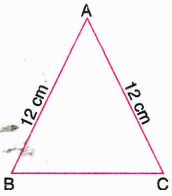
An isosceles triangle has perimeter 30 cm and each of the equal sides is 12 cm. Find the area of the triangle.
9.
Construct an equilateral triangle, given its side and justify the construction.
10.
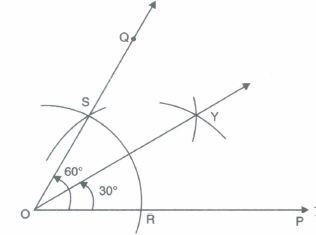
Construct ∠POY=30 o. using compass and ruler.
11.
Two coins are tossed simultaneously 500 times, and we get
| Result | 2 heads | 1 head | No head |
| Frequency | 105 | 275 | 120 |
Find the probability of occurrence of
(i) two heads
(ii) all tails.
12.
In a group of 70 persons, there are 15 boys, 20 girls, 30 men and rest women. Find the probability that a selected person is a woman.
13.
10 numbers 8,11,15,19,x+1,2x-13,28,31,40,41 are written in ascending order. If the median is 24, find x.
14.
The length, breadth, and height of a cuboid are 15 cm, 10 cm, and 20 cm. Find the surface area of the cuboid.
15.
Find the area of an equilateral triangle of side 10 cm.
16.
A pen stand is cylindrical in shape with the base radius 3.5 cm and height 10.55 cm. How much card board will be required to make 25 such pen stand? Also, find volume of 1 pen stand.
17.
The diameter of the moon is approximately one-fourth the diameter of earth. What fraction of volume of earth is the volume of moon?
18.
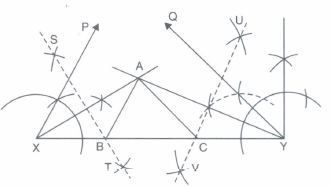
Construct a triangle ABC, in which ㄥB = 60o,ㄥC = 45o and AB + BC + CA = 11 cm
19.
Cards marked with numbers 2 to 101 are placed in a box and mixed thoroughly. One card is drawn from this box. Find the probability that the number on the card is
(a) a number less than 14
(b) a number which is a perfect square
(c) a prime number less than 20
20.
The following observations have been arranged in ascending order. If the median of the data in 65, find the value of x.
32,35,50,51,x,x+2,73,76,83,90
21.
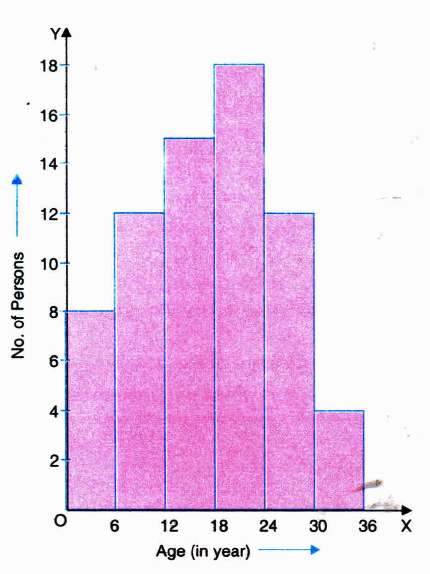
For the following data, draw a histogram.
| Age (in years) | Number of persons |
| 0-6 | 8 |
| 6-12 | 12 |
| 12-18 | 15 |
| 18-24 | 18 |
| 24-30 | 12 |
| 30-36 | 4 |
22.
A triangle and a parallelogram have the same base and the same area.If the sides of the triangle are 15 cm, 14 cm, and 13 cm, and the parallelogram stands on the base 15 cm, find the height of the parallelogram.
23.
An isosceles triangle has perimeter 30 m and each of the equal sides is 12 cm.Find area of the triangle.
24.
A die is thrown, what will be the probability of getting an even number?
25.
The points scored by a basketball team in a series of matches are as follows: 17,2,7,17,25,514,18,10. Find range.
26.
Two cylinders have bases of same size. The diameter of each is 7 cm. If one of the cylinder is 10 cm high and the other is 20 cm high, then the ratio of their volumes is _________________
27.
Compute the curved surface area of a hemishpere whose diameter is 14 cm.
28.
If a 60o angle is bisected twice,what will be measure of each that is constructed?
1.
Arranging data in ascending order: 11,14,14,15,15,16,16,17,17,17
Mean = \(\frac { \sum { x } }{ n } =\frac { 152 }{ 10 } \)=15.2
Here, n =1 0(even), Median
\({ \left[ \frac { { n }^{ th } }{ 2 } +{ \left( \frac { n }{ 2 } +1 \right) }^{ th } \right] }^{ term }\)
= \(\frac { 15+16 }{ 2 } \) = 15.5
Mode = 17
2.
Steps of construction:
i) Draw the line segment BC = 8 cm and at point B construct an angle of 45o .i.e XBC = 45o and AB - AC = 3.5 cm
ii) Cut the line segment BD = 3.5 cm(equal to AB-AC)on ray BX
iii) Join DC and draw the perpendicular bisector PQ of DC
iv) The perpendicular bisector intersects BXat point A.Join AC MBC is the required triangle.
3.
\((i)\frac { 21 }{ 40 }\)
\((ii)\frac { 29 }{ 40 }\)
\((iii)\frac { 29 }{ 40 } \)
4.
O is the most common and AB is the rarest blood group among these students.
5.
1.1 m2
6.
2r = 84 cm
\(\Rightarrow\) r = 42 cm
h = 120 cm
\(\therefore\) Area of the playground levelled in taking 1 complete revolution
\(=2\pi rh\)
\(\\ =2\times \frac { 22 }{ 7 } \times 42\times 120=31680{ cm }^{ 2 }\)
\(\therefore\) Area of the playground = 31680 \(\times\) 500
= 15840000 cm2 \(=\frac { 15840000 }{ 100\times 100 } { m }^{ 2 }\)
= 1584 m2
Hence, the area of the playground is 1584 m2.
7.
Let the radius of the base of the cylinder be r cm.
h = 14 cm
Curved surface area = 88 cm2 Given
\(\Rightarrow\) \(2\pi rh=88\)
\(\Rightarrow\) \(2\times \frac { 22 }{ 7 } \times r\times 14=88\)
\(\Rightarrow\) \(r=\frac { 88\times 7 }{ 2\times 22\times 14 } \)
\(\Rightarrow\) r = 1
\(\Rightarrow\) 2r = 2
Hence, the diameter of the base of the cylinder is 2 cm.
8.
a = 12 cm, b = 12 cm Perimeter = 30 cm
\(\Rightarrow \) a + b + c = 30
\(\Rightarrow \) 12 + 12 + c = 30
\(\Rightarrow \) 24 + c = 30
\(\Rightarrow \) c = 30 - 24
\(\Rightarrow \) c = 6 cm
\(s=\frac { 30 }{ 2 } \) cm = 15 cm
\(\therefore \) Area of the triangle \(=\sqrt { s(s-a)(s-b)(s-c) } \)
\(=\sqrt { 15(15-12)(15-12)(15-6) } \)
\(=\sqrt { 15(3)(3)(9) } =9\sqrt { 15 } \) cm2.
9.
Given: Side (say 4 cm) of an equilateral triangle.
Required: To construct the equilateral triangle and justify the construction.
Steps of Construction:
1. Take a ray AX with initial point A. From AX, cut off AB = 4 cm.
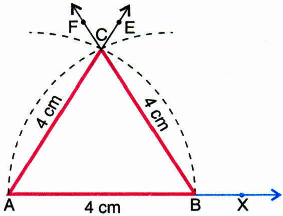
2. Taking A as centre and radius (= 4 em), draw an arc of a circle, which intersects AX, say at a point B.
3. Taking B as centre and with the same radius as before, draw an arc intersecting the previously drawn arc, say at a point C.
4. Draw the ray AE passing through C.
5. Draw the ray BF passing through e. Then \(\Delta \) ABC is the required triangle with given side 4 cm.
10.
Steps of Construction:
i) Draw any line OP.
ii) With O as centre and any suitable radius, draw an arc to meet OP at R.
iii) With R as centre and same radius (as in step 2).draw an arc to meet the previous arc at S.
iv) Join OS and Produce it to Q,then ㄥPOQ=60o
v) With R as centre and any suitable radius (not necessarily) equal to radius of step 1 (but > \(\frac { 1 }{ 2 } \)RS),draw an arc. Also, with 5 as centre and radius draw another arc to meet the previous arc at Y.
vi) Join OY and produced it, the OY is the required bisector of ㄥPOQ (i.e ㄥPOY=30o)
11.
\((i)\frac { 21 }{ 100 }\)
\((ii)\frac { 6 }{ 25 } \)
12.
No of women = 70 - 15(+20 + 30)
= 5
P(women) = \(\frac{5}{70}=\frac{1}{14}\)
13.
20
14.
1300 cm2
15.
\(25\sqrt { 3 } \) cm2
16.
given, base radius of cylinder r = 3.5 cm
Height of cylinder h = 10.5 cm
Amount of card board required to make 1 pen stand = Total surface area of cylinder
\(\therefore\) Total surface area = 2\(\pi\)r(h+r0
\(=2\times \frac { 22 }{ 7 } \times 3.5(10.5+3.5)\)
\(=2\times \frac { 22 }{ 7 } \times 3.5\times 14\)
= 308 cm2
\(\therefore\) 308 cm2 is the amount of card board needed for 1 pen stand, then for 25 stands = 25 \(\times\)308
= 7700 cm2
Volume of 1 pen stand = \(\pi\)r2h
\(=\frac { 22 }{ 7 } \times 3.5\times 3.5\times 10.5\)
= 404.25 cm3.
17.
Let the diameter of earth be d.
\(\therefore\) The radius of the earth will be r1=\(\frac { d }{ 2 } \)
Diameter of moon will be \(\frac { d }{ 4 } \) and radius of moon (r2)=\(\frac { d }{ 4 } \)
Volume of moon=\(\frac { 4 }{ 3 } \pi { r }_{ 2 }^{ 3 }\)
\(=\frac { 4 }{ 3 } \pi { \left( \frac { d }{ 8 } \right) }^{ 3 }\)
\(=\frac { 1 }{ 512 } \times { \pi d }^{ 3 }\times \frac { 4 }{ 3 } \)
Volume of earth = \(\frac { 4 }{ 3 } \pi { r }_{ 1 }^{ 3 }\)
\(=\frac { 4 }{ 3 } p{ \left( \frac { d }{ 2 } \right) }^{ 3 }\)
\(=\frac { 1 }{ 8 } \times \frac { 4 }{ 3 } \pi { d }^{ 3 }\)
\(\frac { Volume\ of\ moon }{ Volume\ of\ earth } =\frac { \frac { 1 }{ 512 } \times { \pi d }^{ 2 }\times \frac { 4 }{ 3 } }{ \frac { 1 }{ 8 } \times \frac { 4 }{ 3 } \pi { d }^{ 3 } } \)
\(=\frac { 1 }{ 64 } \)
\(\Rightarrow \ Volume\ of\ moon=\frac { 1 }{ 64 } (Volume\ of\ earth)\)
\(\Rightarrow \ \frac { Volume\ of\ moon }{ volume\ of\ earth } =\frac { 64 }{ 1 } \)
18.
Steps of construction:
i) Draw a line segment XY = 11 cm (As AB+ BC + CA = 11cm)
ii) Construct an angle PXY of 60o at point X and an angle ㄥQYZ of 45o at point Y
iii) Bisect ㄥPXY and ㄥQYZ .These bisectors intersect each other at point A
iv) Draw perpendicular bisectors ST of XA and UV of YA.
v) Perpendicular bisector ST intersects XY at B and UV intersects XY at C Join AB, AC MBC is the required triangle.
19.
Total number of cards in the box = 100
(a) Numbers less than 14 are 2,3,4,5,6,7,8,9,10,11,12,13
Their number = 12
Probability that the number on the card is a number less than 14
\(=\frac { 12 }{ 100 } =\frac { 3 }{ 25 } \)
(b) Perfect square numbers are 4,9,16,25,36,49,64,81,100
Their number = 9
Probability that the number on the card is a number which is a perfect square
\(=\frac { 9 }{ 100 } \)
(c) Prime numbers less than 20 are 2,3,5,7,11,13,17,19
Their number = 8
Probability that the number on the card is a prime number less than 20
\(=\frac { 8 }{ 100 } =\frac { 2 }{ 25 } \)
20.
Number of observations (n) = 10, which is even,
\(\therefore\) Median
\(=\frac { { \left( \frac { n }{ 2 } \right) }^{ th }observation+{ \left( \frac { n }{ 2 } +1 \right) }^{ th }observation }{ 2 } \)
\(\Rightarrow 65=\frac { 5^{ th }observation+6^{ th }observation }{ 2 } \)
\(\Rightarrow\) \(65 = \frac {x+\left(x+2\right)}{2}\)
\(\Rightarrow\) 2x + 2 = 130
\(\Rightarrow\) 2x = 130 - 2 = 128
\(\Rightarrow\) \(x = \frac {128}{2}=64\)
21.
22.
For triangle a = 15 cm, b = 14 cm, c = 13 cm
\( \therefore \ =\frac { a+b+c }{ 2 } s=\frac { 15+14+13 }{ 2 } =21\)c m
\(\therefore \) Area = \(\sqrt { s(s-a)(s-b)(s-c) } \)
\(=\sqrt { 21(21-15)(21-14)(12-13) } \)
\(=\sqrt { 21(6)(7)(8) } =84\) cm2
Let the height of the parallelogram be h cm.
Then, area of the parallelogram = Base \(\times \) Height = 15 \(\times \) h = 15 cm2
According to the question, Area of the parallelogram = Area of the triangle
\(\Rightarrow \) 15h = 84
\(\Rightarrow \) \(\frac { 84 }{ 15 } \) = 5.6 cm
Hence, the height of the parallelogram is 5.6 cm.
23.
Let the third side be x cm. Then, 12 + 12 + x = 30
24 + x = 30
x = 6 cm
So, a = 12 cm, b = 12 cms, c = 6 cm
\(\therefore s=\frac { a+b+c }{ 2 } =\frac { 12+12+6 }{ 2 } \)
= 15 cm
\(\therefore \) Area \(=\sqrt { s(s-a)(s-b)(s-c) } \)
\(=\sqrt { 15(15-12)(15-12)(15-6) } \)
\(=9\sqrt { 15 } \) cm2
24.
()
Favourable number of outcomes = 3(2,4,6)
Total number of outcomes = 6
Required probability\(=\frac{3}{6}=\frac{1}{2}\)
25.
()
Range = highest point-lowest point
= 27 - 2 = 25
26.
()
Let r denotes the radius of both cylinders and l and h be their heights respectively.
Ratio of their volumes = \(\frac { \pi { r }^{ 2 }h }{ \pi { r }^{ 2 }h' } =\frac { h }{ h' } =\frac { 10 }{ 20 } \)
= 1 : 2.
27.
()
Given diameter of hemisphere = 14 cm
\(\therefore\) radius = 7 cm
\(\therefore\) Curved surface area = 2\(\pi\)r2
\(=2\times \frac { 22 }{ 7 } \times 7\times 7\)
= 308 cm2
28.
()
Since bisector of an angle divides it in two equal parts,so,when it is bisected twice,measure of each angle is 15o

9th Standard CBSE Syllabus & Materials
9th Standard CBSE
CBSE 9th Standard Mathematics Surface Areas and Volumes Sample Question Papers Study Material - QB365 Set A
NEW9th Standard CBSE
CBSE 9th Standard Mathematics Heron's Formula Sample Question Papers Study Material - QB365 Set D
NEW9th Standard CBSE
CBSE 9th Standard Mathematics Heron's Formula Sample Question Papers Study Material - QB365 Set C



NCERT Books

Syllabus

Exam Pattern

Sample Question Papers

Previous year Question Papers

Important Notes

MCQ Practice test

NCERT Exemplers

Case study Questions

Image Based Questions

Passage based Questions

HOT Questions

Value Based Questions

Model Questions Papers
NCERT ( Book Back ) Questions

Assertion and Reason
Important Questions And Answers

CBSE 9th Standard CBSE Subjects
CBSE Standards