9th Standard CBSE Syllabus & Materials
9th Standard CBSE
CBSE 9th Standard Mathematics Statistics Sample Question Papers Study Material - QB365 Set D
NEW9th Standard CBSE
CBSE 9th Standard Mathematics Statistics Sample Question Papers Study Material - QB365 Set B
NEW9th Standard CBSE
CBSE 9th Standard Mathematics Statistics Sample Question Papers Study Material - QB365 Set A
NEW9th Standard CBSE
CBSE 9th Standard Mathematics Surface Areas and Volumes Sample Question Papers Study Material - QB365 Set D
NEW9th Standard CBSE
CBSE 9th Standard Mathematics Surface Areas and Volumes Sample Question Papers Study Material - QB365 Set C
NEW9th Standard CBSE
CBSE 9th Standard Mathematics Surface Areas and Volumes Sample Question Papers Study Material - QB365 Set B

Published on: 29/10/2025
Download CBSE Class 9th Standard CBSE Mathematics question papers, sample papers, important questions, and previous year solved papers in PDF format. Get free study materials, NCERT solutions, and exam preparation resources for Class 9th Standard CBSE Mathematics
Questions + Answers key
Take MCQ Mathematics Test
1.
Simplify: \(\frac { 1 }{ \sqrt { 3 } +\sqrt { 2 } } -\frac { 2 }{ \sqrt { 5 } -\sqrt { 3 } } -\frac { 3 }{ \sqrt { 2 } +\sqrt { 5 } } \)
2.
When 5 times the larger of the two numbers is divided by the smaller, the quotient and remainder are 2 and 9 respectively. Form a linear equation in two variables. Write it in standard form.
3.
If f(x) = x3-3x2+3x-4, find f(2)+f(-2)+f(0).
4.
Express y in terms of x in the equation 5x-4y+20=0.Draw the graph and find the points where the lines represented by this equation cuts x-axis and y-axis
5.
Write four solutions for each of the following equations:
\(\pi x+y=9\)
6.
The perpendicular distance of a point from the x-axis is 4 units and the perpendicular distance from the y-axis is 5 units.Write the coordinates of such a point if it lies in the
(a) I quadrant (b) II quadrant (c) III quadrant (d) IV quadrant
7.
Find six rational numbers between 3 and 4.
8.
If a+b+c=6 and ab+bc+ca=11, find the value of a3+b3+c3-3abc.
9.
Arrange in descending order \(\sqrt [ 3 ]{ 2 } ,\sqrt [ 4 ]{ 5 } ,\sqrt [ 6 ]{ 7 } \) and \(\sqrt[12]{3}\) .
10.
Factorise: \((ax+by)^2+(ay-bx)^2\)
11.
The polynomial \(p(x)=kx^3+9x^2+4x-8\) when divided by (x+3) leaves a remainder 10 (1-k). Find the value of k.
12.
\(\frac { \sqrt { 147 } }{ \sqrt { 75 } } \) is not a rational number as \(\sqrt { 147 } \) and \(\sqrt { 75 } \) are not rational.State whether it is true or false.Justify your answer.
13.
Find your rational numbers between \(\frac { 1 }{ 5 } \) and \(\frac { 1 }{ 6 } \)
14.
Factorize: 12(x2+7)2-8(x2+7)(2x-1)-15(2x-1)2.
15.
Simplify the product:(4√3+3√2)x(4√3-3√2)
16.
Solve 4x - 7 = 9. Represent the solution
(i) on the number line
(ii) in the Cartesian plane.
17.
Write the following equation in the form ax+by+c=0 and find values of a, b and c: 4=3x-5y. Check whether (1, -1) and (3, 1) are solutions of this equation or not.
18.
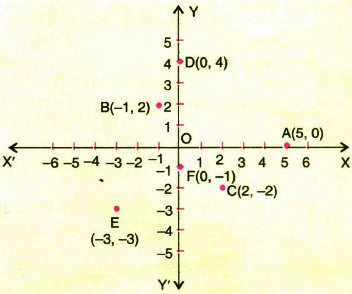
Plot the following points A(5,0), B(-1,2), C(2,-2), D(0,4), E(-3,-3), F(0,-1)
19.
Evaluate 105 x106 without direct-multiplying.
20.
Find three rational numbers between 3/7 and 5/11.How many rational numbers can be determined lying between these numbers?
21.
The points scored by a basketball team in a series of matches are as follows: 17,2,7,17,25,514,18,10. Find range.
22.
In \(\Delta\)ABC, E is the mid-point of median AD, then the ratio of area of \(\Delta\)BED to the area \(\Delta\)ABC is _______________
23.
If a transversal intersects two parallel lines, then which of the pairs of angles is equal.
24.
\(\triangle ABC\cong \triangle PQR,\) AB=PQ. Which statement has been followed in this?
25.
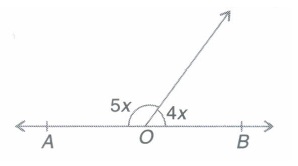
Calculate the value of x in the figure given below.
26.
What does a theorem require?
27.
Factorize: 20x2-9x+1.
28.
Calculate the decimal which represents the fraction \(\frac{7}{8}\)
29.
Geetha told her classmate Radha that "\(\sqrt { \frac { \left( \sqrt { 2 } -1 \right) }{ \left( \sqrt { 2 } +1 \right) } } \) is an irrational number." Radha replied that "you are wrong" and further claimed that "If there is a number 'x' such that x3 is an irrational number, then x5 is also irrational". Geetha said, "No Radha, you are wrong". Radha took some time and after verification accepted her mistakes and thanked Geetha for pointing out these mistakes.
(i) Justify both the statements.
(ii) What value is depicted from this question?
1.
\(\frac { 1 }{ \sqrt { 3 } +\sqrt { 2 } } -\frac { 2 }{ \sqrt { 5 } -\sqrt { 3 } } -\frac { 3 }{ \sqrt { 2 } +\sqrt { 5 } } \)
\(=\frac { 1 }{ \sqrt { 3 } +\sqrt { 2 } } \times \frac { \sqrt { 3 } -\sqrt { 2 } }{ \sqrt { 3 } -\sqrt { 2 } } -\frac { 2 }{ \sqrt { 5 } -\sqrt { 3 } } \times \frac { \sqrt { 5 } +\sqrt { 3 } }{ \sqrt { 5 } +\sqrt { 3 } } -\frac { 3 }{ \sqrt { 2 } +\sqrt { 5 } } \times \frac { \sqrt { 2 } +\sqrt { 5 } }{ \sqrt { 2 } +\sqrt { 5 } } \)
\(=\frac { \sqrt { 3 } -\sqrt { 2 } }{ 1 } -\frac { 2\left( \sqrt { 5 } +\sqrt { 3 } \right) }{ 2 } -\frac { 3\left( \sqrt { 2 } +\sqrt { 5 } \right) }{ -3 } \)
\(=\sqrt { 3 } -\sqrt { 2 } -\sqrt { 5 } -\sqrt { 3 } +\sqrt { 2 } +\sqrt { 5 } \)
= 0
2.
Let larger number be x, then 5 times of larger number=5x and smaller number be y
Quotient=2 and remainder=9
So, according to the question,
5x=2y+9
5x-2y-9=0
3.
f(x) = x3-3x2+3x-4
f(2)=(2)3-3(2)2+3(2)-4
= 8 - 12 + 6 - 4
f(2) = -2
f(-2)=(-2)3-3(-2)2+3(-2)-4
= -8-12-6-4
f(-2)=-30
f(0) = -4
\(\therefore\) f(2)+f(-2)+f(0)=-2-30-4=-36
4.
\(y={5x+20\over4};\ (-4,0);\ (0,5)\)
5.
\(\pi x+y=9\)
\(y=9-\pi x\)
Put x=0, we get y=9-\(\pi\)(0)=9-0=9
Put x=1, we get y=9-\(\pi\)(1)=9-\(\pi\)
Put x=-1, we get y=9-\(\pi\)(-1)=9+\(\pi\)
Put \(x={9\over \pi}\), we get \(y=9-\pi\left(9\over\pi\right)=9-9=0\)
Four solution are (o, 9), (1, 9-\(\pi\)), (-1, 9+\(\pi\)) and \(\left({9\over \pi},0\right)\)
6.
(a) (5,4)
(b) (-5,4)
(c) (-5,-4)
(d) (5,-4)
7.
There can be infinitely many rational numbers between 3 and 4.
\(\frac { 3+4 }{ 2 } =\frac { 7 }{ 2 } \)
\(\\ \frac { 3+\frac { 7 }{ 2 } }{ 2 } =\frac { 13 }{ 4 } \)
\(\\ \frac { 3+\frac { 13 }{ 4 } }{ 2 } =\frac { 25 }{ 8 }\)
\( \\ \frac { 3+\frac { 25 }{ 8 } }{ 2 } =\frac { 49 }{ 16 } =\frac { 3+\frac { 49 }{ 16 } }{ 2 } =\frac { 97 }{ 32 } =\frac { 3+\frac { 97 }{ 32 } }{ 2 } =\frac { 193 }{ 64 } \)
Thus, six rational numbers between 3 and 4
\(\frac { 193 }{ 64 } ,\frac { 97 }{ 32 } ,\frac { 49 }{ 16 } ,\frac { 25 }{ 8 } ,\frac { 13 }{ 4 } \)and \(\frac { 7 }{ 2 } \)
Aliter
\(3=\frac { 3 }{ 1 } =\frac { 3\times 7 }{ 1\times 7 } =\frac { 21 }{ 7 } \)
\(\\ 4=\frac { 4 }{ 1 } =\frac { 4\times 7 }{ 1\times 7 } =\frac { 28 }{ 7 } \)
6 + 1 = 7
the six rational numbers between 3 and 4 can be taken as
\(\frac { 22 }{ 7 } ,\frac { 23 }{ 7 } ,\frac { 24 }{ 7 } ,\frac { 25 }{ 7 } ,\frac { 26 }{ 7 } \) and \(\frac { 27 }{ 7 } \)
8.
(a+b+c)2=a2+b2+c2+2(ab+bc+ca)
(6)2=a2+b2+c2+2\(\times\)11
a2+b2+c2=36-22=14
a3+b3+c3-3abc=(a+b+c)[a2+b2+c2-(ab+bc+ca)]
= 6 \(\times\) (14-11)=6\(\times\)3=18.
9.
LCM of 3,4,6 and 12 is 12
\(\sqrt[12]{2}\)=\({ 2 }^{ \frac { 1 }{ 3 } }\)=\({ 2 }^{ \frac { 4 }{ 12 } }\) \(\sqrt[12]{16}\)
\(\sqrt [ 4 ]{ 5 } ={ 5 }^{ \frac { 1 }{ 4 } }={ 5 }^{ \frac { 3 }{ 12 } }\quad \sqrt [ 12 ]{ 125 } \)
\(\sqrt [ 6 ]{ 7 } ={ 7 }^{ \frac { 1 }{ 6 } }\quad { 7 }^{ \frac { 2 }{ 12 } }\quad \sqrt [ 12 ]{ 49 } \)
\(\sqrt [ 12 ]{ 3 } ={ 3 }^{ \frac { 1 }{ 12 } }=\sqrt [ 12 ]{ 3 } \)
Descending order is
\(\sqrt [ 12 ]{ 125 } ,\sqrt [ 12 ]{ 49 } ,\sqrt [ 12 ]{ 16 } ,\sqrt [ 12 ]{ 3 } \)
i.e., \(\sqrt [ 4 ]{ 5 } ,\sqrt [ 6 ]{ 7 } ,\sqrt [ 3 ]{ 2 } ,\sqrt [ 12 ]{ 3 } \)
10.
\((ax+by)^2+(ay-bx)^2\)
\(=a^2x^2+b^2y^2+2abxy+a^2y^2+b^2x^2-2abxy\)
\(=a^2(x^2+y^2)+b^2(x^2+y^2)\)
\(=(x^2+y^2)(a^2+b^2)\)
11.
Divisor = x + 3
\(x+3=0\ \Rightarrow x=-3\)
\(\therefore\)Remainder= p(-3) | By remainder theorem
\(= k{ (-3) }^{ 3 }+9{ (-3) }^{ 2 }+4(-3)-8\)
\(=-27k+81-12-8\)
\(=-27k+61\)
According to the question,
\(-27k+61=10(1-k)\)
\(\Rightarrow -27k+61=10-10k\)
\(\Rightarrow 17k=51\)
\(\Rightarrow k=3\)
12.
\(\frac { \sqrt { 147 } }{ \sqrt { 75 } } =\frac { \sqrt { 3\times 7\times 7 } }{ \sqrt { 3\times 5\times 5 } } =\frac { 7\sqrt { 3 } }{ 5\sqrt { 3 } } =\frac { 7 }{ 5 } \)
which is clearly a rational number.
Hence, the given statement is false.The reason is that 'if we divide two irrationals, the result may be rational or irrational'.
13.
\(\frac { 1 }{ 5 } =\frac { 1\times 6 }{ 5\times 6 } =\frac { 6 }{ 30 } =\frac { 6\times 10 }{ 30\times 10 } =\frac { 60 }{ 300 } \)
\(\\ \frac { 1 }{ 6 } =\frac { 1\times 5 }{ 6\times 5 } =\frac { 5 }{ 30 } =\frac { 5\times 30 }{ 30\times 10 } =\frac { 50 }{ 300 }\)
\( \\ \because 50<51<52<53<54<60\)
\(\\ \therefore \frac { 50 }{ 300 } <\frac { 51 }{ 300 } <\frac { 52 }{ 300 } <\frac { 53 }{ 300 } <\frac { 54 }{ 300 } <\frac { 60 }{ 300 } \)
Hence, four rational numbers between \(\frac { 1 }{ 5 } \) and \(\frac { 1 }{ 6 } \) can be taken as
\(\frac { 51 }{ 300 } ,\frac { 52 }{ 300 } ,\frac { 53 }{ 300 } \)and \(\frac { 54 }{ 300 } \)
or \(\frac { 17 }{ 100 } ,\frac { 13 }{ 75 } ,\frac { 53 }{ 300 } \)and \(\frac { 9 }{ 50 } \)
14.
Let, x2+7=p and 2x-1=q, then given expression
=12p2-8pq-15q2
=12p2-18pq+10pq-15q2
=6p(2p-3q)+5q(2p-3q)
=(2p-3q)(6p+5q)
=[2(x2+7)-3(2x-1][6(x2+7)+5(2x-1)]
=(2x2+14-6x+3)(6x2+42+10x-5)
=(2x2-6x+17)(6x2+10x+37).
15.
(4√3+3√2)x(4√3-3√2)=(4√3)2-(3√2)2
= 48-18
= 30
16.
x=4
17.
3x-5y-4=0; No; a=3, b=-5, c=-4; Yes
18.
19.
11130
20.
331/770, 166/385, 333/770
21.
()
Range = highest point-lowest point
= 27 - 2 = 25
22.
()
The required ratio is 1:4.
23.
()
Pair of alternate interior angles.
24.
()
If two triangles are congruent, then one side of a triangle is equal to the corresponding side of the other triangle.
Hence, AB=PQ
25.
()
Here, 5x+4x=180o (\(\because\) Straight line makes an angle of 180o)
\(\Rightarrow x=\frac{180^0}{9}\)
=20o
26.
()
Theorem requires a proof.
27.
()
20x2-9x+1 = 20x2-5x-4x+1
=5x(4x-1)-1(4x-1)
=(4x-1)(5x-1)
28.
()
\(\frac{7}{8}\)=0.875
29.
\(\sqrt { \frac { \left( \sqrt { 2 } -1 \right) }{ \left( \sqrt { 2 } +1 \right) } } \)is an irrational number.
\(\sqrt { \frac { \left( \sqrt { 2 } -1 \right) }{ \left( \sqrt { 2 } +1 \right) } } =\sqrt { \frac { \left( \sqrt { 2 } -1 \right) }{ \left( \sqrt { 2 } +1 \right) } \times \frac { \left( \sqrt { 2 } -1 \right) }{ \left( \sqrt { 2 } -1 \right) } } \)
\(=\sqrt { \frac { { \left( \sqrt { 2 } -1 \right) }^{ 2 } }{ 2-1 } } \)
\(=\sqrt { \frac { { \left( \sqrt { 2 } -1 \right) }^{ 2 } }{ 1 } } =\sqrt { 2 } -1\)
which is an irrational number.
Let, there is a number x such that x3 is an irrational number but x5 is a rational number.
Let, x =\(\sqrt[5]{7}\) be the number.
⇒ x3 = (5√7)3 = (7)3/5
is an irrational number.
But x5 = (\(\sqrt[5]{7}\))5=(7)5/5 = 7
=7 is a rational number.
(ii) Accepting own mistakes gracefully, co-operative learning among the classmates.

9th Standard CBSE Syllabus & Materials
9th Standard CBSE
CBSE 9th Standard Mathematics Surface Areas and Volumes Sample Question Papers Study Material - QB365 Set A
NEW9th Standard CBSE
CBSE 9th Standard Mathematics Heron's Formula Sample Question Papers Study Material - QB365 Set D
NEW9th Standard CBSE
CBSE 9th Standard Mathematics Heron's Formula Sample Question Papers Study Material - QB365 Set C



NCERT Books

Syllabus

Exam Pattern

Sample Question Papers

Previous year Question Papers

Important Notes

MCQ Practice test

NCERT Exemplers

Case study Questions

Image Based Questions

Passage based Questions

HOT Questions

Value Based Questions

Model Questions Papers
NCERT ( Book Back ) Questions

Assertion and Reason
Important Questions And Answers

CBSE 9th Standard CBSE Subjects
CBSE Standards