9th Standard CBSE Syllabus & Materials
9th Standard CBSE
CBSE 9th Standard Mathematics Statistics Sample Question Papers Study Material - QB365 Set D
NEW9th Standard CBSE
CBSE 9th Standard Mathematics Statistics Sample Question Papers Study Material - QB365 Set C
NEW9th Standard CBSE
CBSE 9th Standard Mathematics Statistics Sample Question Papers Study Material - QB365 Set B
NEW9th Standard CBSE
CBSE 9th Standard Mathematics Statistics Sample Question Papers Study Material - QB365 Set A
NEW9th Standard CBSE
CBSE 9th Standard Mathematics Surface Areas and Volumes Sample Question Papers Study Material - QB365 Set D
NEW9th Standard CBSE
CBSE 9th Standard Mathematics Surface Areas and Volumes Sample Question Papers Study Material - QB365 Set C

Published on: 29/10/2025
Download CBSE Class 9th Standard CBSE Mathematics question papers, sample papers, important questions, and previous year solved papers in PDF format. Get free study materials, NCERT solutions, and exam preparation resources for Class 9th Standard CBSE Mathematics
Questions + Answers key
Take MCQ Mathematics Test
1.
The total surface area of a solid right circular cylinder is 1540 cm2. If the height is four times the radius of the base, then find the height of the cylinder.
2.
A patient in a hospital is given soup daily in a conical bowl of diameter 7 cm. If the bowl is filled with soup to a height of 6 cm, how much soup the hospital has to prepare daily to serve 320 patients.
3.
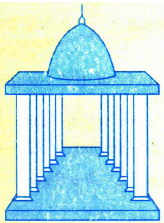
The pillars of a temple are cylindrically shaped. If each pillar has a circular base of radius 20 cm and height 10 m, how much concrete mixture would be required to build 14 such pillars?
4.
A bag of grains contains 2.8 m3 of grain. How many bags of grain are needed to fill a right circular cylindrical drum of radius 4.2 m and height 5 rn?
5.
To construct a wall 25 m long, 0.3 m thick and 6 m high, bricks of dimensions 50 cm \(\times \) 15 cm \(\times \) 10 cm, each are used. If the mortar occupies \(\frac { 1 }{ 10 } \) th of the volume of the wall, find the number of bricks used.
6.
A village having a population of 2000, requires 150 litres of water per head per day. It has a tank measuring 20 m \(\times \) 15 m \(\times \) 6 m. Find how many days will the water of this tank last?
7.
How many metres of cloth \(1\frac { 4 }{ 7 } m\) wide will be 7 required to make a conical tent whose base diameter is 10 m and whose vertical height is 12 cm?
8.
Find the total surface area of a solid cone if its slant height is 21 cm and diameter of its base is 24 cm.
9.
The floor of a rectangular hall has a perimeter of 250 m and its length and breadth are in the ratio of 13: 12. If the cost of painting the four walls and ceiling at the rate of Rs. 5 per m2 is Rs.27000, find the height of the hall.
10.
The surface area of a cuboid is 1372 cm2.If its dimensions are in the ratio 4: 2: 1, find its length.
11.
Three cubes each of the side 3 cm are joined end to end. Find the surface area of the resulting cuboid.
12.
A right angled \(\Delta \)ABC with sides 3 cm, 4 cm and 5 cm is revolved about the fixed side of 4 cm. Find the volume of the solid generated. Also, find the total surface area of the solid.
13.
A well with 10 m inside diameter 10 m deep. Earth taken out of it is spread all around it to a width of 5 m to form an embankment. Find the height of the embankment.
14.
A hollow cylindrical copper pipe is 21 cm long. Its outer and inner diameters are 10 cm and 6 cm respectively. Find the volume of copper used in making the pipe.
15.
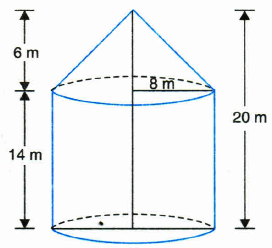
A cylindrical tent has a conical top with dimension as shown in the figure. Calculate the total cost of the canvas required to make the tent, if the cost of canvas is Rs 50 per sq. m.
16.
The difference between the outside and inside surface of a cylindrical metallic pipe 14 cm long is 44 cm2. If the pipe is made of 99 cm3 of metal, find the outer and inner radii of the pipe.
17.
The radius and height of a cylinder are in the ratio 5:7. If its volume is 4400 cm3, find radius of the cylinder.
18.
Find the volume of the largest right circular cone that can be cut off from a cube whose edge is 9 cm. (Use \(\pi =\frac { 22 }{ 7 } \))
19.
The area of the four walls of a room is 80 cm2 and its height is 4 m. Then, the perimeter of the floor of the room is
16 m
5 m
20 m
10 m
20.
The dimensions of a box are 1 m, 80 cm and 50 cm. The area of its four walls is
6000 cm2
12000 cm2
18000 cm2
24000 cm2
21.
The number of edges of a cube are
6
8
12
16.
22.
Identify the wrong statement of the following:
A square can be drawn on our notebook.
A circle can be drawn on the blackboard.
A rectangle can be drawn on a piece of paper.
A triangle cannot be drawn on a wall.
23.
Which of the following is a plane figure?
Cone
Square
Cylinder
Cube.
24.
The radii of two right circular cylinders are in the ratio 2:3 and their heights are in the ratio 5:4, then the ratio of their volumes will be _______________
25.
How many faces does a right circular cylinder have?
26.
Compute the curved surface area of a hemishpere whose diameter is 14 cm.
27.
Two solid spheres made of the same metal have masses 5920 g of and 740 g respectively. Determine the radius of the larger sphere, if the diameter of the smaller sphere is 5 cm.
1.
Given, T.S.A = 1540 cm2
\(\therefore\) 2\(\pi\)r(h + r) = 1540 cm2
Also, h = 4r
\(\therefore\) 2\(\pi\)r(4r + r) = 1540
\(\Rightarrow\) 2\(\pi\)\(\times\)5r 2= 1540
\(\Rightarrow \ { r }^{ 2 }=\frac { 1540\times 7 }{ 2\times 5\times 22 } \)
\(\Rightarrow\) r2= 49
\(\Rightarrow\) r = 7 cm
Now h = 4r
\(\Rightarrow\) h = 28 cm.
2.
24640 cm3
3.
Since the concrete mixture that is to be used to build up the pillars is going to occupy the entire space of the pillar, what we need to find here is the volume of the cylinders.
Radius of base of a cylinder = 20 cm
Height of the cylindrical pillar = 10 m = 1000 cm
So, volume of each cylinder = \(\pi\)r2h
\(=\frac{22}{7} \times 20 \times 20 \times 1000 \mathrm{~cm}^{3}\)
\(=\frac{8800000}{7} \mathrm{~cm}^{3}\)
\(\left.=\frac{8.8}{7} \mathrm{~m}^{3} \text { (Since } 1000000 \mathrm{~cm}^{3}=1 \mathrm{~m}^{3}\right)\)
Therefore, volume of 14 pillars = volume of each cylinder x 14
\(=\frac{8.8}{7} \times 14 \mathrm{~m}^{3}\)
= 17.6 m3
So, 14 pillars would need 17.6 m3 of concrete mixture.
4.
99
5.
5400
6.
6 days
7.
130 m
8.
\(\frac { 8712 }{ 7 } { cm }^{ 2 }\)
9.
21.6 m
10.
28 cm
11.
126 cm2
12.
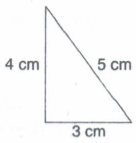
rcone = 3 cm
hcone = 4 cm
lcone= 5 cm
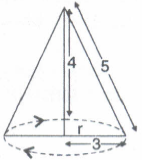
Above given cone is formed with radius 3 cm, height 4 cm and slant height 5 cm when revolved about the fixed side of 4 cm.
\(V=\frac { 1 }{ 3 } \pi { r }^{ 2 }h\)
\(=\frac { 1 }{ 3 } .\frac { 22 }{ 7 } .(3)(3)(4)\)
= 37.71 cm3
Total surface area=\(\pi\)rl+\(\pi\)r2
\(=\frac { 22 }{ 7 } \times 3(5+3)\)
= 75.43 cm2
13.
Radius of the wall (r) = \(\frac{10}{2}\) m = 5 m
Depth of the wall (h )= 10 m
ஃ Volume of the earth dug out
= Volume of the well
=\(\pi r^2h=\pi (5)^2(10)=250\pi m^3\)
Radius of the well with embankment (R)
= 5 + 5 = 10 m
ஃ Area of the embankment
= Area of the well with embankment-Area of the well without embankment
\(=\pi R^2-\pi r^2=\pi (R+r)(R-r)\)
\(= \pi(10+5)(10-5)=75 \pi m^2\)
ஃ Height of the embankment =\(\frac{Volume\ of \ the\ earth\ dug\ out }{Area \ of \ the \ embankment}\)
\(=\frac{250 \pi}{75\pi}=\frac{10}{3}m\)
14.
Length of the pipe (h) = 21 dm =210 cm
∵ Outer diameter = 10 cm
ஃ Outer radius (R) =\(\frac{10}{2}\)cm = 5 cm
ஃ Inner diameter =6 cm
ஃ Inner radius (r) = \(\frac{6}{2}\) cm = 3 cm
Volume of copper used in making the pipe
= Volume of the outer cylinder- Volume of the inner cylinder
\(=\pi R^2h-\pi r^2h\)
\(=\frac{22}{7}\times(5)^2\times210-\frac{22}{7}\times(3)^2\times210\)
\(=\frac{22}{7}\times210\times(5)^2-(3)^2\)
\(=\frac{22}{7}\times210\times16=10560\ cm^3\)
15.
For cone
Base radius (r) = 8 m
Height (h) = 6 m
\(\therefore \) Slant height (l) = \(\sqrt { { r }^{ 2 }+{ h }^{ 2 } } \)
\(=\sqrt { { \left( 8 \right) }^{ 2 }+{ \left( 6 \right) }^{ 2 } } =10m\)
\(\therefore \) Curved surface area = \(\pi rl\)
\(=\pi \left( 8 \right) \left( 10 \right) \)
\(\\ =80\pi { m }^{ 2 }\)
For cylinder
Base radius (R) = 8 m
Height (H) = 14 m
\(\therefore \) Curved surface area = \(2\pi RH\)
\(=2\pi \left( 8 \right) \left( 14 \right) \)
\(\\ =224\pi { m }^{ 2 }\)
\(\therefore \) Total curved surface area = Curved surface area of the cone + Curved surface area of the cylinder
\(=80\pi +224\pi =304\pi { m }^{ 2 }\)
\(\\ =304\times 3.14{ m }^{ 2 }=954.56{ m }^{ 2 }\ \)
\(\therefore \) Cost of canvas = 954.56 \(\times\) 50
= Rs 47728
16.
Let the outer radius be R and inner radius be r.
Outer Surface Area-Inner Surface Area = 44 cm2
2\(\pi\)Rh - 2\(\pi\)rh = 44
2\(\pi\)\(\times\)14(R-r) = 44
\(\therefore \ R-r=\frac { 44\times 7 }{ 2\times 22\times 14 } \)
\(=\frac { 1 }{ 2 } cm\quad \quad .....(i)\)
Volume of metal = 99 cm3
\(\pi\)R2h -\(\pi\)r2h = 99
14\(\pi\)(R2 - r2) = 99
\({ R }^{ 2 }-{ r }^{ 2 }=\frac { 99\times 7 }{ 22\times 14 } \)
\(=\frac { 9 }{ 4 } { cm }^{ 2 }\)
\((R+r)(R-r)=\frac { 9 }{ 4 } \)
\(R+r=\frac { 9 }{ 4 } \times 2\)
\(=\frac { 9 }{ 2 } \quad \quad \quad .......(ii)\)
Adding (i) and (ii), we get
\(2R=\frac { 10 }{ 2 } \)
\(\therefore \ R=\frac { 5 }{ 2 } \)
\(r=\frac { 9 }{ 2 } -\frac { 5 }{ 2 } \)
\(=\frac { 4 }{ 2 } =2\)
\(\therefore\) Outer radius = 2.5 cm and inner radius = 2 cm.
17.
Let r and h be the radius and height of the cylinder given r : h = 5 : 7
\(\therefore\) The radius of the cylinder(r) = 5x
and The height of the cylinder (h) = 7x
Volume of the cylinder = \(\pi\)r2h
\(\therefore\) 4400=\(\frac { 22 }{ 7 } \times { (5x) }^{ 2 }\times 7x\)
\(\left( \because \pi =\frac { 22 }{ 7 } \right) \)
\(\Rightarrow \ 4400=\frac { 22 }{ 7 } \times 5x\times 5x\times 7x\)
\(\Rightarrow \ { x }^{ 3 }=\frac { 4400\times 7 }{ 22\times 5\times 5\times 7 } \)
\(\Rightarrow\) x3 = 8 = 23
\(\therefore\) x = 2
Hence, the radius of the cylinder = 5x
= 5(2)
= 10 cm.
18.
\(\frac { 2673 }{ 14 } c{ m }^{ 3 }\)
19.
Required number \(=\frac { 60\times 30\times 30 }{ 15\times 6\times 4 } =150\)
20.
(c)
18000 cm2
21.
(c)
12
22.
(d)
A triangle cannot be drawn on a wall.
23.
(b)
Square
24.
()
Let radii of cylinders be 2x and 3x and heights be 5y and 3y respectively.
\(\therefore\) Ratio of volumes = \(\frac { \pi { (2x) }^{ 2 }\times 5y }{ \pi { (3x) }^{ 2 }\times 3y } \)
\(=\frac { { 4x }^{ 2 }\times 5 }{ { 9x }^{ 2 }\times 3 } \)
= 20:27.
25.
()
3
26.
()
Given diameter of hemisphere = 14 cm
\(\therefore\) radius = 7 cm
\(\therefore\) Curved surface area = 2\(\pi\)r2
\(=2\times \frac { 22 }{ 7 } \times 7\times 7\)
= 308 cm2
27.
Let r and R be the radii of the smaller and larger spheres respectively, we have
\(r=\frac { 5 }{ 2 } cm\)
Volume of the smaller sphere \(=\frac { 4 }{ 3 } \pi { r }^{ 3 }=\frac { 4 }{ 3 } \pi { \left( \frac { 5 }{ 2 } \right) }^{ 3 }\)
\(=\frac { 4 }{ 3 } \times \pi \times \frac { 125 }{ 8 } { cm }^{ 3 }\)
Density of metal\(=\frac { mass }{ Valume } \)
\(=\frac { 740 }{ \frac { 4 }{ 3 } \pi \times \frac { 125 }{ 8 } } g\quad { cm }^{ 3 }\) ...........(i)
Volume of larger sphere = \(\frac { 4 }{ 3 } \pi { R }^{ 3 }\)
Density of metal=\(\frac { mass }{ Volume } =\frac { 5920 }{ \frac { 4 }{ 3 } \pi { R }^{ 3 } } \) ......(ii)
From (i) and (ii), we have
\(\frac { 740 }{ \frac { 4 }{ 3 } \pi \times \frac { 125 }{ 8 } } =\frac { 5920 }{ \frac { 4 }{ 3 } \pi { R }^{ 3 } } \)
\(\Rightarrow \quad { R }^{ 3 }=\frac { 5920\times 125 }{ 740\times 8 } \)
= 125
\(\Rightarrow\) R = 5 cm.

9th Standard CBSE Syllabus & Materials
9th Standard CBSE
CBSE 9th Standard Mathematics Surface Areas and Volumes Sample Question Papers Study Material - QB365 Set A
NEW9th Standard CBSE
CBSE 9th Standard Mathematics Heron's Formula Sample Question Papers Study Material - QB365 Set D
NEW9th Standard CBSE
CBSE 9th Standard Mathematics Heron's Formula Sample Question Papers Study Material - QB365 Set C



NCERT Books

Syllabus

Exam Pattern

Sample Question Papers

Previous year Question Papers

Important Notes

MCQ Practice test

NCERT Exemplers

Case study Questions

Image Based Questions

Passage based Questions

HOT Questions

Value Based Questions

Model Questions Papers
NCERT ( Book Back ) Questions

Assertion and Reason
Important Questions And Answers

CBSE 9th Standard CBSE Subjects
CBSE Standards