
12th Standard Syllabus & Materials
12th Standard
TN 12th Standard Biology Zoology - Reproduction in Organisms Creative Questions Study Material - QB365 Set D
NEW12th Standard
TN 12th Standard Biology Zoology - Reproduction in Organisms Creative Questions Study Material - QB365 Set C
NEW12th Standard
TN 12th Standard Biology Zoology - Reproduction in Organisms Creative Questions Study Material - QB365 Set B
NEW12th Standard
TN 12th Standard Biology Zoology - Reproduction in Organisms Creative Questions Study Material - QB365 Set A
NEW12th Standard
TN 12th Standard Physics Electronics and Communication Creative Questions Study Material - QB365 Set D
NEW12th Standard
TN 12th Standard Physics Electronics and Communication Creative Questions Study Material - QB365 Set C

Published on: 20/10/2025
Download Tamil Nadu 12th Standard Maths question papers, model tests, one-mark questions, important questions, and public exam papers in PDF format. Free study materials and answer keys for TN State Board students.
Questions + Answers key
Take MCQ Maths Test
Answer any-7
1.
2.
The time T, taken for a complete oscillation of a single pendulum with length l, is given by the equation T = 2ㅠ\(\sqrt { \frac { 1 }{ g } } \), where g is a constant. Find the approximate percentage error in the calculated value of T corresponding to an error of 2 percent in the value of l.
3.
4.
Suppose a pair of unbiased dice is rolled once. If X denotes the total score of two dice, write down
(i) the sample space
(ii) the values taken by the random variable X,
(iii) the inverse image of 10, and
(iv) the number of elements in inverse image of X.
5.
Two fair coins are tossed simultaneously (equivalent to a fair coin is tossed twice). Find the probability mass function for number of heads occurred.
6.
Find the binomial distribution function for each of the following.
(i) Five fair coins are tossed once and X denotes the number of heads.
(ii) A fair die is rolled 10 times and X denotes the number of times 4 appeared.
7.
Construct the truth table for the following statements.
¬(p ∧ ¬q)
8.
Construct the truth table for the following statements.
( p V q) V ¬q
9.
Construct the truth table for the following statements.
(¬p ⟶ r) ∧ ( p ↔️ q)
10.
Prove that q ➝ p ≡ ¬p ➝ ¬q
Answer any-5
11.
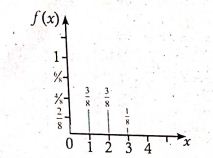
A six sided die is marked '1' on one face, '3' on two of its faces, and '5' on remaining three faces. The die is thrown twice. If X denotes the total score in two throws, find
(i) the probability mass function
(ii) the cumulative distribution function
(iii) P(4 ≤ X < 10)
(iv) P(X ≥ 6)
12.
A random variable X has the following probability mass function.
| x | 1 | 2 | 3 | 4 | 5 |
| f(x) | k2 | 2k2 | 3k2 | 2k | 3k |
Find
(i) the value of k
(ii) P(2 \(\le\) X < 5)
(iii) P(3 < X )
13.
Suppose the amount of milk sold daily at a milk booth is distributed with a minimum of 200 Iitres and a maximum of 600 litres with probability density function
\(\begin{cases} \begin{matrix} k & 200\le x\le 600 \end{matrix} \\ \begin{matrix} 0 & otherwise \end{matrix} \end{cases}\)
Find
(i) the value of k
(ii) the distribution function
(iii) the probability that daily sales will fall between 300 litres and 500 litres?
14.
Four fair coins are tossed once. Find the probability mass function, mean and variance for number of heads occurred.
15.
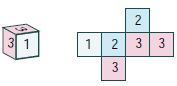
A six sided die is marked ‘1’ on one face, ‘2’ on two of its faces, and ‘3’ on remaining three faces. The die is rolled twice. If X denotes the total score in two throws.
(i) Find the probability mass function.
(ii) Find the cumulative distribution function.
(iii) Find P(3 ≤ X< 6)
(iv) Find P(X ≥ 4) .
16.
A random variable X has the following probability mass function
| x | 1 | 2 | 3 | 4 | 5 | 6 |
| f(x) | k | 2k | 6k | 5k | 6k | 10k |
Find
(i) P(2 < X < 6)
(ii) P(2 ≤ X < 5)
(iii) P(X ≤4)
(iv) P(3 < X )
17.
Verify
(i) closure property
(ii) commutative property
(iii) associative property
(iv) existence of identity and
(v) existence of inverse for the operation +5 on Z5 using table corresponding to addition modulo 5.
18.
Verify
(i) closure property
(ii) commutative property
(iii) associative property
(iv) existence of identity and
(v) existence of inverse for the operation ×11 on a subset A = {1, 3, 4, 5, 9} of the set of remainders {0,1, 2, 3, 4, 5, 6, 7, 8, 9,10}
19.
Using the equivalence property, show that p ↔️ q ≡ ( p ∧ q) v (ㄱp ∧ ㄱq)
20.
Let M = \(\left\{ \left( \begin{matrix} x & x \\ x & x \end{matrix} \right) :x\in R-\{ 0\} \right\} \) and let * be the matrix multiplication. Determine whether M is closed under ∗. If so, examine the commutative and associative properties satisfied by ∗ on M.
21.
Using truth table check whether the statements ¬(p V q) V (¬p ∧ q) and ¬p are logically equivalent.
22.
Prove that p➝(¬q V r) ≡ ¬pV(¬qVr) using truth table.
23.
Show that \(\neg(p \wedge q) \equiv \neg p \vee \neg q\)
24.
Show that \(\neg(p \rightarrow q) \equiv p \wedge \neg q\)
Answer any-7
25.
For the random variable X with the given probability mass function as below, find the mean and variance.
\(f(x)=\begin{cases} \begin{matrix} \frac { 1 }{ 10 } & x=2,5 \end{matrix} \\ \begin{matrix} \frac { 1 }{ 5 } & x=0,1,2,3,4 \end{matrix} \end{cases}\)
26.
Compute P(X = k) for the binomial distribution, B(n, p) where
n = 9, \(p=\frac { 1 }{ 2 } \), k = 7
27.
A pair of fair dice is rolled once. Find the probability mass function to get the number of fours.
28.
Let A =\(\begin{bmatrix} 0 & 1 \\ 1 & 1 \end{bmatrix},B=\begin{bmatrix} 1 & 1 \\ 0 & 1 \end{bmatrix}\)be any two boolean matrices of the same type. Find AvB and A\(\wedge\)B.
29.
Write down the
(i) conditional statement
(ii) converse statement
(iii) inverse statement, and
(iv) contrapositive statement for the two statements p and q given below.
p: The number of primes is infinite.
q: Ooty is in Kerala.
30.
Determine whether ∗ is a binary operation on the sets given below.
a*b = min (a, b) on A = {1, 2, 3, 4, 5}
31.
Let \(*\) be defined on R by (a \(*\) b) = a + b + ab - 7. Is \(*\) binary on R? If so, find 3 \(*\)\(\left( \frac { -7 }{ 15 } \right) \).
32.
Let p: Jupiter is a planet and q: India is an island be any two simple statements. Give verbal sentence describing each of the following statements.
(i) ¬p
(ii) p ∧ ¬q
(iii) ¬p ∨ q
(iv) p➝ ¬q
(v) p↔q
33.
Let \(A=\left( \begin{matrix} 1 & 0 \\ 0 & 1 \\ 1 & 0 \end{matrix}\begin{matrix} 1 & 0 \\ 0 & 1 \\ 0 & 1 \end{matrix} \right) ,B=\left( \begin{matrix} 0 & 1 \\ 1 & 0 \\ 1 & 0 \end{matrix}\begin{matrix} 0 & 1 \\ 1 & 0 \\ 0 & 1 \end{matrix} \right) ,C=\left( \begin{matrix} 1 & 1 \\ 0 & 1 \\ 1 & 1 \end{matrix}\begin{matrix} 0 & 1 \\ 1 & 0 \\ 1 & 1 \end{matrix} \right) \)be any three boolean matrices of the same type. Find AVB
34.
Let \(A=\left( \begin{matrix} 1 & 0 \\ 0 & 1 \\ 1 & 0 \end{matrix}\begin{matrix} 1 & 0 \\ 0 & 1 \\ 0 & 1 \end{matrix} \right) ,B=\left( \begin{matrix} 0 & 1 \\ 1 & 0 \\ 1 & 0 \end{matrix}\begin{matrix} 0 & 1 \\ 1 & 0 \\ 0 & 1 \end{matrix} \right) ,C=\left( \begin{matrix} 1 & 1 \\ 0 & 1 \\ 1 & 1 \end{matrix}\begin{matrix} 0 & 1 \\ 1 & 0 \\ 1 & 1 \end{matrix} \right) \)be any three boolean matrices of the same type.
Find (A∧B)∨C
Answer all
35.
Let X be random variable with probability density function
\(f(x)=\left\{\begin{array}{ll} \frac{2}{x^{3}} & x \geq 1 \\ 0 & x<1 \end{array}\right.\)
Which of the following statement is correct
both mean and variance exist
mean exists but variance does not exist
both mean and variance do not exist
variance exists but Mean does not exist
36.
A rod of length 2l is broken into two pieces at random. The probability density function of the shorter of the two pieces is
\(f(x)=\left\{\begin{array}{ll} \frac{1}{l} & 0< x < l \\ 0 & l <x<2l \end{array}\right.\)
The mean and variance of the shorter of the two pieces are respectively.
\(\frac { l }{ 2 } ,\frac { { l }^{ 2 } }{ 3 } \)
\( \frac { l }{ 2 } ,\frac { { l }^{ 2 } }{ 6 } \)
\(l,\frac { { l }^{ 2 } }{ 12 } \)
\(\frac { l }{ 2 } ,\frac { { l }^{ 2 } }{ 12 } \)
37.
A pair of dice numbered 1, 2, 3, 4, 5, 6 of a six-sided die and 1, 2, 3, 4 of a four-sided die is rolled and the sum is determined. Let the random variable X denote this sum. Then the number of elements in the inverse image of 7 is
1
2
3
4
38.
Let X represent the difference between the number of heads and the number of tails obtained when a coin is tossed n times. Then the possible values of X are
i + 2n, i = 0,1,2... n
2i- n, i = 0,1,2... n
n - i, i = 0,1,2... n
2i + 2n, i = 0, 1, 2...n
39.
If the function \(f(x)=\frac { 1 }{ 12 } \) for a < x < b, represents a probability density function of a continuous random variable X, then which of the following cannot be the value of a and b?
0 and 12
5 and 17
7 and 19
16 and 24
40.
Two coins are to be flipped. The first coin will land on heads with probability 0.6, the second with probability 0.5. Assume that the results of the flips are independent, and let X equal the total number of heads that result The value of E(X) is
0.11
1.1
11
1
41.
42.
If X is a binomial random variable with expected value 6 and variance 2.4, then P(X = 5) is
\(\left( \frac { 10 }{ 5 } \right) \left( \frac { 3 }{ 5 } \right) ^{ 6 }\left( \frac { 2 }{ 5 } \right) ^{ 4 }\)
\(\left( \frac { 10 }{ 5 } \right) \left( \frac { 3 }{ 5 } \right) ^{ 10 }\)
\(\left( \frac { 10 }{ 5 } \right) { \left( \frac { 3 }{ 5 } \right) }^{ 4 }\left( \frac { 2 }{ 5 } \right) ^{ 6 }\)
\(\left( \frac { 10 }{ 5 } \right) \left( \frac { 3 }{ 5 } \right) ^{ 5 }\left( \frac { 2 }{ 5 } \right) ^{ 5 }\)
43.
44.
Which of the following is a discrete random variable?
I. The number of cars crossing a particular signal in a day
II. The number of customers in a queue to buy train tickets at a moment.
III. The time taken to complete a telephone call.
I and II
II only
III only
II and III
45.
46.
Which one of the following is a binary operation on N?
Subtraction
Multiplication
Division
All the above
47.
In the set R of real numbers ‘*’ is defined as follows. Which one of the following is not a binary operation on R?
a*b = min (a.b)
a*b = max (a, b)
a*b = a
a*b = ab
48.
The operation * defined by \(a * b =\frac{ab}{7}\) is not a binary operation on
Q+
Z
R
C
49.
In the set Q define a⊙b = a+b+ab. For what value of y, 3⊙(y⊙5) = 7?
y = \(\frac{2}{3}\)
y = \(\frac{-2}{3}\)
y = \(\frac{-3}{2}\)
y = 4
50.
51.
Which one of the following statements has the truth value T?
sin x is an even function
Every square matrix is non-singular
The product of complex number and its conjugate is purely imaginary
\(\sqrt 5\) is an irrational number
52.
The truth table for (p ∧ q) ∨ ¬q is given below
| p | q | (p ∧ q) ∨ (¬q) |
| T | T | (a) |
| T | F | (b) |
| F | T | (c) |
| F | F | (d) |
Which one of the following is true?
| (a) | (b) | (c) | (d) |
| T | T | T | T |
| (a) | (b) | (c) | (d) |
| T | F | T | T |
| (a) | (b) | (c) | (d) |
| T | T | F | T |
| (a) | (b) | (c) | (d) |
| T | F | F | F |
53.
Determine the truth value of each of the following statements:
(a) 4 + 2 = 5 and 6 + 3 = 9
(b) 3 + 2 = 5 and 6 + 1 = 7
(c) 4 + 5 = 9 and 1 + 2 = 4
(d) 3 + 2 = 5 and 4 + 7 = 11
| (a) | (b) | (c) | (d) |
| F | T | F | T |
| (a) | (b) | (c) | (d) |
| T | F | T | F |
| (a) | (b) | (c) | (d) |
| T | T | F | F |
| (a) | (b) | (c) | (d) |
| F | F | T | T |
54.
Which one of the following is not true?
Negation of a negation of a statement is the statement itself
If the last column of the truth table contains only T then it is a tautology.
If the last column of its truth table contains only F then it is a contradiction
If p and q are any two statements then p↔️q is a tautology.
Answer any-7
1.
2.
Given absolute error = 2%
⇒ \(\frac { dl }{ l } =2 \% =\frac { 2 }{ 100 } =0.02\)
Given T = 2ㅠ\(\sqrt { \frac { 1 }{ g } } \)
Taking logarithm on both sides,
log T = log 2ㅠ + \(\frac12\) log l - \(\frac12\) log g
Taking differential on both sides we get,
\(\frac{1}{T}dT=0+\frac{1}{2}.\frac{1}{l}.dl\)
\(\frac { \Delta T }{ T } =\frac { 1 }{ 2 } (.02)\)
\(\frac { \Delta T }{ T } =0\)
ஃ Percentage error = \(\frac { \Delta T }{ T } \times100=.01\times100=1 \%\)
3.
4.
\(S=\left\{\begin{array}{l} (1,1),(1,2),(1,3),(1,4),(1,5),(1,6) \\ (2,1),(2,2),(2,3),(2,4),(2,5),(2,6) \\ (3,1),(3,2),(3,3),(3,4),(3,5),(3,6) \\ (4,1),(4,2),(4,3),(4,4),(4,5),(4,6) \\ (5,1),(5,2),(5,3),(5,4),(5,5),(5,6) \\ (6,1),(6,2),(6,3),(6,4),(6,5),(6,6) \end{array}\right\}\)
(i) The sample space
S = {1, 2, 3, 4, 5, 6}\(\times\){1, 2, 3, 4, 5, 6}
consists of 36 ordered pairs (α, β) where α and β can take any integer value between 1 and 6 as shown. X is assigned to each point (α, β) the sum of the numbers on the dice .
That is X (α, β) = α + β
Therefore
X (1,1) = 1+1 = 2
X (1, 2) = X (2,1) = 3
X (1,3) = X (2,2) = X (3,1)= 4
X (1, 4) = X (2,3) = X (3, 2) X (4,1) = 5
X (1,5) = X (2,4) = X (3,3) = X (4, 2) = X (5,1) = 6
X (1,6) = X (2,5) = X (3, 4) = X (4,3 = X (5, 2) X (6,1) = 7
X (2,6) = X (3,5) = X (4,4) = X (5,3) = X (6,2) = 8
X (3,6) = X (4,5) = X (5,4) X (6,3) = 9
X (4,6) = X (5,5) X (6,4) = 10
X (5,6) = (6,5) = 11
X (6,6) = 12
(ii) Then the random variable X takes on the values 2, 3, 4, 5, 6, 7, 8, 9, 10, 11, 12.
(iii) The inverse images of 10 is {(4, 6), (5, 5), (6, 4)}.
(iv) The number of inverse images are given below
| Values of the random variable | 2 | 3 | 4 | 5 | 6 | 7 | 8 | 9 | 10 | 11 | 12 | Total |
| Number of elements in inverse image | 1 | 2 | 3 | 4 | 5 | 6 | 5 | 4 | 3 | 2 | 1 | 36 |
5.
The sample space S = {H,T} \(\times\) {H,T}
That is S = {TT, TH, HT, HH}
Let X be the random variable denoting the number of heads.
Therefore
X (TT ) = 0 , X (TH ) = 1,
X (HT) = 1, and X (HH) = 2 .
Then the random variable X takes on the values 0, 1 and 2
| Values of the Random Variable | 0 | 1 | 2 | Total |
| Number of elements in inverse images | 1 | 2 | 1 | 4 |
The probabilities are given by
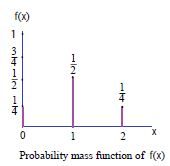
\(f(0)=P(X=0)=\cfrac { 1 }{ 4 } \)
\(f(1)=P(X=1)=\cfrac { 1 }{ 2 } \)
and \(f(2)=P(X=2)=\cfrac { 1 }{ 4 } \)
The function f (x) satisfies the conditions
(i) f (x) ≥ 0 , for x = 0, 1, 2
(ii) \(\underset { x }{ \Sigma } f(x)=\sum _{ x=0 }^{ x=2 }{ f(x) } =f(0)+f(1)+f(2)\)
= \(\cfrac { 1 }{ 4 } +{ \cfrac { 1 }{ 2 } +\cfrac { 1 }{ 4 } =1 }\)
Therefore f (x) is a probability mass function.
The probability mass function is given by
| x | 0 | 1 | 2 |
| f(x) | \(\cfrac { 1 }{ 4 } \) | \(\cfrac { 1 }{ 2 } \) | \(\cfrac { 1 }{ 4 } \) |
(or)
\(f(x)\begin{cases} \begin{matrix} \frac { 1 }{ 4 } & forx=0 \end{matrix} \\ \begin{matrix} \frac { 1 }{ 2 } & forx=1 \end{matrix} \\ \begin{matrix} \frac { 1 }{ 4 } & forx=2 \end{matrix} \end{cases}\)
6.
(i) Given that five fair coins are tossed once. Since the coins are fair coins the probability of getting an head in a single coin is
\(p=\frac { 1 }{ 2 } \) and \(q=1-p=\frac { 1 }{ 2 } \)
Let X denote the number of heads that appear in five coins. X is binomial random variable that takes on the values 0, 1, 2, 3, 4 and 5 and \(p=\frac { 1 }{ 2 } \) That is \(X\sim B\left( 5,\cfrac { 1 }{ 2 } \right) \)
Therefore the binomial distribution is
\(f(x)=\left( \begin{matrix} n \\ x \end{matrix} \right) p*\left( 1-p \right) ^{ n-x }\), x = 0, 1, 2,..,n
becomes
\(f(x)=\left( \begin{matrix} 5 \\ x \end{matrix} \right) \left( \cfrac { 1 }{ 2 } \right) ^{ x }\left( \cfrac { 1 }{ 2 } \right) ^{ n-x }\), x = 0, 1, 2,..,5
That is
\(f(x)=\left( \begin{matrix} 5 \\ x \end{matrix} \right) \left( \cfrac { 1 }{ 2 } \right) ^{ n }\), x = 0, 1, 2...,n
(ii) A fair die is rolled ten times and X denotes the number of times 4 appeared. X is binomial
random variable that takes on the values 0, 1, 2, 3,...10 , with n = 10 and \(p=\cfrac { 1 }{ 6 } \). That is \(X\sim B\left( 10,\cfrac { 1 }{ 6 } \right) \)
Probability of getting a four in a die is \(p=\frac { 1 }{ 2 } \) and \(q=1-p=\frac { 5 }{ 6 } \)
Therefore the binomial distribution is
\(f(x)=\left( \begin{matrix} 10 \\ x \end{matrix} \right) \left( \cfrac { 1 }{ 6 } \right) ^{ x }\left( \cfrac { 5 }{ 6 } \right) ^{ 10-x }\) x = 0, 1, 2,...,10
7.
Truth Table for ~(p ∧ ~q)
| p | q | ~q | p ∧ ~q | ~(p ∧ ~q) |
| T | T | F | F | T |
| T | F | T | T | F |
| F | T | T | F | T |
| F | F | T | F | T |
8.
Truth Table for ( p V q) ∧ ~q
| p | q | p V q | ~q | ( p V q) ∧ ~q |
| T | T | T | F | T |
| T | F | T | T | T |
| F | T | T | F | T |
| F | F | F | T | T |
9.
Truth Table for (~p ⟶ r) ∧ ( p ↔️ q)
| p | q | r | ~ p | ~ p ⟶ r | p ↔️ q | (~p ⟶ r) ∧ ( p ↔️ q) |
| T | T | T | F | T | T | T |
| T | T | F | F | T | T | T |
| T | F | T | F | T | F | F |
| T | F | F | F | T | F | F |
| F | T | T | T | T | F | F |
| F | T | F | T | F | F | F |
| F | F | T | T | T | T | T |
| F | F | F | T | F | F | F |
10.
| p | q | q ➝ p | ~p | ~q | ~q ➝ ~p |
| T | T | T | F | F | T |
| T | F | T | F | T | T |
| F | T | F | T | F | F |
| F | F | T | T | T | T |
The entries in the columns corresponding q ➝ p and ~p ➝ ~q are identical and hence they are equivalent.
q ➝ p ≡ ~p ➝ ~q
Hence proved
Answer any-5
11.
Let X be the thrown random variable denotes the total in two the thrown a die.
Sample space S
| I/II | 1 | 3 | 3 | 5 | 5 | 5 |
| 1 | 2 | 4 | 4 | 6 | 6 | 6 |
| 3 | 4 | 6 | 6 | 8 | 8 | 8 |
| 3 | 4 | 6 | 6 | 8 | 8 | 8 |
| 5 | 6 | 8 | 8 | 10 | 10 | 10 |
| 5 | 6 | 8 | 8 | 10 | 10 | 10 |
| 5 | 6 | 8 | 8 | 10 | 10 | 10 |
n (S) = 36
X = {2, 4, 6, 8, 10}
| Values of the random variable | 2 | 4 | 6 | 8 | 10 | Total |
| No. of elements in inverse images | 1 | 4 | 10 | 12 | 9 | 36 |
\(p(x=2)=\cfrac { 1 }{ 36 } \)
\(p(x=4)=\cfrac { 4 }{ 36 } \)
\(p(x=6)=\cfrac { 10 }{ 36 } \)
\(p(x=8)=\cfrac { 12 }{ 36 } \)
\(p(x=10)=\cfrac { 9 }{ 36 } \)
(i) Probability mass function is
| x | 2 | 4 | 6 | 8 | 10 |
| f(x) | \(\\ \cfrac { 1 }{ 36 } \) | \(\cfrac { 4 }{ 36 } \) | \(\cfrac { 10 }{ 36 } \) | \(\cfrac { 12 }{ 36 } \) | \(\cfrac { 9 }{ 36 } \) |
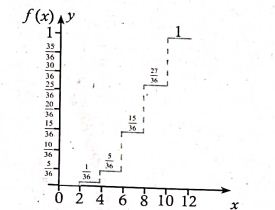
(ii) Cumulative distribution function .
F(x) = p(X ≤ x) = \(\sum_{x_i ≤ x }\)(X = xi)
P(X<2) = 0 for \(\infty\) < x < 2
\(F(2)=\frac { 1 }{ 36 } \)
\(F(4)=\frac { 1 }{ 36 } +\frac { 4 }{ 36 } =\frac { 5 }{ 36 } \)
\(F(6)=\frac { 1 }{ 36 } +\frac { 4 }{ 36 } +\frac { 10 }{ 36 } =\frac { 15 }{ 36 } \)
\(F(8)=\frac { 1 }{ 36 } +\frac { 4 }{ 36 } +\frac { 10 }{ 36 } +\frac { 12 }{ 36 } =\frac { 27 }{ 36 }\)
\(F(10)=\frac { 27 }{ 36 } +\frac { 9 }{ 36 } =\frac { 36 }{ 36 } =1\)
∵ The cumulative distribution function n
\(F(x)=\left\{\begin{array}{lll} 0 & \text { for } & x<2 \\ \frac{1}{36} & \text { for } & x \leq 2 \\ \frac{5}{36} & \text { for } & x \leq 6 \\ \frac{15}{36} & \text { for } & x \leq 8 \\ 1 & \text { for } & x \leq 10 \end{array}\right.\)
(iii) p(4≤ X < 10) = p(x = 4) + p(x = 6) + p(x = 8)
= \(\frac { 4 }{ 36 } +\frac { 10 }{ 36 } +\frac { 12 }{ 36 } +\frac { 26 }{ 36 } =\frac { 13 }{ 18 } \)
(iv) p(x ≥ 6) = p(x = 6) + p(x = 8) + p(x = 10)
= \(\frac { 10 }{ 36 } +\frac { 12 }{ 36 } +\frac { 9 }{ 36 } =\frac { 31 }{ 36 } \)
Sample space = {4 childrens}
12.
Given probability mass function is
| x | 0 | 1 | 2 | 3 | 4 |
| f(x) | \(\frac{1}{36}\) | \(\frac{2}{36}\) | \(\frac{3}{36}\) | \(\frac{2}{36}\) | \(\frac{3}{36}\) |
(i) Since f(x) is a probability mass function.
\(\sum _{ i=1 }^{ 5 }{ f({ x }_{ i }) } =1\)
⇒ k2 + 2k2 + 3k2 + 2k + 3k = 1
⇒ 6k2 + 5k = 1
⇒ 6k2 + 5k - 1 = 0
⇒ (k + 1) (6k - 1) = 0
⇒ k = -1 or ⇒ \(k=\frac { 1 }{ 6 } \)
⇒ \(k=\frac { 1 }{ 6 } \)
(ii) p(2 ≤ x < 5)
= p(x = 2) + p(x = 3) + p(x = 4)
= 2k2 + 3k2 + 2k = 5k2 + 2k
= \(5\left( \frac { 1 }{ 36 } \right) +2\left( \frac { 1 }{ 6 } \right) \)
= \(\frac { 5 }{ 36 } +\frac { 1 }{ 3 } =\frac { 5+12 }{ 36 } \)
= \(\frac { 17 }{ 36 } \)
(iii) p(3 < x) = p(x > 3)
= p(x = 4) + p(x = 5)
= 2k + 3k = 5k
= \(5\left( \frac { 1 }{ 6 } \right) \)
= \(\frac { 5 }{ 6 } \)
13.
Given \(\begin{cases} \begin{matrix} k & 200\le x\le 600 \end{matrix} \\ \begin{matrix} 0 & otherwise \end{matrix} \end{cases}\)
(i) Since f{x) is a probability density function
\(\int _{ -\infty }^{ \infty }{ f(x)d=1\Rightarrow \int _{ 200 }^{ 600 }{ kda } =1 } \)
\(\Rightarrow k[x]_{ 200 }^{ 600 }=1\Rightarrow k(600-200)=1\)
400 k = 1
\(\Rightarrow k=\frac { 1 }{ 400 } \)
(ii) The distribution function
= \(\int _{ -\infty }^{ x }{ f(u) } du\)
Case 1: x < 200
\(F(x) =\int _{ -\infty }^{ u }{ du } =0\)
Case 1: x < 200 ≤ x ≤ 600
\(\int _{ -\infty }^{ x }{ f(u) } du\)
\(F(x)=\int _{ -\infty }^{ 200 }{ f(u)du } =+\int _{ 200 }^{ x }{ f(u)du } \)
= \( =\frac { 1 }{ 400 }(x-200) =\frac { x }{ 400 } =\frac { 1 }{ 2 } \)
Case 3: x > 600
\(F(x) =\int _{ -\infty }^{ u }{ du } =0\)
\(f(x)= \begin{cases}0, & x<200 \\ \frac{x}{400}-\frac{1}{2}, & 200 \leq x \leq 600 \\ 0, & x>600\end{cases}\)
(iii) P(300 < x < 500)
= \(\int _{ 300 }^{ 500 }{ kdx=\frac { 1 }{ 400 } \left[ x \right] _{ 300 }^{ 500 } } \)
= \(\frac { 1 }{ 400 } \left[ 500-300 \right] =\frac { 200 }{ 400 } =\frac { 1 }{ 2 } \)
14.
Let X b the random variable denotes number of heads when four coins are tossed once.
Then X take the values 0,1,2,3,4.
n(S) = 16
| Values of random variable | 0 | 1 | 2 | 3 | 4 | Total |
| Number of elem in inverse image | 1 | 4 | 6 | 4 | 1 | 16 |
The probability mass function is
| x | 0 | 1 | 2 | 3 | 4 |
| f(x) | \(\cfrac { 1 }{ 16 } \) | \(\cfrac { 4 }{ 16 } \) | \(\cfrac { 6 }{ 16 } \) | \(\cfrac { 4 }{ 16 } \) | \(\cfrac { 1 }{ 16 } \) |
Mean
= \(\\ E(x)=E(X)=\Sigma xf(x)\)
= \(0\left( \frac {4 }{ 16 } \right) +1\left( \frac {24 }{ 16 } \right) +2\left( \frac { 36 }{ 16 } \right) +3\left( \frac { 16}{ 16 } \right) = \frac { 80 }{ 16 } \)
= \(\frac { 1 }{ 4 } +\frac { 3 }{ 4 } +\frac { 3 }{ 4 } +\frac { 1 }{ 4 } =\frac { 8 }{ 4 } =2\)
Variance
\(E({ X }^{ 2 })=\Sigma { x }^{ 2 }f(x)\)
= \(0^{ 2 }\left( \frac { 1 }{ 16 } \right) +1^{ 2 }\left( \frac { 1 }{ 4 } \right) +2^{ 2 }\left( \frac { 3 }{ 8 } \right) +3^{ 2 }\left( \frac { 1 }{ 4 } \right) +4^{ 2 }\left( \frac { 1 }{ 16 } \right) \)
\(0\left( \frac {4 }{ 16 } \right) +1\left( \frac {24 }{ 16 } \right) +2\left( \frac { 36 }{ 16 } \right) +3\left( \frac { 16}{ 16 } \right) = \frac { 80 }{ 16 } \)
\( =5\)
(X) = E(X2) - [E(X)]2
= 5 - 22 = 5 - 4 = 1
15.
Since X denotes the total score in two throws, it takes on the values 2, 3, 4, 5 and 6. From the Sample space S, we have
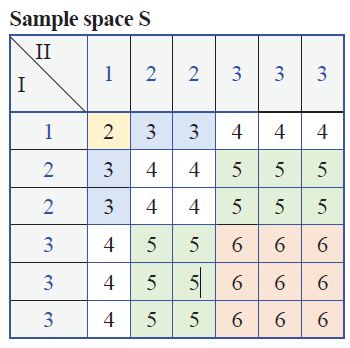
| Values of the Random Variable | 2 | 3 | 4 | 5 | 6 | Total |
| Number of elements in inverse images | 1 | 4 | 10 | 12 | 9 | 36 |
\(P(X=2)=\frac { 1 }{ 36 } \), \(P(X=3)=\frac { 4 }{ 36 } \)
\(P\left( X=4 \right) =\frac { 10 }{ 36 } \) , \(P(X=5)=\frac { 12 }{ 36 } \) and
\(P(X=6)=\frac { 9 }{ 36 } \)
(i) Probability mass function is
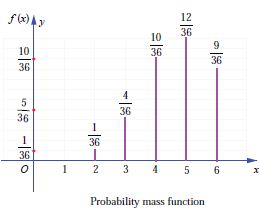
| x | 2 | 3 | 4 | 5 | 6 |
| f(x) | \(\cfrac { 1 }{ 36 } \) | \(\cfrac { 4 }{ 36 } \) | \(\cfrac { 10 }{ 36 } \) | \(\cfrac { 12}{ 36 } \) | \(\cfrac { 9 }{ 36 } \) |
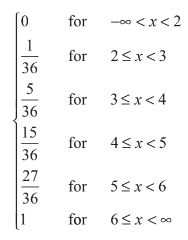
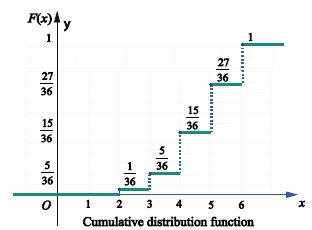
(ii) Cumulative distribution function By definition of the cumulative distribution function for discrete random variable we have
\(f(x)=P(X\le x)=\underset { x_{ 1 }\le x }{ \Sigma } P(X={ x }_{ 1 })\)
\(P(X
\(F(2)=P(X\le 2)=\sum _{ -\infty }^{ 2 }{ P(X=x)=P\left( X \right) <2)+P(X=2) } =0+\frac { 1 }{ 36 } =\frac { 1 }{ 36 } \)
\(F(3)=P(X\le 3)=\sum _{ -\infty }^{ 3 }{ P(X=x) } =P\left( x<2 \right) +P(X=2)+P(X=3)+P(X=4)=0+\frac { 1 }{ 36 } +\frac { 4 }{ 36 } +\frac { 10 }{ 36 } =\frac { 15 }{ 36 } \)
\(F(4)=P(X\le 3)=\sum _{ -\infty }^{ 3 }{ P(X=x) } =P\left( x<2 \right) +P(X=2)+P(X=3)+P(X=4)\)
\(0+\frac { 1 }{ 36 } +\frac { 4 }{ 36 } +\frac { 10 }{ 36 } =\frac { 15 }{ 36 } \)
\(F(5)=P\left( X\le 5 \right) =\sum _{ -\infty }^{ 5 }{ P(X=x) } =P\left( X<2 \right) +P(X=3)+P\left( X=4 \right) +P\left( X=5 \right) \)
= \(0+\frac { 1 }{ 36 } +\frac { 4 }{ 36 } +\frac { 10 }{ 36 } +\frac { 12 }{ 36 } =\frac { 27 }{ 36 } \)
\(F(6)=P(X\le 6)=\sum _{ -\infty }^{ 6 }{ P(X=x) } \)
= \(P(X<2)+P(X=2)+P(X=3)+P(x=4)+P(x=5)P(X=6)\)
\(0+\frac { 1 }{ 36 } +{ \frac { 4 }{ 36 } +\frac { 10 }{ 36 } +\frac { 12 }{ 36 } +\frac { 9 }{ 36 } =1 }\)
(iii) \(P(3\le X\le 6)=\sum _{ x=3 }^{ 5 }{ P(X={ { x }_{ 1 })=P(X=3) }+P(X=4) } +P(X=5)\)
\(=\frac { 4 }{ 36 } +\frac { 10 }{ 36 } +\frac { 12 }{ 36 } +\frac { 26 }{ 36 } \)
(iv) \(X\ge 4)=\sum _{ x=4 }^{ 5 }{ P(X={ x }_{ 1 }) } \)
= \(\frac { 10 }{ 36 } +\frac { 12 }{ 36 } +\frac { 9 }{ 36 } =\frac { 31 }{ 36 } \)
16.
Since the given function is a probability mass function, the total probability is one. That is \(\underset { x }{ \Sigma } f(x)=1\)
From the given data k + 2k + 6k + 5k + 6k +10k+1
\(30k=1\Rightarrow k=\frac { 1 }{ 30 } \)
Therefore the probability mass function is
| x | 1 | 2 | 3 | 4 | 5 | 6 |
| f(x) | \(\cfrac { 1 }{ 30 } \) | \(\cfrac { 2 }{ 30 } \) | \(\cfrac { 6 }{ 30 } \) | \(\cfrac { 5 }{ 30 } \) | \(\cfrac { 6 }{ 30 } \) | \(\cfrac { 10 }{ 30 } \) |
(i) P(2 < X < 6) = f(3)+ f(4)+ f(5) = \(\frac { 6 }{ 30 } +\frac { 5 }{ 30 } +\frac { 6 }{ 30 } =\frac { 17 }{ 30 } \)
(ii) P(2≤X≤5) = f(2)+f(3)+f(4) = \(\frac { 2 }{ 30 } +\frac { 6 }{ 30 } +\frac { 5 }{ 30 } =\frac { 13 }{ 30 } \)
(iii) P(2≤4) = f(1)+f(2)+f(3)+f(4) = \(\frac { 1 }{ 30 } +\frac { 2 }{ 30 } +\frac { 6 }{ 30 } +\frac { 5 }{ 30 } =\frac { 14 }{ 30 } \)
(iv) P(3>X) = f(4)+f(5)+f(6) = \(\frac { 5 }{ 30 } +\frac { 6 }{ 30 } +\frac { 10 }{ 30 } =\frac { 21 }{ 30 } \)
17.
It is known that Z5 = {[0], [1], [2], [3], [4]}. The table corresponding to addition modulo 5 is as follows: We take reminders {0,1,2,3,4} to represent the classes {[0], [1], [2], [3], [4]}.
| +5 | 0 | 1 | 2 | 3 | 4 |
| 0 | 0 | 1 | 2 | 3 | 4 |
| 1 | 1 | 2 | 3 | 4 | 0 |
| 2 | 2 | 3 | 4 | 0 | 1 |
| 3 | 3 | 4 | 0 | 1 | 2 |
| 4 | 4 | 0 | 1 | 2 | 3 |
(i) Since each box in the table is filled by exactly one element of Z5, the output a +5 b is unique and hence +5 is a binary operation.
(ii) The entries are symmetrically placed with respect to the main diagonal. So +5 has commutative property
(iii) The table cannot be used directly for the verification of the associative property. So it is to be verified as usual
For instance, (2+53)+5 4 = 0+5 4 = 4(mod 5)
and 2+5(3+54) = 2 +5 2 = 4(mod5)
Hence (2+53)+54 = 2+5(3+54)
Proceeding like this one can verify this for all possible triples and ultimately it can be shown that +5 is associative
(iv) The row headed by 0 and the column headed by 0 are identical. Hence the identity element is 0.
(v) The existence of inverse is guaranteed provided the identity 0 exists in each row and each column. From Table, it is clear that this property is true in this case. The method of finding the inverse of any one of the elements of Z5, say 2 is outlined below.
First find the position of the identity element 0 in the III row headed by 2. Move horizontally along the III row and after reaching 0, move vertically above 0 in the IV column, because 0 is in the III row and IV column. The element reached at the topmost position of IV column is 3. This element 3 is nothing but the inverse of 2, because, 2+5 5+ = 0 (mod5). In this way, the inverse of each and every element of Z5 can be obtained. Note that the inverse of 0 is 0, that of 1 is 4, that of 2 is 3, that of 3 is 2, and, that of 4 is 1.
18.
The table for the operation x11 is as follows.
| x11 | 1 | 3 | 4 | 5 | 9 |
| 1 | 1 | 3 | 4 | 5 | 9 |
| 3 | 3 | 9 | 1 | 4 | 5 |
| 4 | 4 | 1 | 5 | 9 | 3 |
| 5 | 5 | 4 | 9 | 3 | 1 |
| 9 | 9 | 5 | 3 | 1 | 4 |
Following the same kind of procedure as explained in the previous example, a brief outline of the process of verification of the properties of ×11 on A is given below.
(i) Since each box has an unique element of A, ×11 is a binary operation on A.
(ii) The entries are symmetrical about the main diagonal. Hence ×11 has commutative property.
(iii) As usual, the associative property can be seen to be true.
(iv) The entries of both the row and column headed by the element 1 are identical. Hence 1 is the identity element.
(v) Since the identity 1 exists in each row and each column, the existence of inverse property is assured for ×11. The inverse of 1 is 1, that of 3 is 4, that of 4 is 3, 5 is 9, and, that of 9 is 5.
19.
It can be obtained by using examples 12.15 and 12.16 that
p↔q ≡ (¬ p ∨ q) ∧ (¬q ∨ p) ... (1)
≡ (¬p∨q) ∧ ( p∨ ¬q) (by Commutative Law) ... (2)
≡ (¬p ∧ ( p ∨ ¬q)) ∨ (q ∧ ( p ∨ ¬q)) (by Distributive Law)
≡ (¬p ∧ p) ∨ (¬p ∧ ¬q) ∨ (q ∧ p) ∨ (q ∧ ¬q) (by Distributive Law)
≡ F ∨ (¬p ∧ ¬q) ∨ (q ∧ p) ∨ F; (by Complement Law)
≡ (¬p ∧ ¬q) ∨ (q ∧ p) ; (by Identity Law)
≡ ( p ∧ q) ∨ (¬p ∧ ¬q) ; (by Commutative Law)
Finally (1) becomes p ↔️ q ≡ ( p ∧ q) v (ㄱp ∧ ㄱq)
20.
Given M = \(\left\{ \left( \begin{matrix} x & x \\ x & x \end{matrix} \right) :x\in R-\{ 0\} \right\} \) and * be the matrix multipilication.
Let A \(=\left( \begin{matrix} x & x \\ x & x \end{matrix} \right) \) and B = \(\left( \begin{matrix} y & y \\ y & y \end{matrix} \right) \in M\)
Where x, y ∈R-{0}.
\(A*B=\left( \begin{matrix} x & x \\ x & x \end{matrix} \right) \left( \begin{matrix} y & y \\ y & y \end{matrix} \right) \)
\(\\ =\left( \begin{matrix} 2xy & 2xy \\ 2xy & 2xy \end{matrix} \right) \in M\)
[∵ 2xy ∈R-{0}]
∴ M is closed under *.
Commutative property:
we know A*B =\(\left( \begin{matrix} 2xy & 2xy \\ 2xy & 2xy \end{matrix} \right) ..(1)\)
Let x,y∈R-{0}
Now B + A \(=\left( \begin{matrix} y & y \\ y & y \end{matrix} \right) \left( \begin{matrix} x & x \\ x & x \end{matrix} \right) \)
\(=\left( \begin{matrix} xy+xy & xy+xy \\ xy+xy & xy+xy \end{matrix} \right) \)
\(=\left( \begin{matrix} 2xy & 2xy \\ 2xy & 2xy \end{matrix} \right) \\ \)
From (1) &(2), A*B = B*A
∴ *has commutative property on M
Associative property:
Let A = \(\left( \begin{matrix} x & x \\ x & x \end{matrix} \right) \)
B =\(\left( \begin{matrix} y & y \\ y & y \end{matrix} \right) \) and
C = \(\left( \begin{matrix} z & z \\ z & z \end{matrix} \right) \)
for x, y, z ∈R-{0}
\((A*B)*C=\left( \begin{matrix} 2xy & 2xy \\ 2xy & 2xy \end{matrix} \right) *\left( \begin{matrix} z & z \\ z & z \end{matrix} \right) \)
\(=\left( \begin{matrix} 2xyz+2xyz & 2xyz+2xyz \\ 2xyz+2xyz & 2xyz+2xyz \end{matrix} \right) \)
\(=\left( \begin{matrix} 4xyz & 4xyz \\ 4xyz & 4xyz \end{matrix} \right) ...(1)\)
Now\(A*(B*C)=A*\left( \begin{matrix} 2yz & 2yz \\ 2yz & 2yz \end{matrix} \right) \)
\(=\left( \begin{matrix} x & x \\ x & x \end{matrix} \right) *\left( \begin{matrix} 2yz & 2yz \\ 2yz & 2yz \end{matrix} \right) \)
\(=\left( \begin{matrix} 4xyz & 4xyz \\ 4xyz & 4xyz \end{matrix} \right) ...(2)\\ \)
From (1)&(2), (a*B)*C = A*B*C)
Since matrix multiplication is associative, this axiom holds good for M.
21.
~(p V q) V (~p ∧ q) and ~p
| p | q | p V q | ~(p ∧ q) | ~p | ~p ∧ q | ~(p V q) V (~p ∧ q) |
| T | T | T | F | F | F | F |
| T | F | T | F | F | F | F |
| F | T | T | F | T | T | T |
| F | F | F | T | T | F | T |
The entries in column (5) and column (7) are identical.
∴ ~(p V q) V (~p ∧ q) and ~p are logically equivalent.
22.
| p | q | r | ~ q | ~q V r | p➝(¬qVr) | ~p | ~pV(~qVr) |
| T | T | T | F | T | T | F | T |
| T | T | F | F | F | F | F | F |
| T | F | T | T | T | T | F | T |
| T | F | F | T | T | T | F | T |
| F | T | T | F | T | T | T | T |
| F | T | F | F | F | T | T | T |
| F | F | T | T | T | T | T | T |
| F | F | F | T | T | T | T | T |
From the table, it is clear that the column of p➝(¬q V ~r) and ~pV(~q V r) are identical
∴ p➝(¬q V ~r) ≡ ~pV(~q V r)
Hence proved.
23.
Truth table for \(\neg(p \wedge q)\)
| P | Q | \(p \wedge q\) | \(\neg(p \wedge q)\) |
| T | T | T | F |
| T | F | F | T |
| F | T | F | T |
| F | F | F | T |
Truth table for \(\neg p \vee \neg q\)
| P | Q | \(\neg p\) | \(\neg q\) |  \(\neg p \vee \neg q\) \(\neg p \vee \neg q\) |
| T | T | F | F | F |
| T | F | F | T | T |
| F | T | T | F | T |
| F | F | T | T | T |
24.
To prove \(\neg(p \rightarrow q) \equiv p \wedge \neg q\)
Truth table for \(\neg(p \rightarrow q)\)
| p | q | \(p \rightarrow q \) | \(\neg(p \rightarrow q)\) |
| T | T | T | F |
| T | F | F | T |
| F | T | T | F |
| F | F | T | F |
Truth table for \(p \wedge \neg q\)
| p | q | \(\neg q\) | \(p \wedge \neg q\) |
| T | T | F | F |
| T | F | T | T |
| F | T | F | F |
| F | F | T | T |
The entries in the column \(\neg(p \rightarrow q) \text { and } p \wedge \neg q\) are identical and they are equivalent.
Answer any-7
25.
| x | 0 | 1 | 2 | 3 | 4 | 5 |
| f(x) | \(\cfrac { 1 }{ 5 } \) | \(\cfrac { 1 }{ 5 } \) | \(\cfrac { 1 }{ 10 } \) | \(\cfrac { 1 }{ 5 } \) | \(\cfrac { 1 }{ 5 } \) | \(\cfrac { 1 }{ 10 } \) |
\(\therefore Mean=E(x)=\Sigma xf(x)=0\left( \frac { 1 }{ 5 } \right) +1\left( \frac { 1 }{ 5 } \right) +2\left( \frac { 1 }{ 10 } \right) +3\left( \frac { 1 }{ 5 } \right) +4\left( \frac { 1 }{ 5 } \right) +5\left( \frac { 1 }{ 10 } \right) \)
\(\frac { 1 }{ 5 } +\frac { 1 }{ 5 } +\frac { 3 }{ 5 } +\frac { 4 }{ 5 } +\frac { 1 }{ 2 } \)
= \(\frac { 2+2+6+8+5+ }{ 10 } =\frac { 23 }{ 10 } =2.3\)
= \(f({ x }^{ 2 })=\Sigma { x }^{ 2 }f(x)\)
= \({ 0 }^{ 2 }\left( \frac { 1 }{ 5 } \right) +{ 1 }^{ 2 }\left( \frac { 1 }{ 5 } \right) +2^{ 2 }\left( \frac { 1 }{ 10 } \right) +{ 3 }^{ 2 }\left( \frac { 1 }{ 5 } \right) +{ 4 }^{ 2 }\left( \frac { 1 }{ 5 } \right) +{ 5 }^{ 2 }\left( \frac { 1 }{ 10 } \right) \)
= \(0+\frac { 1 }{ 5 } +\frac { 4 }{ 10 } +\frac { 9 }{ 5 } +\frac { 16 }{ 5 } +\frac { 25 }{ 10 } \)
= \(\frac { 2+4+18+32+25 }{ 10 } =\frac { 81 }{ 10 } =8.1\)
= \(\frac { 2+4+18+32+25 }{ 10 } =\frac { 81 }{ 10 } =8.1\)
Variance = E(X2) - [E(X)]2
= 8.1- (2.3)2
= 8.1- 5.29
= 2.81
26.
\(\mathrm{n}=9, \mathrm{p}=\frac{1}{2}, \mathrm{k}=7
\)
\(
\mathrm{P}(X=x)={ }^{n} C_{x} p^{x} q^{n-x}, x=0,1,2, \ldots, n
\)
\(p =\frac{1}{2}
\)
\(q =1-p=\frac{1}{2} \)
\(P(X=7) ={ }^{9} C_{7}\left(\frac{1}{2}\right)^{7}\left(\frac{1}{2}\right)^{2}
\)
\( =\frac{9 \times 8}{2} \times \frac{1}{2^{9}} \)
\( =36 \times \frac{1}{512}=\frac{9}{128}
\)
27.
\(S=\left|\begin{array}{l} (1,1),(1,2),(1,3),(1,4),(1,5),(1,6) \\ (2,1),(2,2),(2,3),(2,4),(2,5),(2,6) \\ (3,1),(3,2),(3,3),(3,4),(3,5),(3,6) \\ (4,1),(4,2),(4,3),(4,4),(4,5),(4,6) \\ (5,1),(5,2),(5,3),(5,4),(5,5),(5,6) \\ (6,1),(6,2),(6,3),(6,4),(6,5),(6,6) \end{array}\right|\)
Let X be a random variable whose values x are the number of fours.
The sample space S is given in the table.
It can also be written as
S = {(i, j)} , where i = 1, 2, 3, 6 and j = 1, 2, 3, 6
Therefore X takes on the values of 0, 1 and 2.
We observe that
(i) X = 0, if (i, j) for i ≠ 4, j≠ 4,
(ii) X = 1, if (1, 4), (2, 4), (3, 4), (5, 4), (6, 4), (4, 1), (4, 2), (4, 3), (4, 5), (4, 6)
(iii) X = 2, if (4, 4) ,
Therefore,
| Values of the Random Variable X | 0 | 1 | 2 | Toatal |
| Number of elements in inverse images | 25 | 10 | 1 | 36 |
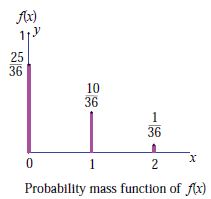
The probabilities are
\(f(0)=P(X=0)\cfrac { 25 }{ 36 } \)
\(f(1)=P(X=1)=\cfrac { 10 }{ 36 } \)
and \(f(20=P(X=2)=\cfrac { 1 }{ 36 } \)
Clearly the function f(x) satisfies the conditions
(i) f (x) ≥ 0, for x = 0, 1, 2 and
(ii) \(\underset { x }{ \Sigma } f(x)=\sum _{ x=0 }^{ x=-2 }{ f(x) } =f(0)+f(1)+f(2)=1\)
\(=\frac{25}{36}+\frac{10}{36}+\frac{1}{36}=1\)
The probability mass function is presented as
| x | 0 | 1 | 2 |
| f(x) | \(\frac { 25 }{ 36 } \) | \(\frac { 10 }{ 36 } \) | \(\frac { 1 }{ 36 } \) |
(or)
\(f(x)=\begin{cases} \begin{matrix} \frac { 25 }{ 36 } & for \ x=0 \end{matrix} \\ \begin{matrix} \frac { 10 }{ 36 } & for \ x=1 \end{matrix} \\ \begin{matrix} \frac { 1 }{ 36 } & for \ x=2 \end{matrix} \end{cases}\)
28.
Then A∨ B =\(\begin{bmatrix} 0 & 1 \\ 1 & 1 \end{bmatrix}\vee \begin{bmatrix} 1 & 1 \\ 0 & 1 \end{bmatrix}=\begin{bmatrix} 0\vee 1 & 1\vee 1 \\ 1\vee 0 & 1\vee 1 \end{bmatrix}=\begin{bmatrix} 1 & 1 \\ 1 & 1 \end{bmatrix}\)
\(A\wedge B=\begin{bmatrix} 0 & 1 \\ 1 & 1 \end{bmatrix}\wedge \begin{bmatrix} 1 & 1 \\ 0 & 1 \end{bmatrix}=\begin{bmatrix} 0\wedge 1 & 1\wedge 1 \\ 1\wedge 0 & 1\wedge 1 \end{bmatrix}=\begin{bmatrix} 0 & 1 \\ 0 & 1 \end{bmatrix}\)
29.
Then the four types of conditional statements corresponding to p and q are respectively listed below.
(i) p →q : (conditional statement) “If the number of primes is infinite then Ooty is in Kerala”.
(ii) q → p : (converse statement) “If Ooty is in Kerala then the number of primes is infinite”
(iii) ¬p → ¬q (inverse statement) “If the number of primes is not infinite then Ooty is not in Kerala”.
(iv) ¬q → ¬p (contrapositive statement) “If Ooty is not in Kerala then the number of primes is not infinite”.
30.
a *b = min (a, b) on A = {1,2,3,4, 5} Let a,b ∈A
A = {1,2, 3, 4, 5}
a*b = min {(a, b)}
Now, 1,2 ∈ A \(\Rightarrow\)1 * 2 = 1 ∈ A
3, 5 ∈ A \(\Rightarrow\) 3 * 5 = 3 ∈ A
Hence * is a binary operation on A
31.
Given a*b = a + b + ab -7, ∀ a,b ∈R
If a ∈R, b∈R then ab ∈ R
(a*b) = a +b+ ab - 7 ∈R
For example, let 1, 2 ∈ R
(1*2) = 1+2+(1)(2)-7
= 2 ∈ R
* a binary operation on R
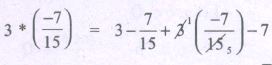
[Here a = 3, b = \(\frac{-7}{15}\)]
\(=3-\frac { 7 }{ 15 } -\frac { 21 }{ 15 } -7\)
\(\therefore 3*\left( \frac { -7 }{ 15 } \right) =\frac { -88 }{ 15 } \)
32.
Given p : Jupiter is a planet and
q : India is an island.
(i) ¬p : Jupiter is not a planet.
(ii) p ∧ ¬q : Jupiter is a planet and India is not an island.
(iii) ¬p ∨ q : Jupiter is not a planet or India is an island.
(iv) p➝ ¬q : If Jupiter is a planet then India is not an island.
(v) p↔q : Jupiter is a planet if and only if India is an island.
33.
Given \(A=\left( \begin{matrix} 1 & 0 \\ 0 & 1 \\ 1 & 0 \end{matrix}\begin{matrix} 1 & 0 \\ 0 & 1 \\ 0 & 1 \end{matrix} \right) ,B=\left( \begin{matrix} 0 & 1 \\ 1 & 0 \\ 1 & 0 \end{matrix}\begin{matrix} 0 & 1 \\ 1 & 0 \\ 0 & 1 \end{matrix} \right) and\quad C=\left( \begin{matrix} 1 & 1 \\ 0 & 1 \\ 1 & 1 \end{matrix}\begin{matrix} 0 & 1 \\ 1 & 0 \\ 1 & 1 \end{matrix} \right) \)
\(=\left( \begin{matrix} 1 & 0 \\ 0 & 1 \\ 1 & 0 \end{matrix}\begin{matrix} 1 & 0 \\ 0 & 1 \\ 0 & 1 \end{matrix} \right) \vee \left( \begin{matrix} 0 & 1 \\ 1 & 0 \\ 1 & 0 \end{matrix}\begin{matrix} 0 & 1 \\ 1 & 0 \\ 0 & 1 \end{matrix} \right) \)
\(=\left( \begin{matrix} 1\vee 0 & 0\vee 1 \\ 0\vee 1 & 1\vee 0 \\ 1\vee 1 & 0\vee 0 \end{matrix}\begin{matrix} 1\vee 0 & 0\vee 1 \\ 0\vee 1 & 1\vee 0 \\ 0\vee 0 & 1\vee 1 \end{matrix} \right) \)
\(=\left( \begin{matrix} 1 & 1 \\ 1 & 1 \\ 1 & 0 \end{matrix}\begin{matrix} 1 & 1 \\ 1 & 1 \\ 0 & 1 \end{matrix} \right) \) [∵ a∨b=max(a,b)]
34.
Given \(A=\left( \begin{matrix} 1 & 0 \\ 0 & 1 \\ 1 & 0 \end{matrix}\begin{matrix} 1 & 0 \\ 0 & 1 \\ 0 & 1 \end{matrix} \right) ,B=\left( \begin{matrix} 0 & 1 \\ 1 & 0 \\ 1 & 0 \end{matrix}\begin{matrix} 0 & 1 \\ 1 & 0 \\ 0 & 1 \end{matrix} \right) and\quad C=\left( \begin{matrix} 1 & 1 \\ 0 & 1 \\ 1 & 1 \end{matrix}\begin{matrix} 0 & 1 \\ 1 & 0 \\ 1 & 1 \end{matrix} \right) \)
\(=\left( \begin{matrix} 0 & 0 \\ 0 & 0 \\ 1 & 0 \end{matrix}\begin{matrix} 0 & 0 \\ 0 & 0 \\ 0 & 1 \end{matrix} \right) \vee \left( \begin{matrix} 1 & 1 \\ 0 & 1 \\ 1 & 1 \end{matrix}\begin{matrix} 0 & 1 \\ 1 & 0 \\ 1 & 1 \end{matrix} \right) \)
\((A\wedge B)\vee C=\left( \begin{matrix} 1 & 1 \\ 0 & 1 \\ 1 & 1 \end{matrix}\begin{matrix} 0 & 1 \\ 1 & 0 \\ 1 & 1 \end{matrix} \right) \)
Answer all
35.
(b)
mean exists but variance does not exist
36.
(d)
\(\frac { l }{ 2 } ,\frac { { l }^{ 2 } }{ 12 } \)
37.
(d)
4
38.
(b)
2i- n, i = 0,1,2... n
39.
(d)
16 and 24
40.
(b)
1.1
41.
(a)
42.
(d)
\(\left( \frac { 10 }{ 5 } \right) \left( \frac { 3 }{ 5 } \right) ^{ 5 }\left( \frac { 2 }{ 5 } \right) ^{ 5 }\)
43.
(b)
44.
(a)
I and II
45.
(c)
46.
(b)
Multiplication
47.
(d)
a*b = ab
48.
(b)
Z
49.
(b)
y = \(\frac{-2}{3}\)
50.
(a)
51.
(d)
\(\sqrt 5\) is an irrational number
52.
(c)
| (a) | (b) | (c) | (d) |
| T | T | F | T |
53.
(a)
| (a) | (b) | (c) | (d) |
| F | T | F | T |
54.
(d)
If p and q are any two statements then p↔️q is a tautology.

12th Standard Syllabus & Materials
12th Standard
TN 12th Standard Physics Electronics and Communication Creative Questions Study Material - QB365 Set B
NEW12th Standard
TN 12th Standard Physics Electronics and Communication Creative Questions Study Material - QB365 Set A
NEW12th Standard
TN 12th Standard Physics Wave Optics Creative Questions Study Material - QB365 Set D
NEW12th Standard
TN 12th Standard Physics Wave Optics Creative Questions Study Material - QB365 Set C



Tamilnadu Stateboard 12th Standard Subjects
Maths

Chemistry

Physics

Biology

Computer Science

Business Maths and Statistics

Economics

Commerce

Accountancy

History

Computer Applications
Biology
Computer Technology
Computer Applications
Computer Science
Business Maths and Statistics
Commerce
Economics
Maths
Chemistry
Physics
Computer Technology
History
Accountancy

Tamil

English

French
Tamilnadu Stateboard Standards


