
12th Standard Syllabus & Materials
12th Standard
TN 12th Standard Biology Zoology - Reproduction in Organisms Creative Questions Study Material - QB365 Set D
NEW12th Standard
TN 12th Standard Biology Zoology - Reproduction in Organisms Creative Questions Study Material - QB365 Set C
NEW12th Standard
TN 12th Standard Biology Zoology - Reproduction in Organisms Creative Questions Study Material - QB365 Set B
NEW12th Standard
TN 12th Standard Biology Zoology - Reproduction in Organisms Creative Questions Study Material - QB365 Set A
NEW12th Standard
TN 12th Standard Physics Electronics and Communication Creative Questions Study Material - QB365 Set D
NEW12th Standard
TN 12th Standard Physics Electronics and Communication Creative Questions Study Material - QB365 Set C

Published on: 20/10/2025
Download Tamil Nadu 12th Standard Maths question papers, model tests, one-mark questions, important questions, and public exam papers in PDF format. Free study materials and answer keys for TN State Board students.
Questions + Answers key
Take MCQ Maths Test
III.ANSWER ANY FOUR OF THE FOLLOWING:
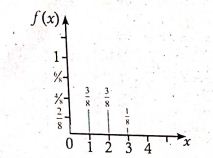
1.
2.
The probability density function of X is given by \(f(x)=\begin{cases} \begin{matrix} kxe^{ -2x } & forx>0 \end{matrix} \\ \begin{matrix} 0 & for\quad x\le 0 \end{matrix} \end{cases}\) Find the value of k.
3.
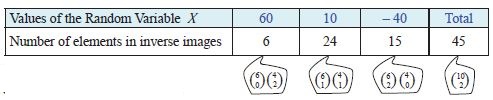
Two balls are chosen randomly from an urn containing 6 white and 4 black balls. Suppose that we win Rs. 30 for each black ball selected and we lose Rs. 20 for each white ball selected. If X denotes the winning amount, then find the values of X and number of points in its inverse images.
4.
Construct the truth table for the following statements.
¬(p ∧ ¬q)
5.
Construct the truth table for the following statements.
( p V q) V ¬q
II. ANSWER ANY FOUR OF THE FOLLOWING:
6.
For the random variable X with the given probability mass function as below, find the mean and variance \(f(x)= \begin{cases}2(x-1) & 1
7.
Using binomial distribution find the mean and variance of X for the following experiments
(i) A fair coin is tossed 100 times, and X denote the number of heads.
(ii) A fair die is tossed 240 times, and X denote the number of times that four appeared.
8.
Write down the
(i) conditional statement
(ii) converse statement
(iii) inverse statement, and
(iv) contrapositive statement for the two statements p and q given below.
p: The number of primes is infinite.
q: Ooty is in Kerala.
9.
Let A = {a +\(\sqrt5\) b : a,b∈Z}. Check whether the usual multiplication is a binary operation on A.
10.
Compute P(X = k) for the binomial distribution, B(n, p) where
\(n=10, p=\frac{1}{5}, k=4\)
I. CHOOSE THE CORRECT ANSWER:
11.
If the function \(f(x)=\frac { 1 }{ 12 } \) for a < x < b, represents a probability density function of a continuous random variable X, then which of the following cannot be the value of a and b?
0 and 12
5 and 17
7 and 19
16 and 24
12.
Two coins are to be flipped. The first coin will land on heads with probability 0.6, the second with probability 0.5. Assume that the results of the flips are independent, and let X equal the total number of heads that result The value of E(X) is
0.11
1.1
11
1
13.
14.
The probability mass function of a random variable is defined as:
| x | -2 | -1 | 0 | 1 | 2 |
| f(x) | k | 2k | 3k | 4k | 5k |
Then E(X ) is equal to:
\(\frac { 1 }{ 15 } \)
\(\frac { 1 }{ 10 } \)
\(\frac { 1 }{ 3 } \)
\(\frac { 2 }{ 3 } \)
15.
Let X have a Bernoulli distribution with mean 0.4, then the variance of (2X - 3) is
0.24
0.48
0.6
0.96
16.
The operation * defined by \(a * b =\frac{ab}{7}\) is not a binary operation on
Q+
Z
R
C
17.
In the set Q define a⊙b = a+b+ab. For what value of y, 3⊙(y⊙5) = 7?
y = \(\frac{2}{3}\)
y = \(\frac{-2}{3}\)
y = \(\frac{-3}{2}\)
y = 4
18.
19.
Which one of the following statements has truth value F?
Chennai is in India or \(\sqrt 2\) is an integer
Chennai is in India or \(\sqrt 2\) is an irrational number
Chennai is in China or \(\sqrt 2\) is an integer
Chennai is in China or \(\sqrt 2\) is an irrational number
20.
IV. ANSWER ANY FOUR (TWO QUESTIONS FROM EACH CHAPTER)
21.
Find the probability mass function f(x) of the discrete random variable X whose cumulative distribution function F(x) is given by

Also find
(i) P(X < 0) and
(ii) P(\(X \geq-1)\)
22.
A random variable X has the following probability mass function
| x | 1 | 2 | 3 | 4 | 5 | 6 |
| f(x) | k | 2k | 6k | 5k | 6k | 10k |
Find
(i) P(2 < X < 6)
(ii) P(2 ≤ X < 5)
(iii) P(X ≤4)
(iv) P(3 < X )
23.
The probability density function of random variable X is given by \(f(x)=\begin{cases} \begin{matrix} k & 1\le x\le 5 \end{matrix} \\ \begin{matrix} 0 & otherwise \end{matrix} \end{cases}\) Find
(i) Distribution function
(ii) P(X < 3)
(iii) P(2 < X < 4)
(iv) P(3 ≤ X )
24.
Verify the
(i) closure property,
(ii) commutative property,
(iii) associative property
(iv) existence of identity and
(v) existence of inverse for the arithmetic operation + on Z.
25.
Verify whether the following compound propositions are tautologies or contradictions or contingency
(( p V q)∧ ¬ p) ➝ q
26.
Let M = \(\left\{ \left( \begin{matrix} x & x \\ x & x \end{matrix} \right) :x\in R-\{ 0\} \right\} \) and let ∗ be the matrix multiplication. Determine whether M is closed under ∗ . If so, examine the existence of identity, existence of inverse properties for the operation ∗ on M.
III.ANSWER ANY FOUR OF THE FOLLOWING:
1.
2.
Given \(f(x)=\begin{cases} \begin{matrix} kxe^{ -2x } & forx>0 \end{matrix} \\ \begin{matrix} 0 & for\quad x\le 0 \end{matrix} \end{cases}\)
Since the given function is a probability density function
\(\int _{ -\infty }^{ \infty }{ f(x)dx } \) = 1
\(\Rightarrow k\int _{ 0 }^{ \infty }{ { xe }^{ -2x }dx=1 } \)
\(\Rightarrow k \frac { 1! }{ \left( 2 \right) ^{ 2 } } =1\)
[\(\int _{ 0 }^{ \infty }{ { x }^{ n }e^{ -ax } } =\frac { n! }{ { a }^{ +1 } } \), Here a = 2, n = 1]
\(\Rightarrow \frac { k }{ 4 } =1\\ \Rightarrow k=4\)
3.
The possible events of selection are
(i) both balls may be black, or
(ii) one white and one black or
(iii) both are white.
Therefore X is a random variable that take the values,
X (both are black balls) = Rs. 2(30) = Rs. 60
X (one black and one white ball) = Rs. 30 − Rs. 20 = Rs. 10
X (both are white balls) = Rs. 2( − 20) = - Rs. 40
Therefore X takes on the values 60,10, and − 40.
4.
Truth Table for ~(p ∧ ~q)
| p | q | ~q | p ∧ ~q | ~(p ∧ ~q) |
| T | T | F | F | T |
| T | F | T | T | F |
| F | T | T | F | T |
| F | F | T | F | T |
5.
Truth Table for ( p V q) ∧ ~q
| p | q | p V q | ~q | ( p V q) ∧ ~q |
| T | T | T | F | T |
| T | F | T | T | T |
| F | T | T | F | T |
| F | F | F | T | T |
II. ANSWER ANY FOUR OF THE FOLLOWING:
6.
\(f(x)= \begin{cases}2(x-1) & 1
\(Mean=E(X)=\int _{ 1 }^{ 2 }{ f(x)dx=\int _{ 1 }^{ 2 }{ 2((x-1)dx } } \)
\( =2\left[\frac{8}{3}-\frac{4}{2}-\frac{1}{3}+\frac{1}{2}\right] \)
\( =2\left(\frac{7}{3}-\frac{3}{2}\right) \)
\( =2 \times \frac{5}{6} \)
\( =\frac{5}{3} \)
\(E({ x }^{ 2 })=\int _{ 1 }^{ 2 }{ { x }^{ 2 }f(x)dx } \)
= \(\int _{ 1 }^{ 2 }{ { x }^{ 2 }.2\left( x-1 \right) } dx\)
= \(2\int _{ 1 }^{ 2 }{ ({ x }^{ 3 }-{ x }^{ 2 })dx } \)
= \(2\left[ \frac { { x }^{ 4 } }{ 4 } -\frac { { x }^{ 3 } }{ 3 } \right] _{ 1 }^{ 2 }\)
= \(2\left[ \left( 4-\frac { 8 }{ 3 } \right) -\left( \frac { 1 }{ 4 } -\frac { 1 }{ 3 } \right) \right] \)
= \(2\left[ \frac { 4 }{ 3 } +\frac { 1 }{ 12 } \right] =2\left[ \frac { 16+1 }{ 12 } \right] \)
= \(\frac { 17 }{ 6 } \)
ஃ Var(X) = E(X2) - [E(X)]2
= \(\frac { 17 }{ 6 } -(\frac{5}{ 3 }^{ 2 })=\frac { 17 }{ 6 } -\frac { 25 }{ 9 } \)
= \(\frac{51-50}{18}\)
= \(\frac{1}{18}\)
7.
Let p be the probability of getting heads
q = 1-p
\(p=\frac { 1 }{ 2 } \)
\(Mean=np=100\times \frac { 1 }{ 2 } =50\)
\(Variance=npq=100\times \frac { 1 }{ 2 } \times \frac { 1 }{ 2 } =25\)
(ii)Let p be the probability of getting 4 when a die is thrown
n = 240
\(p=\frac { 1 }{ 6 } \) [ஃ 4 appears only one]
\(\therefore Mean=np =240\times \frac { 1 }{ 6 } =40\)
\(Variance=npq= 40\times \frac { 5 }{ 6 } \)
\(Variance=\frac { 100 }{ 3 } \)
8.
Then the four types of conditional statements corresponding to p and q are respectively listed below.
(i) p →q : (conditional statement) “If the number of primes is infinite then Ooty is in Kerala”.
(ii) q → p : (converse statement) “If Ooty is in Kerala then the number of primes is infinite”
(iii) ¬p → ¬q (inverse statement) “If the number of primes is not infinite then Ooty is not in Kerala”.
(iv) ¬q → ¬p (contrapositive statement) “If Ooty is not in Kerala then the number of primes is not infinite”.
9.
A = {a+\(\sqrt5\) b:a,b ∈ z}
Let C = a+\(\sqrt5\) b
B = c+\(\sqrt5\)d∈A
where a, b, c, d ∈ Z
[∵ ac + 5bd∈Z and ad+bc ∈Z]
∴ B = (a+\(\sqrt5\)b).(c+\(\sqrt5\)d)
= ac+\(\sqrt5\)ad+cb\(\sqrt5\) + 5bd
= (ac+5bd)+\(\sqrt5\)(ad+bc)∈A
∴ C.B ∈A∀ a, b, c, d∈Z
∴ Usual multiplicaition is a binary operation on.
10.
\( \therefore q =1-p=1-\frac{1}{5}=\frac{4}{5} \)
\(\mathrm{P}(\mathrm{X}=x) =n \mathrm{C}_{x} p^{x} q^{n-x}, x=0,1,2, \ldots \ldots n \)
\(\mathrm{P}(\mathrm{X}=k) =\mathrm{P}(\mathrm{X}=4) \)
\(=10 \mathrm{C}_{4}\left(\frac{1}{5}\right)^{4}\left(\frac{4}{5}\right)^{10-4}=210\left(\frac{1}{5^{4}}\right)\left(\frac{4^{6}}{5^{6}}\right)=210\left(\frac{1}{5}\right)^{4}\left(\frac{4}{5}\right)^{6} \)
I. CHOOSE THE CORRECT ANSWER:
11.
(d)
16 and 24
12.
(b)
1.1
13.
(a)
14.
(d)
\(\frac { 2 }{ 3 } \)
15.
(d)
0.96
16.
(b)
Z
17.
(b)
y = \(\frac{-2}{3}\)
18.
(a)
19.
(c)
Chennai is in China or \(\sqrt 2\) is an integer
20.
(c)
IV. ANSWER ANY FOUR (TWO QUESTIONS FROM EACH CHAPTER)
21.
Since X is a discrete random variable, from the given data, X takes on the values
−2, −1, 0, and 1.
For discrete random variable X, by definition, we have f (x) = P(X = x)
Therefore left hand limit of f(x) at x = -2 is F(− 2− )
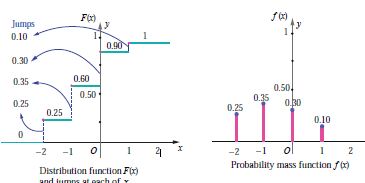
f (−2) = P(X =-2 ) = F(-2 ) - F(- 2- )= 0.25-0 = 0.25
Similarly for other jump points, we have
f (−1) = P(X = -1) = F(-1) - F(-2) = 0.60 - 0.25 = 0.35.
f (0) = P(X ) 0) = F(0) - F(-1) = 0.90 - 0.60 = 0.30 ,
f (1) = P(X =1) = F(1) - F(0) 1- 0.90 = 0.10 .
Therefore the probability mass function is
| x | -2 | -1 | 0 | 1 |
| f(x) | 0.25 | 0.35 | 0.30 | 0.10 |
The distribution function F(x) has jumps at x = -2, -1, 0, and 1. The jumps are respectively 0.25, 0.35, 0.30, and 0.1 is shown in the figure given below.
These jumps determine the probability mass function
(i) \(P(X<0)=\sum _{ -\infty }^{ -1 }{ P(X=x)=P(X=-1)=0.25+0.35 } =0.60\)
(ii) \(P(X\ge -1)=\sum _{ -1 }^{ 1 }{ P(X=x)=P(x=-1) } +P(X=0)+P(X=1)=0.35+030+0.10=0.75\)
22.
Since the given function is a probability mass function, the total probability is one. That is \(\underset { x }{ \Sigma } f(x)=1\)
From the given data k + 2k + 6k + 5k + 6k +10k+1
\(30k=1\Rightarrow k=\frac { 1 }{ 30 } \)
Therefore the probability mass function is
| x | 1 | 2 | 3 | 4 | 5 | 6 |
| f(x) | \(\cfrac { 1 }{ 30 } \) | \(\cfrac { 2 }{ 30 } \) | \(\cfrac { 6 }{ 30 } \) | \(\cfrac { 5 }{ 30 } \) | \(\cfrac { 6 }{ 30 } \) | \(\cfrac { 10 }{ 30 } \) |
(i) P(2 < X < 6) = f(3)+ f(4)+ f(5) = \(\frac { 6 }{ 30 } +\frac { 5 }{ 30 } +\frac { 6 }{ 30 } =\frac { 17 }{ 30 } \)
(ii) P(2≤X≤5) = f(2)+f(3)+f(4) = \(\frac { 2 }{ 30 } +\frac { 6 }{ 30 } +\frac { 5 }{ 30 } =\frac { 13 }{ 30 } \)
(iii) P(2≤4) = f(1)+f(2)+f(3)+f(4) = \(\frac { 1 }{ 30 } +\frac { 2 }{ 30 } +\frac { 6 }{ 30 } +\frac { 5 }{ 30 } =\frac { 14 }{ 30 } \)
(iv) P(3>X) = f(4)+f(5)+f(6) = \(\frac { 5 }{ 30 } +\frac { 6 }{ 30 } +\frac { 10 }{ 30 } =\frac { 21 }{ 30 } \)
23.
Since f (x) is a probability density function, f (x) ≥ 0 and \(\int _{ -\infty }^{ \infty }{ f(x) } dx=1\)
That is \(\int _{ -\infty }^{ 1 }{ 0dx } +\int _{ 1 }^{ 5 }{ kdx } +\int _{ 5 }^{ \infty }{ 0dx } =1\)
\(0+k\left( x \right) _{ 1 }^{ 5 }+0=1\Rightarrow 4k=1\Rightarrow k=\frac { 1 }{ 4 } \)
Therefore the probability density function is
\(f\left( x \right) =\begin{cases} \begin{matrix} \frac { 1 }{ 4 } & 1\le x\le 5 \end{matrix} \\ \begin{matrix} 0 & Otherwise \end{matrix} \end{cases}\)
(i) Distribution function
The distribution function
\(F(x)=P\left( X\le x \right) =\int _{ -\infty }^{ x }{ f(u)dx } \)
When x < 1, \(F(x)=\int _{ -\infty }^{ x }{ f(u)du } =\int _{ -\infty }^{ x }{ oldu } =0\)
When 1 ≤ x ≤ 5 \(F(x)=\int _{ -\infty }^{ x }{ f(u)du=\int _{ -\infty }^{ x }{ 0du } +\int _{ 1 }^{ x }{ odu } +\int _{ 1 }^{ x }{ \frac { 1 }{ 4 } du } =\frac { 1 }{ 4 } (x-1) } \)
When x ≥ 5 \(F(x)=\int _{ -\infty }^{ x }{ f(u) } du=\int _{ -\infty }^{ x }{ odu } +\int _{ 1 }^{ 5 }{ \frac { 1 }{ 4 } du } +\int _{ 1 }^{ 5 }{ \frac { 1 }{ 4 } du } +\int _{ 5 }^{ 5 }{ odu } =1\)
Thus \(F(x)=\begin{cases} \begin{matrix} 0 & x<1 \end{matrix} \\ \begin{matrix} \frac { x-1 }{ 1 } & 1\le x\le 5 \end{matrix} \\ \begin{matrix} 1 & x>5 \end{matrix} \end{cases}\)
(ii) P(X < 3) = P(X ≤ 3) = F(3) = \(\frac { 3-1 }{ 2 } =\frac { 1 }{ 2 } \) (Since F(x) is continuous)
(iii) P(2 < X < 4) = P(2 ≤ X ≤ 4) F(4) - F(2) = \(\frac { 3 }{ 4 } -\frac { 1 }{ 4 } =\frac { 1 }{ 2 } \)
(iv) P(3 ≤ X ) = P(X ≥ 3) = 1− P(X < 3) = 1 - \(1-\frac { 1 }{ 2 } =\frac { 1 }{ 2 } \)
24.
(i) m + n∈Z, ∀m, n∈Z. Hence + is a binary operation on Z.
(ii) Also m + n = n + m,∀m, n∈Z. So the commutative property is satisfied
(iii) ∀m, n, p∈Z, m+ (n + p) = (m+ n) + p. Hence the associative property is satisfied.
(iv) m + e = e + m = m ⇒ e = 0. Thus ヨ 0∈Z⋺(m+ 0) = (0 + m) = m. Hence the existence of identity is assured.
(v) m + m' = m'+ m = 0 ⇒ m' = −m. Thus ∀∈Z,ョ−m∈Z ⋺ m+ (−m) = (−m) + m = 0. Hence, the existence of inverse property is also assured. Thus we see that the usual addition + on Z satisfies all the above five properties.
25.
(( p V q)∧ ~p)) ➝ q
| p | q | p V q | ~p | ( p V q) ∧ ~q | ( p V q) ∧ ~q |
| T | T | T | F | F | T |
| T | F | T | F | F | T |
| F | T | T | T | T | T |
| F | F | F | T | F | T |
The statement (( p V q)∧ ~p) ➝ q is a tautology.
26.
Given M = \(\left\{ \left( \begin{matrix} x & x \\ x & x \end{matrix} \right) :x\in R-\{ 0\} \right\} \) and ∗ be the matrix multiplication.
Let A = \(\left( \begin{matrix} x & x \\ x & x \end{matrix} \right) \)and
B = \(\left( \begin{matrix} y & y \\ y & y \end{matrix} \right) \)∈M
Where x, y ∈R-{0}.
\(A*B=\left( \begin{matrix} x & x \\ x & x \end{matrix} \right) \left( \begin{matrix} y & y \\ y & y \end{matrix} \right) \)
\(=\left( \begin{matrix} xy+xy & xy+xy \\ xy+xy & xy+xy \end{matrix} \right) \)
\(=\left( \begin{matrix} 2xy & xy \\ 2xy & 2xy \end{matrix} \right) \in M\\ \)
[∵ 2xy∈R-{0}]
∴ M is closed under M
Identity:
Since identity of 2\(\times\)2 matrices is I =\(\left( \begin{matrix} 1 & 0 \\ 0 & 1 \end{matrix} \right) \)∉M
∴ M has no identity under *.
Inverse:
Since it has no identity, it won't have inverse also.

12th Standard Syllabus & Materials
12th Standard
TN 12th Standard Physics Electronics and Communication Creative Questions Study Material - QB365 Set B
NEW12th Standard
TN 12th Standard Physics Electronics and Communication Creative Questions Study Material - QB365 Set A
NEW12th Standard
TN 12th Standard Physics Wave Optics Creative Questions Study Material - QB365 Set D
NEW12th Standard
TN 12th Standard Physics Wave Optics Creative Questions Study Material - QB365 Set C



Tamilnadu Stateboard 12th Standard Subjects
Maths

Chemistry

Physics

Biology

Computer Science

Business Maths and Statistics

Economics

Commerce

Accountancy

History

Computer Applications
Biology
Computer Technology
Computer Applications
Computer Science
Business Maths and Statistics
Commerce
Economics
Maths
Chemistry
Physics
Computer Technology
History
Accountancy

Tamil

English

French
Tamilnadu Stateboard Standards


