
12th Standard Syllabus & Materials
12th Standard
TN 12th Standard Biology Zoology - Reproduction in Organisms Creative Questions Study Material - QB365 Set D
NEW12th Standard
TN 12th Standard Biology Zoology - Reproduction in Organisms Creative Questions Study Material - QB365 Set C
NEW12th Standard
TN 12th Standard Biology Zoology - Reproduction in Organisms Creative Questions Study Material - QB365 Set B
NEW12th Standard
TN 12th Standard Biology Zoology - Reproduction in Organisms Creative Questions Study Material - QB365 Set A
NEW12th Standard
TN 12th Standard Physics Electronics and Communication Creative Questions Study Material - QB365 Set D
NEW12th Standard
TN 12th Standard Physics Electronics and Communication Creative Questions Study Material - QB365 Set C

Published on: 20/10/2025
Download Tamil Nadu 12th Standard Maths question papers, model tests, one-mark questions, important questions, and public exam papers in PDF format. Free study materials and answer keys for TN State Board students.
Questions + Answers key
Take MCQ Maths Test
3 Marks
1.
In a pack of 52 playing cards, two cards are drawn at random simultaneously. If the number of black cards drawn is a random variable, find the values of the random variable and number of points in its inverse images.
2.
3.
The probability that Mr.Q hits a target at any trial is \(\frac { 1 }{ 4 } \). Suppose he tries at the target 10 times. Find the probability that he hits the target
(i) exactly 4 times
(ii) at least one time.
4.
In a binomial distribution consisting of 5 independent trials, the probability of 1 and 2 successes are 0.4096 and 0.2048 respectively. Find the mean and variance of the random variables.
5 Marks
5.
A six sided die is marked '1' on one face, '3' on two of its faces, and '5' on remaining three faces. The die is thrown twice. If X denotes the total score in two throws, find
(i) the probability mass function
(ii) the cumulative distribution function
(iii) P(4 ≤ X < 10)
(iv) P(X ≥ 6)
6.
Suppose a discrete random variable can only take the values 0, 1, and 2. The probability mass function is defined by
\(\\ \\ \\ \\ \\ f(x)=\begin{cases} \begin{matrix} \frac { { x }^{ 2 }+1 }{ k } & forx=0,1,2 \end{matrix} \\ \begin{matrix} 0 & otherwise \end{matrix} \end{cases}\\ \\ \\ \\ \\ \\ \)
Find
(i) the value of k
(ii) cumulative distribution function
(iii) P(X ≥ 1).
7.
A random variable X has the following probability mass function
| x | 1 | 2 | 3 | 4 | 5 | 6 |
| f(x) | k | 2k | 6k | 5k | 6k | 10k |
Find
(i) P(2 < X < 6)
(ii) P(2 ≤ X < 5)
(iii) P(X ≤4)
(iv) P(3 < X )
8.
Find the mean and variance of a random variable X , whose probability density function is \(f(x)=\begin{cases} \begin{matrix} { \lambda e }^{ -2x } & for\ge 0 \end{matrix} \\ \begin{matrix} 0 & otherwise \end{matrix} \end{cases}\)
9.
A multiple choice examination has ten questions, each question has four distractors with exactly one correct answer. Suppose a student answers by guessing and if X denotes the number of correct answers, find
(i) binomial distribution
(ii) probability that the student will get seven correct answers
(iii) the probability of getting at least one correct answer
Multiple Choice Question
10.
Let X be random variable with probability density function
\(f(x)=\left\{\begin{array}{ll} \frac{2}{x^{3}} & x \geq 1 \\ 0 & x<1 \end{array}\right.\)
Which of the following statement is correct
both mean and variance exist
mean exists but variance does not exist
both mean and variance do not exist
variance exists but Mean does not exist
11.
A pair of dice numbered 1, 2, 3, 4, 5, 6 of a six-sided die and 1, 2, 3, 4 of a four-sided die is rolled and the sum is determined. Let the random variable X denote this sum. Then the number of elements in the inverse image of 7 is
1
2
3
4
12.
Let X represent the difference between the number of heads and the number of tails obtained when a coin is tossed n times. Then the possible values of X are
i + 2n, i = 0,1,2... n
2i- n, i = 0,1,2... n
n - i, i = 0,1,2... n
2i + 2n, i = 0, 1, 2...n
13.
Four buses carrying 160 students from the same school arrive at a football stadium. The buses carry, respectively, 42, 36, 34, and 48 students. One of the students is randomly selected. Let X denote the number of students that were on the bus carrying the randomly selected student. One of the 4 bus drivers is also randomly selected. Let Y denote the number of students on that bus. Then E(X) and E(Y) respectively are
50,40
40,50
40.75,40
41,41
14.
15.
If X is a binomial random variable with expected value 6 and variance 2.4, then P(X = 5) is
\(\left( \frac { 10 }{ 5 } \right) \left( \frac { 3 }{ 5 } \right) ^{ 6 }\left( \frac { 2 }{ 5 } \right) ^{ 4 }\)
\(\left( \frac { 10 }{ 5 } \right) \left( \frac { 3 }{ 5 } \right) ^{ 10 }\)
\(\left( \frac { 10 }{ 5 } \right) { \left( \frac { 3 }{ 5 } \right) }^{ 4 }\left( \frac { 2 }{ 5 } \right) ^{ 6 }\)
\(\left( \frac { 10 }{ 5 } \right) \left( \frac { 3 }{ 5 } \right) ^{ 5 }\left( \frac { 2 }{ 5 } \right) ^{ 5 }\)
16.
17.
If \(f(x)=\left\{\begin{array}{ll} 2 x & 0 \leq x \leq a \\ 0 & \text { otherwise } \end{array}\right.\) is a probability density function of a random variable, then the value of a is
1
2
3
4
18.
Let X have a Bernoulli distribution with mean 0.4, then the variance of (2X - 3) is
0.24
0.48
0.6
0.96
19.
2 Marks
20.
For the random variable X with the given probability mass function as below, find the mean and variance.
\(f(x)=\begin{cases} \begin{matrix} \cfrac { 1 }{ 2 } e^{ -\frac { x }{ 2 } } & for\quad x>0 \end{matrix} \\ \begin{matrix} 0 & otherwise \end{matrix} \end{cases}\)
21.
Compute P(X = k) for the binomial distribution, B(n, p) where
n = 9, \(p=\frac { 1 }{ 2 } \), k = 7
22.
The probability that a certain kind of component will survive a electrical test is \(\frac { 3 }{ 4 } \). Find the probability that exactly 3 of the 5 components tested survive.
23.
A pair of fair dice is rolled once. Find the probability mass function to get the number of fours.
3 Marks
1.
Let X be the random variable of number of black cards occur.
X = {0,1,2}
Sample space 52C2 = 1326
Let X denote the number of black cards drawn.
X = 0, X (both are red cards) = 26C2 = 325
X = 1 (1 black card and 1 red card) = 26C1 \(\times\) 26C1 = 676
X = 2 (both are black cards) = 26C2 = 325
∴ X takes the values 0, 1, 2
| Values of random variable X | 0 | 1 | 2 | Total |
| Number of elements in inverse images | 325 | 676 | 325 | 1326 |
2.
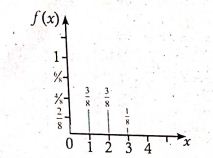
3.
Given P (hitting the target) = \(\frac { 1 }{ 4 } \Rightarrow P=\frac { 1 }{ 4 } \)
n = 10,
(i) P(X = 4)
\(P(X+4)=\left( \begin{matrix} n \\ x \end{matrix} \right) { p }^{ x }(1-p)^{ n-x },x\)
= 0,1,2,...n
(i) Probability of hitting the target exactly 4 times
P(X = 4) = \(^{10}{ C }_{ 4 } \times\left( \begin{matrix} 1 \\ 4 \end{matrix} \right) ^{ 4 }\times \left( \cfrac { 3 }{ 4 } \right) ^{ 6 }\)
\( =\frac{10 \times 9 \times 8 \times 7}{4 \times 3 \times 2} \times \frac{1}{4^{4}} \times \frac{3^{6}}{4^{6}} \\ =210 \times \frac{3^{6}}{4^{10}} \)
(ii) Probability of hitting atleast one time
= P(X≥1) = 1-P(x<1)
= 1-P(X = 0)
\( =1-{ }^{10} \mathrm{C}_{0} \times\left(\frac{1}{4}\right)^{0} \times\left(\frac{3}{4}\right)^{10} \\ =1-\frac{3^{10}}{4^{10}} \)
4.
n = 5, X B{n, p)
P(X = 1) = 0.4096
P(X = 2) 0.2048
P(X = x) = nCx px qn-x, x = 0, 1, 2, .., n
ஃnC1,p1q4 0.4096
5C1, p2q4 = 0.4096
5C2 p2q3 = 0.2048
5pq4 = 0.4096 .....(1)
10 p2 q3 = 0.2048 ....(2)
Dividing (2) by (1) we get
\(\cfrac { 5{ pq }^{ 4 } }{ 10{ p }^{ 2 }{ q }^{ 3 } } =2\)
q = 4p
q = 4(1- q)
q = 4 - 4q
5q = 4
q = 4/5
\(p=1-q= p=\frac { 1 }{ 5 } \)
\(Mean=np=5\times \frac { 1 }{ 5 } =1\)
\( Variance =n p q=\not 5 \times \frac{1}{\not 5} \times \frac{4}{5}=\frac{4}{5}\)
Distribution
(i) \(P(X=x)= ^5C_{ x }\left( \frac { 1 }{ 5 } \right) ^{ x }\left( \frac { 4 }{ 5 } \right) ^{ 5-x }\) , x = 0,1,2..n
5 Marks
5.
Let X be the thrown random variable denotes the total in two the thrown a die.
Sample space S
| I/II | 1 | 3 | 3 | 5 | 5 | 5 |
| 1 | 2 | 4 | 4 | 6 | 6 | 6 |
| 3 | 4 | 6 | 6 | 8 | 8 | 8 |
| 3 | 4 | 6 | 6 | 8 | 8 | 8 |
| 5 | 6 | 8 | 8 | 10 | 10 | 10 |
| 5 | 6 | 8 | 8 | 10 | 10 | 10 |
| 5 | 6 | 8 | 8 | 10 | 10 | 10 |
n (S) = 36
X = {2, 4, 6, 8, 10}
| Values of the random variable | 2 | 4 | 6 | 8 | 10 | Total |
| No. of elements in inverse images | 1 | 4 | 10 | 12 | 9 | 36 |
\(p(x=2)=\cfrac { 1 }{ 36 } \)
\(p(x=4)=\cfrac { 4 }{ 36 } \)
\(p(x=6)=\cfrac { 10 }{ 36 } \)
\(p(x=8)=\cfrac { 12 }{ 36 } \)
\(p(x=10)=\cfrac { 9 }{ 36 } \)
(i) Probability mass function is
| x | 2 | 4 | 6 | 8 | 10 |
| f(x) | \(\\ \cfrac { 1 }{ 36 } \) | \(\cfrac { 4 }{ 36 } \) | \(\cfrac { 10 }{ 36 } \) | \(\cfrac { 12 }{ 36 } \) | \(\cfrac { 9 }{ 36 } \) |
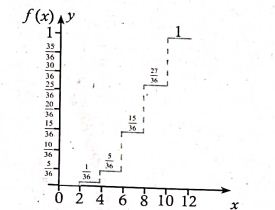
(ii) Cumulative distribution function .
F(x) = p(X ≤ x) = \(\sum_{x_i ≤ x }\)(X = xi)
P(X<2) = 0 for \(\infty\) < x < 2
\(F(2)=\frac { 1 }{ 36 } \)
\(F(4)=\frac { 1 }{ 36 } +\frac { 4 }{ 36 } =\frac { 5 }{ 36 } \)
\(F(6)=\frac { 1 }{ 36 } +\frac { 4 }{ 36 } +\frac { 10 }{ 36 } =\frac { 15 }{ 36 } \)
\(F(8)=\frac { 1 }{ 36 } +\frac { 4 }{ 36 } +\frac { 10 }{ 36 } +\frac { 12 }{ 36 } =\frac { 27 }{ 36 }\)
\(F(10)=\frac { 27 }{ 36 } +\frac { 9 }{ 36 } =\frac { 36 }{ 36 } =1\)
∵ The cumulative distribution function n
\(F(x)=\left\{\begin{array}{lll} 0 & \text { for } & x<2 \\ \frac{1}{36} & \text { for } & x \leq 2 \\ \frac{5}{36} & \text { for } & x \leq 6 \\ \frac{15}{36} & \text { for } & x \leq 8 \\ 1 & \text { for } & x \leq 10 \end{array}\right.\)
(iii) p(4≤ X < 10) = p(x = 4) + p(x = 6) + p(x = 8)
= \(\frac { 4 }{ 36 } +\frac { 10 }{ 36 } +\frac { 12 }{ 36 } +\frac { 26 }{ 36 } =\frac { 13 }{ 18 } \)
(iv) p(x ≥ 6) = p(x = 6) + p(x = 8) + p(x = 10)
= \(\frac { 10 }{ 36 } +\frac { 12 }{ 36 } +\frac { 9 }{ 36 } =\frac { 31 }{ 36 } \)
Sample space = {4 childrens}
6.
Given
\(\\ \\ \\ \\ \\ f(x)=\begin{cases} \begin{matrix} \frac { { x }^{ 2 }+1 }{ k } & forx=0,1,2 \end{matrix} \\ \begin{matrix} 0 & otherwise \end{matrix} \end{cases}\\ \\ \\ \\ \\ \\ \)
The random variable X take the values 0, 1, 2.
Probability mass function.
| x | 0 | 1 | 2 |
| f(x) | \(\cfrac { 1 }{ k } \) | \(\cfrac { 2 }{ k } \) | \(\cfrac {5 }{ k } \) |
\(\sum _{ i=0 }^{ 2 }{ f(x_{ i })=1\Rightarrow f(0)+f(1)+f(2)=1 } \)
\(\Rightarrow \frac { 0+1 }{ k } +\frac { 1+1 }{ k } +\frac { 4+1 }{ k } \)
\(\Rightarrow \frac { 1 }{ k } +\frac { 2 }{ k } +\frac { 5 }{ k } =1\)
\(\Rightarrow \frac { 8 }{ k } =1\)
\(\Rightarrow k=8\)
(ii) Cumulative distribution function
| x | 0 | 1 | 2 |
| f(x) | \(\cfrac { 1 }{ 8 } \) | \(\cfrac { 2 }{ 8 } \) | 1 |
\(F(0)=P(X<0)\\P(x=0)\\ =\frac { 1 }{ 8 } \)
\(F(1)=P(X = 0)+ P(X = 1)\\
\frac { 1 }{ 8 } +\frac { 2 }{ 8 } =\frac { 3 }{ 8 } \)
\(F(2)=P(X= 0) + P(X = 1) + P(X = 2) = \frac { 1 }{ 8 } +\frac { 2 }{ 8 } +\frac { 5 }{ 8 } =1\)
Cumulative distribution function is
\(f(x)=\begin{cases} \begin{matrix} \frac { 1 }{ 8 } & for & x\le 0 \end{matrix} \\ \begin{matrix} \frac { 2 }{ 8 } +\frac { 1 }{ 8 } & for & \frac { 3 }{ 8 } forx\le 1 \end{matrix} \\ \begin{matrix} \frac { 3 }{ 8 } +\frac { 5 }{ 8 } =1 & for & x\le 2 \end{matrix} \end{cases}\)
(iii) p(x ≥ 1) = p(x = 1) + p(x = 2)
= \(\frac { 2 }{ 8 } +\frac { 5 }{ 8 } \)
\(p(x\ge 1)=\frac { 7 }{ 8 } \)
7.
Since the given function is a probability mass function, the total probability is one. That is \(\underset { x }{ \Sigma } f(x)=1\)
From the given data k + 2k + 6k + 5k + 6k +10k+1
\(30k=1\Rightarrow k=\frac { 1 }{ 30 } \)
Therefore the probability mass function is
| x | 1 | 2 | 3 | 4 | 5 | 6 |
| f(x) | \(\cfrac { 1 }{ 30 } \) | \(\cfrac { 2 }{ 30 } \) | \(\cfrac { 6 }{ 30 } \) | \(\cfrac { 5 }{ 30 } \) | \(\cfrac { 6 }{ 30 } \) | \(\cfrac { 10 }{ 30 } \) |
(i) P(2 < X < 6) = f(3)+ f(4)+ f(5) = \(\frac { 6 }{ 30 } +\frac { 5 }{ 30 } +\frac { 6 }{ 30 } =\frac { 17 }{ 30 } \)
(ii) P(2≤X≤5) = f(2)+f(3)+f(4) = \(\frac { 2 }{ 30 } +\frac { 6 }{ 30 } +\frac { 5 }{ 30 } =\frac { 13 }{ 30 } \)
(iii) P(2≤4) = f(1)+f(2)+f(3)+f(4) = \(\frac { 1 }{ 30 } +\frac { 2 }{ 30 } +\frac { 6 }{ 30 } +\frac { 5 }{ 30 } =\frac { 14 }{ 30 } \)
(iv) P(3>X) = f(4)+f(5)+f(6) = \(\frac { 5 }{ 30 } +\frac { 6 }{ 30 } +\frac { 10 }{ 30 } =\frac { 21 }{ 30 } \)
8.
Observe that the given distribution is continuous
By definition \(\mu =E(X)=\int _{ -\infty }^{ \infty }{ xf(x) } dx\) (We can also use integration by parts or Bernoulli’s formula)
= \(\int _{ -\infty }^{ 0 }{ 0\left( \lambda { e }^{ -2x } \right) dx } +\int _{ 0 }^{ \infty }{ x\left( { \lambda e }^{ -\lambda x } \right) } dx\)
= \(0+\lambda \int _{ 0 }^{ \infty }{ x\left( { e }^{ -\lambda x } \right) dx } \)
= \(0+\lambda \left( \frac { 1 }{ { \lambda }^{ 2 } } \right) \) (using Gamma integral for positive integer n,\(\int _{ 0 }^{ \infty }{ { x }^{ n } } { e }^{ -ax }dx=\cfrac { n }{ { a }^{ n+1 } } \))
= \(\frac { 1 }{ \lambda } \)
Variance :
By definition,\(E\left( { X }^{ 2 } \right) =\int _{ -\infty }^{ \infty }{ { x }^{ 2 }f(x) } dx\) (We can also use integration by parts or Bernoulli’s formula)
= \(\int _{ -\infty }^{ 0 }{ 0\left( \lambda { e }^{ -\lambda x } \right) } dx+\int _{ 0 }^{ \infty }{ { x }^{ 2 }\left( \lambda { e }^{ -2x } \right) } dx\)
= \(0+\lambda \int _{ 0 }^{ \infty }{ { x }^{ 2 }\left( { e }^{ -2x } \right) dx } \)
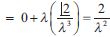 (using Gamma integral for positive integer)
Therefore Var(X ) = E(X2 )- E(X )2
= \(\frac { 2 }{ { \lambda }^{ 2 } } -\left( \frac { 1 }{ \lambda } \right) ^{ 2 }=\frac { 1 }{ { \lambda }^{ 2 } } \)
Hence the mean and variance are respectively \(\frac { 1 }{ \lambda } \) and \(\frac { 1 }{ { \lambda }^{ 2 } } \)
9.
(i) Since X denotes the number of success, X can take the values 0,1, 2, ...10
The probability for success is \(p=\frac { 1 }{ 4 } \) and for failure \(q=1-p=\frac { 3 }{ 4 } \) and n = 10
Therefore X follows a binomial distribution denoted by \(X\sim B\left( 10,\frac { 1 }{ 4 } \right) \)
This gives,\(f(x)=\left( \begin{matrix} 10 \\ x \end{matrix} \right) \left( \cfrac { 1 }{ 4 } \right) ^{ x }\left( \cfrac { 3 }{ 4 } \right) ^{ 10-x }\) x = 0, 1, 2,..,10
(ii) Probability for seven correct answers is
\(P(X=7)=f(7)=\left( \begin{matrix} 10 \\ 7 \end{matrix} \right) \left( \cfrac { 1 }{ 4 } \right) ^{ 7 }\left( \cfrac { 3 }{ 4 } \right) ^{ 10-7 }=120\left( \cfrac { { 3 }^{ 2 } }{ { 4 }^{ 10 } } \right) \)
Probability that the student will get seven correct answers is \(120\left( \cfrac { { 3 }^{ 2 } }{ { 4 }^{ 10 } } \right) \)
(iii) Probability for at least one correct answer is
P(X ≥1) = 1- P(X <1) = 1- P(X = 0)
= \(1-\left( \begin{matrix} 10 \\ 0 \end{matrix} \right) \left( \cfrac { 1 }{ 4 } \right) ^{ 0 }\left( \cfrac { 3 }{ 4 } \right) ^{ 10 }=1-\left( \cfrac { 3 }{ 4 } \right) ^{ 10 }\)
Probability that the student will get for at least one correct answer is \(1-\left( \cfrac { 3 }{ 4 } \right) ^{ 10 }\)
Multiple Choice Question
10.
(b)
mean exists but variance does not exist
11.
(d)
4
12.
(b)
2i- n, i = 0,1,2... n
13.
(c)
40.75,40
14.
(a)
15.
(d)
\(\left( \frac { 10 }{ 5 } \right) \left( \frac { 3 }{ 5 } \right) ^{ 5 }\left( \frac { 2 }{ 5 } \right) ^{ 5 }\)
16.
(b)
17.
(a)
1
18.
(d)
0.96
19.
(b)
2 Marks
20.
\(f(x)=\begin{cases} \begin{matrix} \frac { 1 }{ 2 } e^{ -\frac { x }{ 2 } } & for\quad x>0 \end{matrix} \\ \begin{matrix} 0 & otherwise \end{matrix} \end{cases}\)
\(\int _{ 0 }^{ \infty }{ x.f(x)dx } =\frac { 1 }{ 2 } \int _{ 0 }^{ \infty }{ x.{ e }^{ \frac { -x }{ 2 } } } dx\)
\(\left[ \int _{ 0 }^{ \infty }{ { e }^{ -ax }.{ x }^{ n }dx=\cfrac { n! }{ { a }^{ n+1 } } } \right] \)
= \(\frac { 1 }{ 2 } \times \frac { 1! }{ \left( \frac { 1 }{ 2 } \right) ^{ 2 } } =\frac { 1 }{ 2 } \times \frac { 1 }{ \frac { 1 }{ 4 } } \)
= \(\frac { 1 }{ 2 } \times \frac { 4 }{ 1 } =2\)
\(E({ X }^{ 2 })=\int _{ 0 }^{ \infty }{ { x }^{ 2 }.f(x) } dx\)
= \(\int _{ 0 }^{ \infty }{ { x }^{ 2 }.\frac { 1 }{ 2 } { e }^{ -\frac { x }{ 2 } } } dx\)
= \(\frac { 1 }{ 2 } \int { { x }^{ 2 }.{ e }^{ -\frac { x }{ 2 } }dx } \)
= \(\frac { 1 }{ 2 } \times \frac { 2! }{ \left( \frac { 1 }{ 3 } \right) ^{ 3 } } =\frac { 1 }{ 2 } \times \frac { 2 }{ \frac { 1 }{ 8 } } \)
= \(\frac { 1 }{ 2 } \times 2\times 8=8\)
ஃVar(X)=E(X2) - [E(x)]2
= 8-22
= 8 - 4 = 4
21.
\(\mathrm{n}=9, \mathrm{p}=\frac{1}{2}, \mathrm{k}=7
\)
\(
\mathrm{P}(X=x)={ }^{n} C_{x} p^{x} q^{n-x}, x=0,1,2, \ldots, n
\)
\(p =\frac{1}{2}
\)
\(q =1-p=\frac{1}{2} \)
\(P(X=7) ={ }^{9} C_{7}\left(\frac{1}{2}\right)^{7}\left(\frac{1}{2}\right)^{2}
\)
\( =\frac{9 \times 8}{2} \times \frac{1}{2^{9}} \)
\( =36 \times \frac{1}{512}=\frac{9}{128}
\)
22.
Given \(p=\frac { 3 }{ 4 } \)
n = 5
P(X = x) = nCxpx (1-p)n-x
\(P(X=3)={ 5C }_{ 3 }\left( \frac { 3 }{ 4 } \right) ^{ 3 }\left( 1-\frac { 3 }{ 4 } \right) ^{ 2 }\)
\(P(X=3)={ 5C }_{ 2 }\left( \frac { 3 }{ 4 } \right) ^{ 3 }\left( \frac { 1 }{ 4 } \right) ^{ 2 }\) [∵nCr = nCn-r]
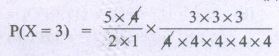
= \(\frac { 135 }{ 512 } \)
23.
\(S=\left|\begin{array}{l} (1,1),(1,2),(1,3),(1,4),(1,5),(1,6) \\ (2,1),(2,2),(2,3),(2,4),(2,5),(2,6) \\ (3,1),(3,2),(3,3),(3,4),(3,5),(3,6) \\ (4,1),(4,2),(4,3),(4,4),(4,5),(4,6) \\ (5,1),(5,2),(5,3),(5,4),(5,5),(5,6) \\ (6,1),(6,2),(6,3),(6,4),(6,5),(6,6) \end{array}\right|\)
Let X be a random variable whose values x are the number of fours.
The sample space S is given in the table.
It can also be written as
S = {(i, j)} , where i = 1, 2, 3, 6 and j = 1, 2, 3, 6
Therefore X takes on the values of 0, 1 and 2.
We observe that
(i) X = 0, if (i, j) for i ≠ 4, j≠ 4,
(ii) X = 1, if (1, 4), (2, 4), (3, 4), (5, 4), (6, 4), (4, 1), (4, 2), (4, 3), (4, 5), (4, 6)
(iii) X = 2, if (4, 4) ,
Therefore,
| Values of the Random Variable X | 0 | 1 | 2 | Toatal |
| Number of elements in inverse images | 25 | 10 | 1 | 36 |
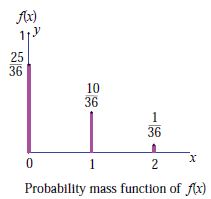
The probabilities are
\(f(0)=P(X=0)\cfrac { 25 }{ 36 } \)
\(f(1)=P(X=1)=\cfrac { 10 }{ 36 } \)
and \(f(20=P(X=2)=\cfrac { 1 }{ 36 } \)
Clearly the function f(x) satisfies the conditions
(i) f (x) ≥ 0, for x = 0, 1, 2 and
(ii) \(\underset { x }{ \Sigma } f(x)=\sum _{ x=0 }^{ x=-2 }{ f(x) } =f(0)+f(1)+f(2)=1\)
\(=\frac{25}{36}+\frac{10}{36}+\frac{1}{36}=1\)
The probability mass function is presented as
| x | 0 | 1 | 2 |
| f(x) | \(\frac { 25 }{ 36 } \) | \(\frac { 10 }{ 36 } \) | \(\frac { 1 }{ 36 } \) |
(or)
\(f(x)=\begin{cases} \begin{matrix} \frac { 25 }{ 36 } & for \ x=0 \end{matrix} \\ \begin{matrix} \frac { 10 }{ 36 } & for \ x=1 \end{matrix} \\ \begin{matrix} \frac { 1 }{ 36 } & for \ x=2 \end{matrix} \end{cases}\)

12th Standard Syllabus & Materials
12th Standard
TN 12th Standard Physics Electronics and Communication Creative Questions Study Material - QB365 Set B
NEW12th Standard
TN 12th Standard Physics Electronics and Communication Creative Questions Study Material - QB365 Set A
NEW12th Standard
TN 12th Standard Physics Wave Optics Creative Questions Study Material - QB365 Set D
NEW12th Standard
TN 12th Standard Physics Wave Optics Creative Questions Study Material - QB365 Set C



Tamilnadu Stateboard 12th Standard Subjects
Maths

Chemistry

Physics

Biology

Computer Science

Business Maths and Statistics

Economics

Commerce

Accountancy

History

Computer Applications
Biology
Computer Technology
Computer Applications
Computer Science
Business Maths and Statistics
Commerce
Economics
Maths
Chemistry
Physics
Computer Technology
History
Accountancy

Tamil

English

French
Tamilnadu Stateboard Standards


