
12th Standard Syllabus & Materials
12th Standard
TN 12th Standard Biology Zoology - Reproduction in Organisms Creative Questions Study Material - QB365 Set D
NEW12th Standard
TN 12th Standard Biology Zoology - Reproduction in Organisms Creative Questions Study Material - QB365 Set C
NEW12th Standard
TN 12th Standard Biology Zoology - Reproduction in Organisms Creative Questions Study Material - QB365 Set B
NEW12th Standard
TN 12th Standard Biology Zoology - Reproduction in Organisms Creative Questions Study Material - QB365 Set A
NEW12th Standard
TN 12th Standard Physics Electronics and Communication Creative Questions Study Material - QB365 Set D
NEW12th Standard
TN 12th Standard Physics Electronics and Communication Creative Questions Study Material - QB365 Set C

Published on: 20/10/2025
Download Tamil Nadu 12th Standard Maths question papers, model tests, one-mark questions, important questions, and public exam papers in PDF format. Free study materials and answer keys for TN State Board students.
Questions + Answers key
Take MCQ Maths Test
1.
The temperature T in celsius in a long rod of length 10 m, insulated at both ends, is a function of length x given by T = x(10 − x). Prove that the rate of change of temperature at the midpoint of the rod is zero.
2.
Find the asymptotes of the function f(x) = \(\frac{1}{x}\)
3.
An egg of a particular bird is very nearly spherical. If the radius to the inside of the shell is 5 mm and radius to the outside of the shell is 5.3 mm, find the volume of the shell approximately.
4.
Evaluate \(\begin{gathered} \text { lim } \\ (x, y) \rightarrow(1,2) \end{gathered}\)g(x, y), if the limit exists, where g\((x,y)=\frac { { 3x }^{ 2 }-xy }{ { x }^{ 2 }+{ y }^{ 2 }+3 } \)
5.
Find the area of the region bounded by the line 6x + 5y = 30, x − axis and the lines x = −1 and x = 3.
6.
A pair of fair dice is rolled once. Find the probability mass function to get the number of fours.
7.
Write down the
(i) conditional statement
(ii) converse statement
(iii) inverse statement, and
(iv) contrapositive statement for the two statements p and q given below.
p: The number of primes is infinite.
q: Ooty is in Kerala.
8.
Determine whether ∗ is a binary operation on the sets given below.
a*b = b = a.|b| on R
9.
IF u(x, y) = x2 + 3xy + y2, x, y, ∈ R, find tha linear appraoximation for u at (2, 1)
10.
Find the volume of the solid obtained by revolving the area of the triangle whose sides are x = 4, y = 0 and 3x – 4y = 0 about x axis.
11.
A road running north to south crosses a road going east to west at the point P. Car A is driving north along the first road, and car B is driving east along the second road. At a particular time car A 10 kilometres to the north of P and traveling at 80 km/hr, while car B is 15 kilometres to the east of P and traveling at 100 km/hr. How fast is the distance between the two cars changing?
12.
If the curves ax2+ by2 = 1 and cx2+ dy2 = 1 intersect each other orthogonally then, \(\frac{1}{a}-\frac{1}{b}=\frac{1}{c}-\frac{1}{d}\)
13.
14.
For the function f{x) = 4x3 + 3x2 - 6x + 1 find the intervals of monotonicity, local extrema, intervals of concavity and points of inflection.
15.
A right circular cylinder has radius r =10 cm. and height h = 20 cm. Suppose that the radius of the cylinder is increased from 10 cm to 10. 1 cm and the height does not change. Estimate the change in the volume of the cylinder. Also, calculate the relative error and percentage error.
16.
Suppose the amount of milk sold daily at a milk booth is distributed with a minimum of 200 Iitres and a maximum of 600 litres with probability density function
\(\begin{cases} \begin{matrix} k & 200\le x\le 600 \end{matrix} \\ \begin{matrix} 0 & otherwise \end{matrix} \end{cases}\)
Find
(i) the value of k
(ii) the distribution function
(iii) the probability that daily sales will fall between 300 litres and 500 litres?
17.
The probability density function of X is given
\(f(x)=\begin{cases} \begin{matrix} { Ke }^{ \frac { -x }{ 3 } } & \begin{matrix} for & x>0 \end{matrix} \end{matrix} \\ \begin{matrix} 0 & \begin{matrix} for & x\le 0 \end{matrix} \end{matrix} \end{cases}\)
Find
(i) the value of k
(ii) the distribution function.
(iii) P(X <3)
(iv) P(5 ≤X)
(v) P(X ≤ 4)
18.
Two balls are drawn in succession without replacement from an urn containing four red balls and three black balls. Let X be the possible outcomes drawing red balls. Find the probability mass function and mean for X.
19.
The mean and standard deviation of a binomial variate X are respectively 6 and 2.
Find
(i) the probability mass function
(ii) P(X = 3)
(iii) P(X\(\ge \)2).
20.
21.
The curve y = (x − 2)2 +1 has a minimum point at P. A point Q on the curve is such that the slope of PQ is 2. Find the area bounded by the curve and the chord PQ.
22.
If u = sin-1 \(\left( \frac { x+y }{ \sqrt { x } +\sqrt { y } } \right) \), Show that \(x\frac { \partial u }{ \partial x } +y\frac { \partial u }{ \partial y } =\frac { 1 }{ 2 } tanu\)
23.
Define an operation∗ on Q as follows: a*b = \(\left( \frac { a+b }{ 2 } \right) \); a,b ∈Q. Examine the existence of identity and the existence of inverse for the operation * on Q.
24.
Using truth table check whether the statements ¬(p V q) V (¬p ∧ q) and ¬p are logically equivalent.
25.
Prove that there is a zero of the polynomial \(2x^{3}-9x^{2}-11x+12\) in the interval (2, 7) given that 2 and 7 are the zeros of the polynomial \(x^{4}-6x^{3}-11x^{2}+24x+28\)
26.
Suppose f(x) is a differentiable function for all x with f'(x) ≤ 29 and f(2) = 17. What is the maximum value of f(7)?
27.
Prove that the function f (x) = x2 + 2 is strictly increasing in the interval (2,7) and strictly decreasing in the interval (−2, 0)
28.
The time T, taken for a complete oscillation of a single pendulum with length l, is given by the equation T = 2ㅠ\(\sqrt { \frac { 1 }{ g } } \), where g is a constant. Find the approximate percentage error in the calculated value of T corresponding to an error of 2 percent in the value of l.
29.
Assuming log10e = 0.4343, find an approximate value of log10 1003
30.
The probability that Mr.Q hits a target at any trial is \(\frac { 1 }{ 4 } \). Suppose he tries at the target 10 times. Find the probability that he hits the target
(i) exactly 4 times
(ii) at least one time.
31.
Suppose a pair of unbiased dice is rolled once. If X denotes the total score of two dice, write down
(i) the sample space
(ii) the values taken by the random variable X,
(iii) the inverse image of 10, and
(iv) the number of elements in inverse image of X.
32.
If X is the random variable with distribution function F(x) given by,
\(F(x)=\begin{cases} \begin{matrix} 0 & x<0 \end{matrix} \\ \begin{matrix} x & 0\le x<1 \end{matrix} \\ \begin{matrix} 1 & 1\le x \end{matrix} \end{cases}\)
then find
(i) the probability density function f(x)
(ii) P(0.2 ≤ X ≤ 0.7)
33.
Find the volume of a sphere of radius a.
34.
Find the area bounded by the curve y=sin x,y=cosx and the y-axis
35.
A balloon rises straight up at 10 m/s. An observer is 40 m away from the spot where the balloon left the ground. The rate of change of the balloon's angle of elevation in radian per second when the balloon is 30 metres above the ground.
\(\frac{3}{25} \text { radians } / \mathrm{sec}\)
\(\frac{4}{25} \text { radians } / \mathrm{sec}\)
\(\frac{1}{5} \text { radians } / \mathrm{sec}\)
\(\frac{1}{3} \text { radians } / \mathrm{sec}\)
36.
What is the value of the limit \(\lim _{x \rightarrow 0}\left(\cot x-\frac{1}{x}\right) \text { is }\)
0
1
2
∞
37.
The function sin4 x + cos4 x is increasing in the interval
\(\left[ \frac { 5\pi }{ 8 } ,\frac { 3\pi }{ 4 } \right] \)
\(\left[ \frac { \pi }{ 2 } ,\frac { 5\pi }{ 8 } \right] \)
\(\left[ \frac { \pi }{ 4 } ,\frac { \pi }{ 2 } \right] \)
\(\left[ 0,\frac { \pi }{ 4 } \right] \)
38.
The minimum value of the function |3 - x| + 9 is
0
3
6
9
39.
The maximum slope of the tangent to the curve y = ex sin x, x ∈ [0, 2π] is at
\(x=\frac { \pi }{ 4 } \)
\(x=\frac { \pi }{ 2 } \)
\(x=\pi \)
\(x=\frac { 3\pi }{ 2 } \)
40.
The maximum value of the function \(x^{2} e^{-2 x}, x>0\) is
\(\frac { 1 }{ e } \)
\(\frac { 1 }{ 2e } \)
\(\frac { 1 }{ { e }^{ 2 } } \)
\(\frac { 4 }{ { e }^{ 4 } } \)
41.
The maximum product of two positive numbers, when their sum of the squares is 200, is
100
\(25\sqrt { 7 } \)
28
\(24\sqrt { 14 } \)
42.
Let X be random variable with probability density function
\(f(x)=\left\{\begin{array}{ll} \frac{2}{x^{3}} & x \geq 1 \\ 0 & x<1 \end{array}\right.\)
Which of the following statement is correct
both mean and variance exist
mean exists but variance does not exist
both mean and variance do not exist
variance exists but Mean does not exist
43.
If the function \(f(x)=\frac { 1 }{ 12 } \) for a < x < b, represents a probability density function of a continuous random variable X, then which of the following cannot be the value of a and b?
0 and 12
5 and 17
7 and 19
16 and 24
44.
Two coins are to be flipped. The first coin will land on heads with probability 0.6, the second with probability 0.5. Assume that the results of the flips are independent, and let X equal the total number of heads that result The value of E(X) is
0.11
1.1
11
1
45.
46.
Let X have a Bernoulli distribution with mean 0.4, then the variance of (2X - 3) is
0.24
0.48
0.6
0.96
47.
A circular template has a radius of 10 cm. The measurement of radius has an approximate error of 0.02 cm. Then the percentage error in calculating area of this template is
0.2%
0.4%
0.04%
0.08%
48.
The percentage error of fifth root of 31 is approximately how many times the percentage error in 31?
\(\frac{1}{31}\)
\(\frac15\)
5
31
49.
If v (x, y) = log (ex + ey), then \(\frac { { \partial }v }{ \partial x } +\frac { \partial v }{ \partial y } \) is equal to
ex + ey
\(\frac{1}{e^x + e^y}\)
2
1
50.
If f (x, y) = exy then \(\frac { { \partial }^{ 2 }f }{ \partial x\partial y } \) is equal to
xyexy
(1 +xy)exy
(1 +y)exy
(1 + x)exy
51.
Which one of the following is a binary operation on N?
Subtraction
Multiplication
Division
All the above
52.
The operation * defined by \(a * b =\frac{ab}{7}\) is not a binary operation on
Q+
Z
R
C
53.
In the set Q define a⊙b = a+b+ab. For what value of y, 3⊙(y⊙5) = 7?
y = \(\frac{2}{3}\)
y = \(\frac{-2}{3}\)
y = \(\frac{-3}{2}\)
y = 4
54.
1.
We are given that, T = 10x − x2
Hence, the rate of change at any distance from one end is given by \(\frac{dT}{dx}=10-2x \)
The mid point of the rod is at x = 5
Substituting x = 5, we get \(\frac{dT}{dx}=0\)
2.
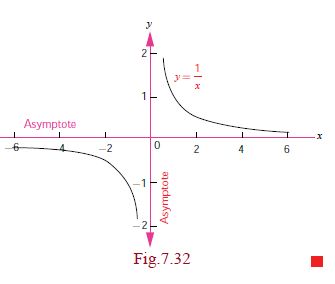
We have,
\(\underset { x\rightarrow { 0 }^{ - } }{ lim } =-\infty \ and\ \underset { x\rightarrow { 0 }^{ x } }{ lim } =\frac { 1 }{ x } =\infty \). Hence, the required vertical asymptote is x = 0 or the y -axis.
As the curve is symmetric with respect to both the axes, y = 0 or the x -axis is also an asymptote.
Hence this (rectangular hyperbola) curve has both the vertical and horizontal asymptotes.
3.
Volume of sphere = \(\frac43\) πr3
Given r = 5 mm
⇒ dr = (5.3 - 5) = 0.3 mm
\(\text { Approximate volume }=\frac{4}{\not 3} \pi \cdot \not 3 r^{2} d r\)
= 4π (52) (0.3)
= 100 π (0.3)
= 30π mm3
4.
Given g(x, y) = \(\frac { { 3x }^{ 2 }-xy }{ { x }^{ 2 }+{ y }^{ 2 }+3 } \)
\(\begin{matrix} lim \\ (x,y)\rightarrow (1,2) \end{matrix}g(x,y)=\begin{matrix} lim \\ (x,y)\rightarrow (1,2) \end{matrix}\frac { { 3x }^{ 2 }-xy }{ { x }^{ 2 }+{ y }^{ 2 }+3 } \)
\(=\frac { { 3(1) }^{ 2 }-1(2) }{ { 1 }^{ 2 }+{ 2 }^{ 2 }+3 } =\frac { 3-2 }{ 8 } =\frac { 1 }{ 8 } \)
5.
The region is sketched. It lies above the x − axis. Hence, the required area is given by
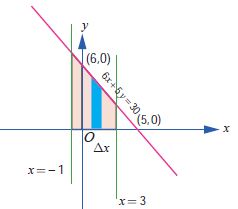
\(A=\int _{ -1 }^{ 3 }{ ydx } =\int _{ -1 }^{ 3 }{ \left( \frac { 30-6x }{ 5 } \right) dx={ \left( \frac { 30x-3{ x }^{ 2 } }{ 5 } \right) }_{ -1 }^{ 3 } } \)
\(=\left( \frac { 90-27 }{ 5 } \right) -\left( \frac { -30-3 }{ 5 } \right) =\frac { 96 }{ 5 } \)
6.
\(S=\left|\begin{array}{l} (1,1),(1,2),(1,3),(1,4),(1,5),(1,6) \\ (2,1),(2,2),(2,3),(2,4),(2,5),(2,6) \\ (3,1),(3,2),(3,3),(3,4),(3,5),(3,6) \\ (4,1),(4,2),(4,3),(4,4),(4,5),(4,6) \\ (5,1),(5,2),(5,3),(5,4),(5,5),(5,6) \\ (6,1),(6,2),(6,3),(6,4),(6,5),(6,6) \end{array}\right|\)
Let X be a random variable whose values x are the number of fours.
The sample space S is given in the table.
It can also be written as
S = {(i, j)} , where i = 1, 2, 3, 6 and j = 1, 2, 3, 6
Therefore X takes on the values of 0, 1 and 2.
We observe that
(i) X = 0, if (i, j) for i ≠ 4, j≠ 4,
(ii) X = 1, if (1, 4), (2, 4), (3, 4), (5, 4), (6, 4), (4, 1), (4, 2), (4, 3), (4, 5), (4, 6)
(iii) X = 2, if (4, 4) ,
Therefore,
| Values of the Random Variable X | 0 | 1 | 2 | Toatal |
| Number of elements in inverse images | 25 | 10 | 1 | 36 |
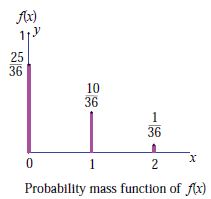
The probabilities are
\(f(0)=P(X=0)\cfrac { 25 }{ 36 } \)
\(f(1)=P(X=1)=\cfrac { 10 }{ 36 } \)
and \(f(20=P(X=2)=\cfrac { 1 }{ 36 } \)
Clearly the function f(x) satisfies the conditions
(i) f (x) ≥ 0, for x = 0, 1, 2 and
(ii) \(\underset { x }{ \Sigma } f(x)=\sum _{ x=0 }^{ x=-2 }{ f(x) } =f(0)+f(1)+f(2)=1\)
\(=\frac{25}{36}+\frac{10}{36}+\frac{1}{36}=1\)
The probability mass function is presented as
| x | 0 | 1 | 2 |
| f(x) | \(\frac { 25 }{ 36 } \) | \(\frac { 10 }{ 36 } \) | \(\frac { 1 }{ 36 } \) |
(or)
\(f(x)=\begin{cases} \begin{matrix} \frac { 25 }{ 36 } & for \ x=0 \end{matrix} \\ \begin{matrix} \frac { 10 }{ 36 } & for \ x=1 \end{matrix} \\ \begin{matrix} \frac { 1 }{ 36 } & for \ x=2 \end{matrix} \end{cases}\)
7.
Then the four types of conditional statements corresponding to p and q are respectively listed below.
(i) p →q : (conditional statement) “If the number of primes is infinite then Ooty is in Kerala”.
(ii) q → p : (converse statement) “If Ooty is in Kerala then the number of primes is infinite”
(iii) ¬p → ¬q (inverse statement) “If the number of primes is not infinite then Ooty is not in Kerala”.
(iv) ¬q → ¬p (contrapositive statement) “If Ooty is not in Kerala then the number of primes is not infinite”.
8.
Given a*b = a.|b| on R
a,b ∈ R \(\Rightarrow\) a.|b| ∈R as a ∈ R and |b|∈R.
Hence * is a binary operation on R
9.
Given u(x, y) = x2 + 3xy + y2
u(xo, yo) = u(2,1)
= 22 + 3(2)(1) + 12
= 4 + 6 + 1 = 11
\(\frac { \partial u }{ \partial x } \) = 2x+ 3y
\({ \left( \frac { \partial u }{ \partial x } \right) }_{ (2,1) }\)= 2 + 3 = 5
\(\frac { \partial u }{ \partial y } \) = 3x+ 2y
\({ \left( \frac { \partial u }{ \partial y } \right) }_{ (2,1) }\) = 6 + 2 = 8
Linear approximation
L(x,y) = U(xo, yo) + \({ \left( \frac { \partial u }{ \partial x } \right) }_{ ({ x }_{ 0 },{ y }_{ 0 }) }\) (x - xo) + \({ \left( \frac { \partial u }{ \partial y} \right) }_{ ({ x }_{ 0 }{ ,y }_{ 0 }) }\)(y - yo)
L (x,y) = 11 + 5 (x - 2) + 8 (y - 1)
= 11 + 5x - 10 + 8y - 8
L(x,y) = 5x + 8y - 7
10.
12π
11.
Let a(t) be the distance of car A north of P at time t, and b (t) the distance of car B east of P at time t, and let c(t) be the distance from car A to car B at time t. By the Pythagorean Theorem, c(t)2 = a(t)2 + b(t)2
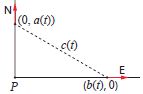
Taking derivatives, we get 2c(t)c'(t) = 2a(t)a'(t) + 2b(t)b'(t).
So, c′ = \(\frac { { aa }^{ ' }+{ bb }^{ ' } }{ c } =\frac { { aa }^{ ' }+{ bb }^{ ' } }{ \sqrt { { a }^{ 2 }+{ b }^{ 2 } } } \)
Substituting known values, we get
\(c' =\frac { (10\times 80)+(15\times 100) }{ \sqrt { { 10 }^{ 2 }+{ 15 }^{ 2 } } } =\frac { 460 }{ \sqrt { 13 } } \) ≈ 127.6 km/hr at the time of intersect
12.
Let the two curves intersect at a point (x0 , y0) This leads to (a-c)x02 + (b-d)y02 = 0
Let us now find the slope of the curves at the point of intersection (x0, y0). The slopes of the curves are as follows :
For the curve ax2 + by2 = 1, \(\frac{dy}{dx}= -\frac{ax}{by}\)
For the curve cx2 + dy2 = 1, \(\frac{dy}{dx}= -\frac{cx}{by}\)
Now, two curves cut orthogonally, if the product of their slopes intersection (x0, y0) is −1. Hence, for the above two curves to cut orthogonally at (x0, y0) if
\((-\frac{ax_{0}}{by_{0}})\times(-\frac{cx_{0}}{dy_{0}})=-1\)
That is, acx02 + bdy02 = 0,
together with \((a-c)x^{2}_{0}+(b-d)y_{0}^{2}=0\)
gives, \(\frac{a-c}{ac}=\frac{b-d}{bd}\)
That is, \(\frac{1}{c}-\frac{1}{a}=\frac{1}{d}-\frac{1}{b}\).
Hence, \(\frac{1}{a}-\frac{1}{b}=\frac{1}{c}-\frac{1}{d}\).
13.
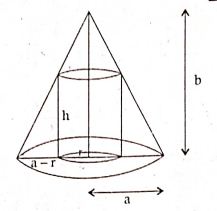
14.
Given f(x) = 4x3 + 3x2- 6x + 1
f'(x) = 12x2 + 6x - 6
f"(x) = 24x + 6
f'(x) = 0
⇒12x2 + 6x - 6 = 0
⇒ 2x2 + x - 1 = 0
⇒ (x + 1)(2x - 1) = 0
\(\Rightarrow x=-1,\frac { 1 }{ 2 } \)
The critical numbers are -1, \(\frac { 1 }{ 2 } \)
The possible intervals of monotonicity are
\(\left( -\infty ,-1 \right) \left( -1,\frac { 1 }{ 2 } \right) \left( \frac { 1 }{ 2 } ,\infty \right) \)
| Interval | (∞,-1) | \(\left( -1,\frac { 1 }{ 2 } \right) \) | \(\left( \frac { 1 }{ 2 } ,\infty \right) \) |
| Sign of f'(x) | Say x = -2 12(-2)2 + 6 (-2)-6 = +ve |
Say x = 0 = -6 -ve |
Say x = 1 I2(1)2 + 6(1) - 6 = +ve |
| Monoto nicity | strictly increasmg | Strictly decreasing | Strictly increasing |
∴ f(x) is strictly increasing in \(\left( -\infty ,-1 \right) \left( \frac { 1 }{ 2 } ,\infty \right) \) and strictly decreasing in \(\left( -1,\frac { 1 }{ 2 } \right) \)
f"(x) = 0
\(\Rightarrow 24x+6=0\Rightarrow 24x=-6\)
\(x=\frac { -6 }{ 24 } =\frac { -1 }{ 4 } \)
The possible intervals of concavity are \(\left( -\infty ,\frac { -1 }{ 4 } \right) \left( \frac { -1 }{ 4 } ,\infty \right) \)
| Interval | \(\left( -\infty ,\frac { -1 }{ 4 } \right) \) | \(\left( \frac { -1 }{ 4 } ,\infty \right) \) |
| Sign of f'(x) | Say x = -1 24(-1) + 6 = -ve |
Say x = 0 +ve |
| Concavity | Concave down | Concave up |
ஃf(x) concave down in \(\left( -\infty ,\frac { -1 }{ 4 } \right) \) and concave up in \(\left( \frac { -1 }{ 4 } ,\infty \right) \)
As f"(x) changes its sign when it passes through
\(x=\frac { -1 }{ 4 } \), the point of inflection is \(\left( -\frac { 1 }{ 4 } ,f\left( -\frac { 1 }{ 4 } \right) \right) \)
Now \(f\left( \frac { -1 }{ 4 } \right) =\left( -\frac { 1 }{ 4 } \right) ^{ 3 }+3\left( \frac { -1 }{ 4 } \right) ^{ 2 }-6\left( \frac { -1 }{ 4 } \right) +1\)
= \(4\left( \frac { -1 }{ 4 } \right) +\frac { 3 }{ 16 } +\frac { 6 }{ 4 } +1\)
= \(\frac { -1 }{ 16 } +\frac { 3 }{ 16 } +\frac { 3 }{ 22 } +1=\frac { 1 }{ 8 } +\frac { 3 }{ 2 } +1\)
= \(\frac { 1+12+8 }{ 8 } =\frac { 21 }{ 8 } \)
ஃ Point of inflection. \(\left( \frac { -1 }{ 4 } ,\frac { 21 }{ 8 } \right) \)
Since f'(x) changes its sign from positive to negative at x = -1, it has a local maximum at x = -1.
ஃf (-1) = 4 (-1)3 + 3 (-1)2 - 6(-1) + 1
Since f'(x) changes its sign from negative to positive at \(x=\frac { 1 }{ 2 } \) it has a local minimum at \(x=\frac { 1 }{ 2 } \)
\(\therefore f\left( \frac { 1 }{ 2 } \right) =4\left( \frac { 1 }{ 2 } \right) ^{ 3 }+3\left( \frac { 1 }{ 2 } \right) ^{ 2 }-6\left( \frac { 1 }{ 2 } \right) +1\)
= \(\frac { 4 }{ 8 } +\frac { 3 }{ 4 } -\frac { -3 }{ 2 } +1=\frac { 1 }{ 2 } +\frac { 3 }{ 4 } -\frac { 3 }{ 2 } +1\)
= \(\frac { 2+3-6+4 }{ 4 } =\frac { 3 }{ 4 } \)
15.
Recall that volume of a right circular cylinder is given by V = \(\pi \)r2h where r is the radius and h is the height. So we have V (r) = \(\pi \)r2h = 20\(\pi \)r2
V (10.1) −V (10)≈ \(\frac { dV }{ dr } { { | }_{ r=10 } }\) (10.1 10) = 20\(\pi \)2(10(0.1))
Thus the estimate for the change in the volume is 40 \(\pi \) cm3
Exact calculation of the volume change gives
V (10.1) −V (10) = 2040.2\(\pi \) -2000\(\pi \) = 40.2\(\pi \) cm3.
So relative error = \(\frac { 40.2\pi -40\pi }{ 40.2\pi } \) = \(\frac { 1 }{ 201 } \) = 0.00497 and hence
the percentage error = relative error x 100 = \(\frac { 1 }{ 201 } \)x100 = 0.497%
16.
Given \(\begin{cases} \begin{matrix} k & 200\le x\le 600 \end{matrix} \\ \begin{matrix} 0 & otherwise \end{matrix} \end{cases}\)
(i) Since f{x) is a probability density function
\(\int _{ -\infty }^{ \infty }{ f(x)d=1\Rightarrow \int _{ 200 }^{ 600 }{ kda } =1 } \)
\(\Rightarrow k[x]_{ 200 }^{ 600 }=1\Rightarrow k(600-200)=1\)
400 k = 1
\(\Rightarrow k=\frac { 1 }{ 400 } \)
(ii) The distribution function
= \(\int _{ -\infty }^{ x }{ f(u) } du\)
Case 1: x < 200
\(F(x) =\int _{ -\infty }^{ u }{ du } =0\)
Case 1: x < 200 ≤ x ≤ 600
\(\int _{ -\infty }^{ x }{ f(u) } du\)
\(F(x)=\int _{ -\infty }^{ 200 }{ f(u)du } =+\int _{ 200 }^{ x }{ f(u)du } \)
= \( =\frac { 1 }{ 400 }(x-200) =\frac { x }{ 400 } =\frac { 1 }{ 2 } \)
Case 3: x > 600
\(F(x) =\int _{ -\infty }^{ u }{ du } =0\)
\(f(x)= \begin{cases}0, & x<200 \\ \frac{x}{400}-\frac{1}{2}, & 200 \leq x \leq 600 \\ 0, & x>600\end{cases}\)
(iii) P(300 < x < 500)
= \(\int _{ 300 }^{ 500 }{ kdx=\frac { 1 }{ 400 } \left[ x \right] _{ 300 }^{ 500 } } \)
= \(\frac { 1 }{ 400 } \left[ 500-300 \right] =\frac { 200 }{ 400 } =\frac { 1 }{ 2 } \)
17.
Given
\(f(x)=\begin{cases} \begin{matrix} { Ke }^{ \frac { -x }{ 3 } } & \begin{matrix} for & x>0 \end{matrix} \end{matrix} \\ \begin{matrix} 0 & \begin{matrix} for & x\le 0 \end{matrix} \end{matrix} \end{cases}\)
(i) Since f(x) is a probability density function
\(\int _{ -\infty }^{ \infty }{ f(x) } dx=1\)
\(\Rightarrow \int _{ 0 }^{ \infty }{ K.{ e }^{ \frac { -x }{ 3 } } } dx=1\Rightarrow k\frac { \left[ { e }^{ \frac { -x }{ 3 } } \right] ^{ \infty } }{ -\frac { 1 }{ 3 } } \)
\(\Rightarrow -3k\left[ { e }^{ -\infty }-{ e }^{ 0 } \right] =1\) [∵ e∞ = 0, e0 = 1]
\(\Rightarrow 3k=1\Rightarrow k=\frac { 1 }{ 3 } \)
\(\therefore k=\cfrac { 1 }{ 3 } \)
(ii) The distribution function F(x) = \(\int _{ -\infty }^{ x }{ f(u)du } \)
Case 1: x < 0,
\(F(x)=\int _{ -\infty }^{ x }{ f(x)dx=0 } \)
Case 2: x > 0,
\(f(x)=\int _{ -\infty }^{ x }{ f(x)dx } \)
= \(\int _{ -\infty }^{ 0 }{ f(x)dx+\int _{ 0 }^{ x }{ f(x) } dx } \)
= \(0+k\int _{ 0 }^{ x }{ { e }^{ \frac { -x }{ 3 } } } dx\)
= \(\frac { 1 }{ 3 } \left[ \cfrac { { e }^{ \frac { -x }{ 3 } } }{ -\frac { 1 }{ 3 } } \right] =-\left[ { e }^{ -\frac { x }{ 3 } }-{ e }^{ o } \right] \)
= \(-[{ e }^{ -\frac { x }{ 3 } }-1]\)
= \(1-{ e }^{ -\frac { x }{ 3 } }\)
\(\therefore F(x)=\begin{cases} \begin{matrix} 0 & x\le 0 \end{matrix} \\ \begin{matrix} 1-{ e }^{ \frac { -x }{ 3 } } & x>0 \end{matrix} \end{cases}\)
(iii) p(X < 3)
= \(\int _{ 0 }^{ 3 }{ ke^{ -\frac { x }{ 3 } } } dx=\cfrac { 1 }{ 3 } \int _{ 0 }^{ 3 }{ { e }^{ -\frac { x }{ 3 } }dx } \)
= \(\cfrac { 1 }{ 3 } \left[ \frac { { e }^{ -\frac { x }{ 3 } } }{ \frac { -1 }{ 3 } } \right] \)
= -[e-1-e0] = -[e-1-1]
(iv) \(p(5\le X)=p(X\ge 5)=\int _{ 5 }^{ \infty }{ f(x)dx } \)
= \(\int _{ 5 }^{ \infty }{ ke^{ -\frac { x }{ 3 } } } dx=\cfrac { 1 }{ 3 } \cfrac { \left[ { e }^{ -\frac { x }{ 3 } } \right] _{ 5 }^{ \infty } }{ \frac { -1 }{ 3 } } \)
= \(-\left[ { e }^{ -\infty }-e^{ \frac { -3 }{ 5 } } \right] =\left[ 0-{ e }^{ \frac { -5 }{ 3 } } \right] \)
= \({ e }^{ \frac { -5 }{ 3 } }\)
(v) \(p(X\le 4)=\int _{ -\infty }^{ 4 }{ f(x)dx } \)
= \(\int _{ -\infty }^{ 0 }{ f(x)dx+\int _{ 0 }^{ 4 }{ f(x)dx } } \)
= \(0+\int _{ 0 }^{ 4 }{ { ke }^{ -\frac { x }{ 3 } }dx } =k\left[ \frac { { e }^{ -\frac { x }{ 3 } } }{ -\frac { 1 }{ 3 } } \right] _{ 0 }^{ 4 }\)
= \(\cfrac { 1 }{ 3 } \cfrac { \left[ { e }^{ -\frac { x }{ 3 } } \right] _{ 0 }^{ 4 } }{ -\frac { 1 }{ 3 } } =-\left[ { e }^{ \frac { -4 }{ 3 } }-{ e }^{ o } \right] \)
= \(-\left[ { e }^{ \frac { -4 }{ 3 } }-1 \right] =1-{ e }^{ \frac { -4 }{ 3 } }\)
18.
Let X be the random variablc denotes number of red balls.
Then X take the values 0, 1, 2
Sample space = 7C2 = 21
Let X denote the drawing the red ball.
Then X take the values 0, 1, 2
P(X = 0), X-1 (BB) = 3C2 = 3
P(X = 1), X-1 (BR) = 3C1 x 4C1 = 12
P(X = 2), X-1 (BR) = 3C2 = 6
| Values of random variable | 0 | 1 | 2 | Total |
| Number of elements in inverseimage | 3 | 12 | 6 | 21 |
The probability mass function is
| x | 0 | 1 | 2 |
| f(x) | \(\cfrac { 1 }{ 7 } \) | \(\cfrac { 4 }{ 7 } \) | \(\cfrac { 2 }{ 7 } \) |
Mean :
\(E(x)=\Sigma x.f\left( x \right) \)
= \(0(\frac { 1 }{ 7 } )+1\left( \frac { 4 }{ 7 } \right) +2\left( \frac { 2 }{ 7 } \right) \)
= \(\frac { 4 }{ 7 } +\frac { 4 }{ 7 } =\frac { 8 }{ 7 }\)
19.
X~ B(n, p)
Given mean np = 6
\(S.D=\sqrt { npq } =2\)
\(\Rightarrow npq=4\)
\( \rightarrow \frac { npq }{ np } =\frac { 4 }{ 6 } =\frac { 2 }{ 3 } \)
\(\Rightarrow q=\frac { 2 }{ 3 } \)
\(\Rightarrow 1-P=\frac { 2 }{ 3 } \)
\(\Rightarrow 1-\frac { 2 }{ 3 } =P\)
\(\therefore P=\frac { 1 }{ 3 } \)
\(n\times \frac { 1 }{ 3 } =6\Rightarrow n=18\)
(i) The probability mass function
P(X = x) nCx px (1 - p )n-x,
X = 0,1,2, ... , n
\(\therefore P(X=x)=\ ^{18}{ C }_{ x }\left( \frac { 1 }{ 3 } \right) ^{ x }\left( \frac { 2 }{ 3 } \right) ^{ 18-x }\)
x=0,1,2...,8
(ii) \(P(X=3)=\ ^{ 18}{C }_{ 3 }\left( \frac { 1 }{ 3 } \right) ^{ 3 }\left( \frac { 2 }{ 3 } \right) ^{ 18-3 }\)
= \(^{ 18}{C }_{ 3 }\left( \frac { 1 }{ 3 } \right) ^{ 3 }\left( \frac { 2 }{ 3 } \right) ^{ 15 }\)
(iii) P(X ≥ 2)
P(X ≥ 2) 1 -P(X < 2)
= 1 - [P(X = 0) + P(X = 1)]
= \(1-\left[ ^{18}{ C }_{ 0 }\left( \frac { 1 }{ 3 } \right) ^{ 0 }\left( \frac { 2 }{ 3 } \right) ^{ 18 }+^{ 18}{C }_{ 1 }\left( \frac { 1 }{ 3 } \right) ^{ 1 }\left( \frac { 2 }{ 3 } \right) ^{ 17 } \right] \)
= \(1-\left[ \left( \frac { 2 }{ 3 } \right) ^{ 18 }+6\left( \frac { 2 }{ 3 } \right) ^{ 17 } \right] \)
= \(1-\left( \frac { 2 }{ 3 } \right) ^{ 17 }\left[ \frac { 2 }{ 3 } +6 \right] \)
= \(1-\left( \frac { 2 }{ 3 } \right) ^{ 17 }\left( \frac { 20 }{ 3 } \right) \)
= \(1-\frac { 20 }{ 3 } \left( \frac { 2 }{ 3 } \right) ^{ 17 }\)
20.
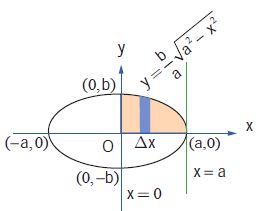
21.
Given equation of the parabola is (y-1) = (x-2)2
\(\Rightarrow\) y = (x - 2)2 + 1
It vertex is (2, 1) which is the minimum point P. Let Q(x, y) be a point on the parabola given slope of PQ = 2
\(\Rightarrow \frac { y-1 }{ x-2 } =2\ \left[ \because slope=\frac { { y }_{ 2 }-{ y }_{ 1 } }{ { x }_{ 2 }-{ x }_{ 1 } } \right] \)
\(\Rightarrow\) y-1 = 2(x-2) \(\Rightarrow\) y-1 = 2x-4 \(\Rightarrow\) y = 2x-4+1
\(\Rightarrow\) y = 2x + 3
From (1) and (2), (x-2)2+1 = 2x-3
\(\Rightarrow\) x2-4x + 4 + 1 = 2x - 3 \(\Rightarrow\) x2- 6x + 8 = 0
\(\Rightarrow\) (x-4) (x-2) = 0 \(\Rightarrow\) x = 2, 4
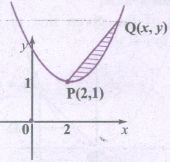
\(\therefore\) Required area \(=\int _{ 2 }^{ 4 }{ ({ y }_{ 1 }-{ y }_{ 2 }) } dx\)
\(=\int _{ 2 }^{ 4 }{ (2x-3)-{ (x-2) }^{ 2 }-1dx } \)
\(=\int _{ 2 }^{ 4 }{ (2x-3-{ x }^{ 2 }+4x-4-1)dx } \)
\(=\int _{ 2 }^{ 4 }{ (-{ x }^{ 2 }+6x-8)dx } \)
\({ \left[ \frac { -{ x }^{ 3 } }{ 3 } +3{ x }^{ 2 }-8x \right] }_{ 2 }^{ 4 }=\left( \frac { -64 }{ 3 } +48-32 \right) -\left( \frac { -8 }{ 3 } +12-16 \right) \)
\(=\left( \frac { -64 }{ 3 } +16 \right) -\left( -\frac { 8 }{ 3 } -4 \right) \)
\(=\left( \frac { -64+48 }{ 3 } \right) -\left( \frac { -8-12 }{ 3 } \right) \)
\(=\frac { 16 }{ 3 } \) sq.units
22.
Note that the function u is not homogeneous. So we cannot apply Euler’s Theorem for u.
However, note that f(x,y) = \(\frac { x+y }{ \sqrt { x } +\sqrt { y } }\) = sin u is homogeneous; because
f(tx,ty) = \(\frac { tx+ty }{ \sqrt { tx } +\sqrt { ty } } \) = t1/2 f(x, y), \(\forall \) x, y, t\(\ge \)0
Thus f is homogeneous with degree \(\frac { 1 }{ 2 } \) and so by Euler’s Theorem we have
\(x\frac { \partial f }{ \partial x } +y\frac { \partial f }{ \partial y } =\frac { 1 }{ 2 } f(x,y)\).
Now substituting f = sin u in the above equation, we obtain
\(x\frac { \partial (sinu) }{ \partial x } +y\frac { \partial (sinu) }{ \partial y } =\frac { 1 }{ 2 } sin \ u\)
\(x\quad cosu\frac { \partial u }{ \partial x } +y\quad cosu\frac { \partial u }{ \partial x } =\frac { 1 }{ 2 } sin \ u\) ...(19)
Dividing both sides by cosu we obtain
\(x\frac { \partial u }{ \partial x } +y\frac { \partial u }{ \partial y } =\frac { 1 }{ 2 } tan \ u\)
Note:
Solving this problem by direct calculation will be possible; but will involve lengthy calculations.
23.
Given \(a*b=\frac { a+b }{ 2 } \), where a.b ∈Q Let a,b ∈Q
An element e has to found out such that
a*e = e*a = a
Let a = 5, Then 5*e = 5
\(\Rightarrow \frac { 5+e }{ 2 } =\)5 ⇒ 5 + e = 10
Let a = \(\frac{2}{3}\). Then \(\frac{2}{3}\)*e = \(\frac{2}{3}\)
\(\Rightarrow \frac { \frac { 2 }{ 3 } +e }{ 2 } =\frac { 2 }{ 3 } \)
\(\Rightarrow \frac { 2 }{ 3 } +e=\frac { 4 }{ 3 } \)
\(\Rightarrow e=\frac { 4 }{ 3 } -\frac { 2 }{ 3 } =\frac { 2 }{ 3 } \)
It is seen that for the binary operation * defined on Q, identity element e is not unique. Hence identity element not defined for the binary operation * on Q.
The identity does not exist. Hence inverse also does not exist for the operation * on Q.
24.
~(p V q) V (~p ∧ q) and ~p
| p | q | p V q | ~(p ∧ q) | ~p | ~p ∧ q | ~(p V q) V (~p ∧ q) |
| T | T | T | F | F | F | F |
| T | F | T | F | F | F | F |
| F | T | T | F | T | T | T |
| F | F | F | T | T | F | T |
The entries in column (5) and column (7) are identical.
∴ ~(p V q) V (~p ∧ q) and ~p are logically equivalent.
25.
P(x) = \(x^{4}-6x^{3}-11x^{2}+24x+28\), \(\alpha\) = 2, \(\beta\) = 7
and observing \(\frac{P'(x)}{2}=2x^{3}-9x^{2}-11x+12=Qx\), (say).
This implies that there is a zero of the polynomial Q(x) in the interval (2, 7)
For verification,
Q(2) = 16 - 36 - 22 +12 = 28 - 58 = -30 < 0
Q(7) = 686 - 441 - 77 +12 = 698 - 518 = 180 > 0
From this we may see that there is a zero of the polynomial Q(x) in the interval (2, 7)
26.
By the mean value theorem we have, there exists 'c'∈(2, 7) such that,
\(\frac { f(7)-f(2) }{ 7-2 } \) = f'(c) ≤ 29
Hence, f(7) ≤ 5× 29 +17 = 162
Therefore, the maximum value of f (7) is 162.
27.
We have,
\(f'(x)=2x>0, \forall x\in(2,7)\) and
\(f'(x)=2x>0, \forall x\in(-2,0)\)
and hence the proof is completed.
28.
Given absolute error = 2%
⇒ \(\frac { dl }{ l } =2 \% =\frac { 2 }{ 100 } =0.02\)
Given T = 2ㅠ\(\sqrt { \frac { 1 }{ g } } \)
Taking logarithm on both sides,
log T = log 2ㅠ + \(\frac12\) log l - \(\frac12\) log g
Taking differential on both sides we get,
\(\frac{1}{T}dT=0+\frac{1}{2}.\frac{1}{l}.dl\)
\(\frac { \Delta T }{ T } =\frac { 1 }{ 2 } (.02)\)
\(\frac { \Delta T }{ T } =0\)
ஃ Percentage error = \(\frac { \Delta T }{ T } \times100=.01\times100=1 \%\)
29.
log10e = 0.4343 to find log10g 1003
f(1000) = log101000 = log10103 = 3log10103 = 3 log1010
= 3(1) = 3
f'(x) = \(\frac1x\). log10e
f'(1000) = \(\frac{1}{1000}\)(0.4343)
∴ L(x) = f(x0) f'(x0) (x - x0)
= 3 + \(\frac{1}{1000}\) (0.4343) (3)
= 3 + \(\frac{1.3029}{1000}\)
= 3 + 0.0013029
log101003 = 3.0013029
30.
Given P (hitting the target) = \(\frac { 1 }{ 4 } \Rightarrow P=\frac { 1 }{ 4 } \)
n = 10,
(i) P(X = 4)
\(P(X+4)=\left( \begin{matrix} n \\ x \end{matrix} \right) { p }^{ x }(1-p)^{ n-x },x\)
= 0,1,2,...n
(i) Probability of hitting the target exactly 4 times
P(X = 4) = \(^{10}{ C }_{ 4 } \times\left( \begin{matrix} 1 \\ 4 \end{matrix} \right) ^{ 4 }\times \left( \cfrac { 3 }{ 4 } \right) ^{ 6 }\)
\( =\frac{10 \times 9 \times 8 \times 7}{4 \times 3 \times 2} \times \frac{1}{4^{4}} \times \frac{3^{6}}{4^{6}} \\ =210 \times \frac{3^{6}}{4^{10}} \)
(ii) Probability of hitting atleast one time
= P(X≥1) = 1-P(x<1)
= 1-P(X = 0)
\( =1-{ }^{10} \mathrm{C}_{0} \times\left(\frac{1}{4}\right)^{0} \times\left(\frac{3}{4}\right)^{10} \\ =1-\frac{3^{10}}{4^{10}} \)
31.
\(S=\left\{\begin{array}{l} (1,1),(1,2),(1,3),(1,4),(1,5),(1,6) \\ (2,1),(2,2),(2,3),(2,4),(2,5),(2,6) \\ (3,1),(3,2),(3,3),(3,4),(3,5),(3,6) \\ (4,1),(4,2),(4,3),(4,4),(4,5),(4,6) \\ (5,1),(5,2),(5,3),(5,4),(5,5),(5,6) \\ (6,1),(6,2),(6,3),(6,4),(6,5),(6,6) \end{array}\right\}\)
(i) The sample space
S = {1, 2, 3, 4, 5, 6}\(\times\){1, 2, 3, 4, 5, 6}
consists of 36 ordered pairs (α, β) where α and β can take any integer value between 1 and 6 as shown. X is assigned to each point (α, β) the sum of the numbers on the dice .
That is X (α, β) = α + β
Therefore
X (1,1) = 1+1 = 2
X (1, 2) = X (2,1) = 3
X (1,3) = X (2,2) = X (3,1)= 4
X (1, 4) = X (2,3) = X (3, 2) X (4,1) = 5
X (1,5) = X (2,4) = X (3,3) = X (4, 2) = X (5,1) = 6
X (1,6) = X (2,5) = X (3, 4) = X (4,3 = X (5, 2) X (6,1) = 7
X (2,6) = X (3,5) = X (4,4) = X (5,3) = X (6,2) = 8
X (3,6) = X (4,5) = X (5,4) X (6,3) = 9
X (4,6) = X (5,5) X (6,4) = 10
X (5,6) = (6,5) = 11
X (6,6) = 12
(ii) Then the random variable X takes on the values 2, 3, 4, 5, 6, 7, 8, 9, 10, 11, 12.
(iii) The inverse images of 10 is {(4, 6), (5, 5), (6, 4)}.
(iv) The number of inverse images are given below
| Values of the random variable | 2 | 3 | 4 | 5 | 6 | 7 | 8 | 9 | 10 | 11 | 12 | Total |
| Number of elements in inverse image | 1 | 2 | 3 | 4 | 5 | 6 | 5 | 4 | 3 | 2 | 1 | 36 |
32.
(i) Differentiating F(x) with respect to x at continuity points of f(x), we get
\(f(x)={ F }^{ 1 }(x)=\begin{cases} \begin{matrix} 0 & x<0 \end{matrix} \\ \begin{matrix} 1 & 0\le x<1 \end{matrix} \\ \begin{matrix} 0 & x\ge 1 \end{matrix} \end{cases}\)
The pdf f(x) is not continuous at x = 0, or at x = 1. We can define f(0) and f(1) in any manner. Choosing f(0) = 1, and f(1) = 0 .
Therefore the probability density function f(x) is
\(f(x)=\begin{cases} \begin{matrix} 1 & 0\le x<1 \end{matrix} \\ \begin{matrix} 0 & otherwise \end{matrix} \end{cases}\)
(ii) P(0.2 ≤ X ≤ 0.7) = F(0.7) − F(0.2)
= 0.7-0.2 = 0.5
\(P(0.2\le X\le 0.7)=\int _{ 0.2 }^{ 0.7 }{ f(x) } dx=\int _{ 0.2 }^{ 0.7 }{ 1dx } =0.5\)
33.
By revolving the upper semicircular region enclosed between the circle x2 + y2 = a2 and the x-axis, we get a sphere of radius a.
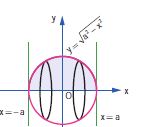
The boundaries of the region are y = \(\\ \\ \\ \\ \\ \\ \\ \sqrt { { a }^{ 2 }-{ x }^{ 2 } } \) x-axis, the lines x = −a and x = a. Hence, the volume of the sphere is given by
\(v=\pi \int _{ -a }^{ a }{ { y }^{ 2 }dx=\pi } \int _{ -a }^{ a }{ \left( { a }^{ 2 }-{ x }^{ 2 } \right) } dx\)
\(=2\pi \int _{ 0 }^{ a }{ ({ a }^{ 2 }-{ x }^{ 2 })dx } \) since the integrand (a2-x2) is an even function
\(=2\pi { \left( { a }^{ 2 }x-\frac { { x }^{ 3 } }{ 3 } \right) }_{ 0 }^{ a }=2\pi \left( { a }^{ 3 }-\frac { { a }^{ 3 } }{ 3 } \right) =\frac { 4 }{ 3 } { \pi a }^{ 3 }\)
34.
\(\sqrt { 2 } -1\)
35.
(b)
\(\frac{4}{25} \text { radians } / \mathrm{sec}\)
36.
(a)
0
37.
(c)
\(\left[ \frac { \pi }{ 4 } ,\frac { \pi }{ 2 } \right] \)
38.
(d)
9
39.
(b)
\(x=\frac { \pi }{ 2 } \)
40.
(c)
\(\frac { 1 }{ { e }^{ 2 } } \)
41.
(a)
100
42.
(b)
mean exists but variance does not exist
43.
(d)
16 and 24
44.
(b)
1.1
45.
(a)
46.
(d)
0.96
47.
(b)
0.4%
48.
(b)
\(\frac15\)
49.
(d)
1
50.
(b)
(1 +xy)exy
51.
(b)
Multiplication
52.
(b)
Z
53.
(b)
y = \(\frac{-2}{3}\)
54.
(c)

12th Standard Syllabus & Materials
12th Standard
TN 12th Standard Physics Electronics and Communication Creative Questions Study Material - QB365 Set B
NEW12th Standard
TN 12th Standard Physics Electronics and Communication Creative Questions Study Material - QB365 Set A
NEW12th Standard
TN 12th Standard Physics Wave Optics Creative Questions Study Material - QB365 Set D
NEW12th Standard
TN 12th Standard Physics Wave Optics Creative Questions Study Material - QB365 Set C



Tamilnadu Stateboard 12th Standard Subjects
Maths

Chemistry

Physics

Biology

Computer Science

Business Maths and Statistics

Economics

Commerce

Accountancy

History

Computer Applications
Biology
Computer Technology
Computer Applications
Computer Science
Business Maths and Statistics
Commerce
Economics
Maths
Chemistry
Physics
Computer Technology
History
Accountancy

Tamil

English

French
Tamilnadu Stateboard Standards


