
12th Standard Syllabus & Materials
12th Standard
TN 12th Standard Biology Zoology - Reproduction in Organisms Creative Questions Study Material - QB365 Set D
NEW12th Standard
TN 12th Standard Biology Zoology - Reproduction in Organisms Creative Questions Study Material - QB365 Set C
NEW12th Standard
TN 12th Standard Biology Zoology - Reproduction in Organisms Creative Questions Study Material - QB365 Set B
NEW12th Standard
TN 12th Standard Biology Zoology - Reproduction in Organisms Creative Questions Study Material - QB365 Set A
NEW12th Standard
TN 12th Standard Physics Electronics and Communication Creative Questions Study Material - QB365 Set D
NEW12th Standard
TN 12th Standard Physics Electronics and Communication Creative Questions Study Material - QB365 Set C

Published on: 13/05/2022
12th Standard Chemistry English Medium Metallurgy Important Questions
latest Sample Question PapersDownload Tamil Nadu 12th Standard Chemistry question papers, model tests, one-mark questions, important questions, and public exam papers in PDF format. Free study materials and answer keys for TN State Board students.
Questions + Answers key
Take MCQ Chemistry Test
1.
The tertiary nitro compound is ___________
2-nitropropane
1-nitropropane
1-nitro-2, 2-dimethyl propane
2-nitro-2-methyl propane
2.
The quality of a soap is described in term of _______
LDPE
HDPE
TFM (Total fatty matter)
LFM (Lowfatty matter)
3.
The free radical polymerisation of the monomer 2 - chloro buta - l,3-diene gives _______________.
Buna N
Buna S
Neoprene
PHB
4.
Electrolytic reduction of nitrobenzene in strongly acidic medium gives
aniline
p - aminophenol
m-nitroaniline
azoxybenzene
5.
Disaccharides linked through the glycosidic carbon atoms of C1 of glucose and C2 of fructose are_______
non-reducing
reducing
both (a) and (b)
neither (a) nor (b)
6.
Which is not a saturated fatty acid?
Palmitic acid
Stearic acid
Oleic acid
Glyceric acid
7.
acid chloride + alcohol \(\longrightarrow\)?.
acids
amides
esters
amines
8.
The metals near the bottom of the electro chemical series are ______.
strong reducing agents
strong oxidising agents
weak reducing agents
weak oxidising agents
9.
The number of carbon atoms in a chain can be increased with _______ reaction.
Grignard
Cannizaro reaction
HVZ
Clemmensen
10.
What happens during the electrolysis of molten sodium chloride?
Cl2 is released at the cathode
Liquid sodium is obtained at the anode
The emf of the overall reaction is -4.07 V
Cl2 is released at the cathode and Liquid sodium is obtained at the anode
11.
Henderson equation for a weak acid and its salt is _______.
pH = pKb+ log (Salt) / (Acid)
pH = pKa + log (Salt) / (Acid)
pH = pKa + log (Salt) / (Base)
pH = pKa + log (Acid) / (Salt)
12.
The characteristic odour of lower phenol is _________.
carbolic acid
fruity
oil of bitter almond
rotten fish
13.
Which among the following has the highest pH?
1M NH4 OH
1M HCI
1M NaOH
0.1 M NaOH
14.
Ethers in the presence of atmospheric oxygen oxidises to give hydroperoxides and dialkyl peroxides Such a spontaneous reaction by atmospheric oxygen is called ______.
auto oxidation
acylation
alkylation
dehydration
15.
An emulsion is a colloidal solution of _______.
two solids
two liquids
two gases
one solid and one liquid
16.
Which among the following does not affect adsorption?
surface area of the adsorbent
catalyst
temperature
pressure
17.
Antiseptics and disinfectants either kill or prevent growth of microorganisms. Identify which of the following statement is not true.
dilute solutions of boric acid and hydrogen peroxide are strong antiseptics.
Disinfectants harm the living tissues
A 0.2% solution of phenol is an antiseptic while 1% solution acts as a disinfectant
Chlorine and iodine are used as strong disinfectants
18.
Dettol is the mixture of _____________.
Chloroxylenol and bithionol
Chloroxylenol and \(\alpha\)-terpineol
phenol and iodine
terpineol and bithionol
19.
Which of the following amino acids are achiral?
Alanine
Leucine
Proline
Glycine
20.
Which of the following vitamins is water soluble?
Vitamin E
Vitamin K
Vitamin A
Vitamin B
21.
The order of basic strength for methyl substituted amines in aqueous solution is _________.
N(CH3)3> N(CH3)2H> N(CH3)H2> NH3
N(CH3)H2>N(CH3)2H > N(CH3)3>NH3
NH3> N(CH3)H2> N(CH3)2 H>N(CH3)3
N(CH3)2H>N(CH3)H2> N(CH3)3> NH3
22.
Which one of the following nitro compounds does not react with nitrous acid.
CH3 -CH2 -CH2 -NO2
(CH3)2 CH - CH2NO2
(CH3)3 C NO2
\({ CH }_{ 3 }-\underset { \overset { || }{ O } }{ C } -\underset { \overset { || }{ { CH }_{ 3 } } }{ CH } -{ NO }_{ 2 }\)
23.
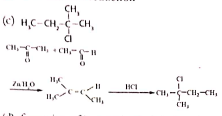
An alkene “A” on reaction with O3 and Zn - H2O gives propanone and ethanol in equimolar ratio. Addition of HCl to alkene “A” gives “B” as the major product. The structure of product “B” is ______.
\(Cl-{ CH }_{ 2 }-CH_{ 2 }-\overset { \overset { CH_{ 3 } }{ | } }{ \underset { \underset { CH_{ 3 } }{ | } }{ CH } } \)
\({ H }_{ 3 }C-{ CH }_{ 2 }-\overset { \overset { CH_{ 2 }Cl }{ | } }{ CH } -{ CH }_{ 3 }\)
\(\\ { H }_{ 3 }C-{ CH }_{ 2 }-\overset { \overset { CH_{ 3 } }{ | } }{ \underset { \underset { CL{ } }{ | } }{ C } } -{ CH }_{ 3 }\)
\({ H }_{ 3 }C-{ CH }-\overset { \overset { CH_{ 3 } }{ | } }{ \underset { \underset { Cl }{ | } }{ C } } \)
24.
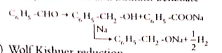
Phenyl methanal is reacted with concentrated NaOH to give two products X and Y. X reacts with metallic sodium to liberate hydrogen X and Y are ________.
sodium benzoate and phenol
Sodium benzoate and phenyl methanol
phenyl methanol and sodium benzoate
none of these
25.
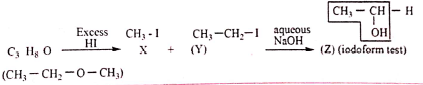
One mole of an organic compound (A) with the formula C3H8O reacts completely with two moles of HI to form X and Y. When Y is boiled with aqueous alkali it forms Z. Z answers the iodoform test. The compound (A) is ______.
propan – 2-ol
propan -1-ol
ethoxy ethane
methoxy ehane
26.
Which of the following compound can be used as antifreeze in automobile rediators?
methanol
ethanol
Neopentyl alcohol
ethan -1, 2-diol
27.
Which one of the following is correctly matched?
Emulsion - Smoke
Gel - butter
foam - Mist
whipped cream - sol
28.
Which one of the following characteristics are associated with adsorption?
\(\Delta\)G and \(\Delta\)H are negative but \(\Delta\)S is positive
\(\Delta\)G and \(\Delta\)S are negative but \(\Delta\)H is positive
\(\Delta\)G is negative but \(\Delta\)H and \(\Delta\)S are positive
\(\Delta\)G, \(\Delta\)H and \(\Delta\)S all are negative.
29.
While charging lead storage battery _______.
PbSO4 on cathode is reduced to Pb
PbSO4 on anode is oxidised to PbO2
PbSO4 on anode is reduced to Pb
PbSO4 on cathode is oxidised to Pb
30.
How many faradays of electricity are required for the following reaction to occur MnO4-→ Mn2+
5F
3F
1F
7F
31.
Dissociation constant of NH4OH is 1.8 x 10⁻⁵ the hydrolysis constant of NH4Cl would be _______.
1.8 × 10⁻¹⁹
5.55 × 10⁻¹⁰
5.55 × 10⁻⁵
1.80 × 10⁻⁵
32.
What is the decreasing order of strength of bases
OH, NH2- H - C ≡ C and CH3 - CH2-
OH->NH2- >H-C≡C >CH3-CH2-
NH2->OH->CH3-CH2- >H-C≡C
CH3-CH2->NH2->H-C≡C->OH-
OH->H-C ≡ C->CH3-CH2- >NH2-
33.
The half-life period of a first order reaction is 69.3 seconds. Its rate constant is ________.
10-2 s-1
10-4 s-1
10 s-1
102 s-1
34.
For a reaction: aA ⟶ bB, the rate of reaction is doubled when the concentration of A is increased by four times. The rate of reaction is equal to _____.
k[A]a
\(k{ \left[ A \right] }^{ \frac { 1 }{ 2 } }\)
\(k{ \left[ A \right] }^{ \frac { 1 }{ a } }\)
K[A]
35.
The high reactivity of fluorine is due to________.
high ionisation energy
low bond dissociation energy
low electron affinity
high electro negativity
36.
Which reaction is not feasible.
\({ 2H }_{ 2 }O+{ 2F }_{ 2 }\longrightarrow 4HF+{ O }_{ 2 }\)
\(2 \mathrm{KBr}+\mathrm{I}_{2} \longrightarrow 2 \mathrm{KI}+\mathrm{Br}_{2}\)
\(2KBr+{ Cl }_{ 2 }\longrightarrow 2KCl+{ Br }_{ 2 }\)
\(2 \mathrm{KI}+\mathrm{Br}_{2} \longrightarrow 2 \mathrm{KBr}+\mathrm{I}_{2}\)
37.
ABAB type of packing is called _________.
hexagonal close packing
cubic close packing
tetragonal close packing
none of the above
38.
In a face centred cubic cell, an atom at the face contributes to the unit cell_______.
\(\frac{1}{4}\)Part
1Part
\(\frac{1}{2}\)Part
\(\frac{1}{8}\)Part
39.
Chemical formula of phosgene is_______.
COCl2
CaOCl2
CaCO3
COCI
40.
Lewis acid character of boron trihalides is as a follows _______.
BF3 > BCl3 > BBr3 > BI3
BCI3 > BF3 > BBr3 > BI3
BI3 > BBr3 > BCl3 > BF3
BI3 > BF3 > BCl3 > BBr3
41.
_________ is known as Bayer's reagent.
Hot dilute alkaline KMnO4
Cold dilute alkaline KMnO4
Hot Conc. acidic KMnO4
Cold Conc. acidic KMnO4
42.
Identify the paramagnetic species.
Cu+
Cr+
MnO4
Zn2+
43.
Steel is an alloy of___________
iron and carbon
iron and calcium
copper and carbon
copper and iron
44.
Concentration of copper glance is done by________.
leaching
magnetic separation
froth flotation
hydraulic washing
45.
In an octahedral complex, the (n-1) d orbital are involved in hybridization. The complex is called ________ complex.
inner orbital
low spin
spin paired
all the above
46.
The hypothetical complex triamminediaqua chloridocobalt (III)chloride can be represented as _______.
[Co(NH3)3(H2O)2Cl]Cl2
[Co(NH)3(H2O)Cl3]
[Co(NH2)3(H2O)2Cl]
[Co(NH3)3(H2O)3]Cl3
47.
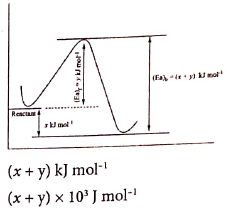
In a reversible reaction, the enthalpy change and the activation energy in the forward direction are respectively −x kJ mol-1 and y kJ mol-1. Therefore, the energy of activation in the backward direction is _______.
(y-x) kJ mol-1
(x+y) J mol-1
(x-y) KJ mol-1
(x+y) x 103J mol-1
48.
For a reaction Rate = k[acetone]3/2 then unit of rate constant and rate of reaction respectively is _______.
(mol L-1 S-1),(mol1/2 L1/2 S-1)
(mol-1/2 L1/2 s-1),(mol L-1 s-1)
(mol1/2 L1/2 s-1),(mol L-1 s-1)
(mol L s-1),(mol1/2 L1/2 s)
49.
The ionic radii of A+ and B− are 0.98 x 10⁻¹⁰ m and 1.81 x 10⁻¹⁰ m. the coordination number of each ion in AB is ________.
8
2
6
4
50.
In a solid atom M occupies ccp lattice and \(\left( \frac { 1 }{ 3 } \right) \) of tetrahedral voids are occupied by atom N. Find the formula of solid formed by M and N ________.
MN
M3N
MN3
M3N2
51.
Formula of tris(ethane-1, 2-diamine)iron(II)phosphate _______.
[Fe(CH3-CH(NH2)2)3](PO4)3
[Fe(H2N-CH2-CH2-NH2)3](PO4)
[Fe(H2N-CH2-CH2-NH2)3](PO4)2
[Fe(H2N-CH2-CH2-NH2)3]3(PO4)2
52.
Which one of the following will give a pair of enantiomorphs?
[Cr(NH3)6][Co(CN)6]
[Co(en)2Cl2]Cl
[Pt(NH3)4][PtCl4]
[Co(NH3)4Cl2]NO2
53.
The catalytic behaviour of transition metals and their compounds is ascribed mainly due to _______.
their magnetic behaviour
their unfilled d orbitals
their ability to adopt variable oxidation states
their chemical reactivity
54.
Sc (Z = 21) is a transition element but Zinc (z = 30) is not because _______.
both Sc3+ and Zn2+ ions are colourless and form white compounds
In case of Sc, 3d orbital are partially filled but in Zn these are completely filled
last electron as assumed to be added to 4s level in case of zinc
both Sc and Zn do not exhibit variable oxidation states
55.
Which of the following is not sp2 hybridised?
Graphite
graphene
Fullerene
dry ice
56.
Which of these is not a monomer for a high molecular mass silicone polymer?
Me3SiCl
PhSiCl3
MeSiCl3
Me2SiCl2
57.
Which of the following is strongest acid among all?
HI
HF
HBr
HCl
58.
Which of the following is not true with respect to Ellingham diagram?
Free energy changes follow a straight line. Deviation occurs when there is a phase change.
The graph for the formation of CO2 is a straight line almost parallel to free energy axis.
Negative slope of CO shows that it becomes more stable with increase in temperature.
Positive slope of metal oxides shows that their stabilities decrease with increase in temperature.
59.
Which of the metal is extracted by Hall-Heroult process?
Al
Ni
Cu
Zn
60.
1.
(d)
2-nitro-2-methyl propane
2.
(c)
TFM (Total fatty matter)
3.
(c)
Neoprene
4.
(b)
p - aminophenol
5.
(a)
non-reducing
6.
(d)
Glyceric acid
7.
(c)
esters
8.
(a)
strong reducing agents
9.
(a)
Grignard
10.
(c)
The emf of the overall reaction is -4.07 V
11.
(b)
pH = pKa + log (Salt) / (Acid)
12.
(a)
carbolic acid
13.
(c)
1M NaOH
14.
(a)
auto oxidation
15.
(b)
two liquids
16.
(b)
catalyst
17.
(a)
dilute solutions of boric acid and hydrogen peroxide are strong antiseptics.
18.
(b)
Chloroxylenol and \(\alpha\)-terpineol
19.
(d)
Glycine
20.
(d)
Vitamin B
21.
(d)
N(CH3)2H>N(CH3)H2> N(CH3)3> NH3
22.
(c)
(CH3)3 C NO2
23.
24.
25.
26.
(d)
ethan -1, 2-diol
27.
(b)
Gel - butter
28.
Adsorption leads to decrease in randomnes (entropy).i.e, ΔS < 0 for the adsorption to occur, ΔG slhould be -ve. We know that ΔG = ΔH - TΔS if ΔS is -ve, TΔS is +ve.It means that ΔG will become negative only when ΔH is -ve and ΔH > TΔS.
29.
Charging anode:
PbSO4(s) + 2e- ➝ Pb(s) + SO42-(aq)
Cathode:
PbSO4(s) + 2H2O(I) ➝ PbO2(s) + SO42-(aq) + 2e-
30.
7MnO4- + 5e- → Mn2+ + 4H2O
5 moles of electrons i.e., 5F charge is required.
31.
\(K_h= { \frac { { K }_{ w } }{ K_b } } = \frac{1 \times 10^{-14}}{1.8 \times 10^{-5}}\)
= 0.55 x 10-9 = 5.5 x 10⁻¹⁰
32.
(c)
CH3-CH2->NH2->H-C≡C->OH-
33.
(a)
10-2 s-1
34.
(b)
\(k{ \left[ A \right] }^{ \frac { 1 }{ 2 } }\)
35.
(b)
low bond dissociation energy
36.
(b)
\(2 \mathrm{KBr}+\mathrm{I}_{2} \longrightarrow 2 \mathrm{KI}+\mathrm{Br}_{2}\)
37.
(a)
hexagonal close packing
38.
(c)
\(\frac{1}{2}\)Part
39.
(a)
COCl2
40.
(c)
BI3 > BBr3 > BCl3 > BF3
41.
(b)
Cold dilute alkaline KMnO4
42.
(b)
Cr+
43.
(a)
iron and carbon
44.
(c)
froth flotation
45.
(d)
all the above
46.
(a)
[Co(NH3)3(H2O)2Cl]Cl2
47.
48.
Rate = k[A]n
Rate = \(\frac{-\mathrm{d}[\mathrm{A}]}{\mathrm{dt}}\)
unit of rate = \(\frac{mol L^{-1}}{s}\)=mol L-1/s-1
unit of rate constant
\(=\frac{ (mol{ L }^{ -1 }{ S }^{ -1 }) }{ ({ mol }{ L }^{ -1 })^n } \)
= mol1-nLn-1s-1
in the case
rate = k [Acetone]3/2
n = 3/2
= mol1-(3/2)L(3/2)-1s-1
(mol-(1/2) L(1/2) s-1).
49.
\(\left( \frac { r_{c^+} }{ r_{A^-} } \right) \) = \(\left( \frac { 0.98 \times 10^{-10 }}{ 1.81 \times 10^{-10} } \right) = 0.54\)
It is in the range of 0.414 to 0.732, hence the coordination number of each ion is 6.
50.
If the total number of M atoms is n, then the number of tetrahedral voids = 2n
Given that \(\left( \frac { 1 }{ 3 } \right) ^{rd}\) of tetrahedral voids are occupied.
i.,e \(\left( \frac { 1 }{ 3 } \right) \times 2n\) are occupied by N atoms
\(\therefore\)M : N = n : \(\left( \frac { 2 }{ 3 } \right) n\)
= 1 : \(\frac { 2 }{ 3 }\)
Hence M3N2 = 3 : 2
51.
[Fe(H2N-CH2-CH2-NH2)3]3(PO4)2
[Fe(en)3]2+(\(PO_{4}^{3-}\))
52.
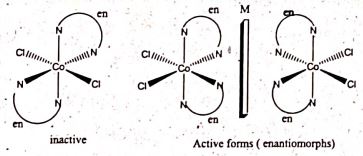
Complexes given in other options (a), (c) and (d) have symmetry elements and hence they are optically inactive.
53.
(c)
their ability to adopt variable oxidation states
54.
(b)
In case of Sc, 3d orbital are partially filled but in Zn these are completely filled
55.
(d)
dry ice
56.
(a)
Me3SiCl
57.
(a)
HI
58.
(b)
The graph for the formation of CO2 is a straight line almost parallel to free energy axis.
59.
(a)
Al
60.
(d)

12th Standard Syllabus & Materials
12th Standard
TN 12th Standard Physics Electronics and Communication Creative Questions Study Material - QB365 Set B
NEW12th Standard
TN 12th Standard Physics Electronics and Communication Creative Questions Study Material - QB365 Set A
NEW12th Standard
TN 12th Standard Physics Wave Optics Creative Questions Study Material - QB365 Set D
NEW12th Standard
TN 12th Standard Physics Wave Optics Creative Questions Study Material - QB365 Set C



Tamilnadu Stateboard 12th Standard Subjects

Maths
Chemistry

Physics

Biology

Computer Science

Business Maths and Statistics

Economics

Commerce

Accountancy

History

Computer Applications
Biology
Computer Technology
Computer Applications
Computer Science
Business Maths and Statistics
Commerce
Economics
Maths
Chemistry
Physics
Computer Technology
History
Accountancy

Tamil

English

French
Tamilnadu Stateboard Standards


