9th Standard CBSE Syllabus & Materials
9th Standard CBSE
CBSE 9th Standard Mathematics Statistics Sample Question Papers Study Material - QB365 Set D
NEW9th Standard CBSE
CBSE 9th Standard Mathematics Statistics Sample Question Papers Study Material - QB365 Set C
NEW9th Standard CBSE
CBSE 9th Standard Mathematics Statistics Sample Question Papers Study Material - QB365 Set B
NEW9th Standard CBSE
CBSE 9th Standard Mathematics Statistics Sample Question Papers Study Material - QB365 Set A
NEW9th Standard CBSE
CBSE 9th Standard Mathematics Surface Areas and Volumes Sample Question Papers Study Material - QB365 Set D
NEW9th Standard CBSE
CBSE 9th Standard Mathematics Surface Areas and Volumes Sample Question Papers Study Material - QB365 Set C

Published on: 29/10/2025
Download CBSE Class 9th Standard CBSE Mathematics question papers, sample papers, important questions, and previous year solved papers in PDF format. Get free study materials, NCERT solutions, and exam preparation resources for Class 9th Standard CBSE Mathematics
Questions + Answers key
Take MCQ Mathematics Test
1.
(i) The centre of a circle lies in __________ of the circle. (exterior/interior).
(ii) A point, whose distance from the centre of a circle is greater than its radius lies in___________ of the circle. (exterior/interior).
(iii) The longest chord of circle is a ________ of the circle.
(iv) An arc is a _____________ when its ends are the ends of a diameter.
(v) Segment of a circle is the region between an arc and __________ of the circle.
(vi) A circle divides the plane, on which it lies, ___________ parts.
2.
Find the length of a chord which is at a distance of 3 cm from the centre of a circle whose radius is 5 cm.
3.
Find the length of a chord of a circle which is at a distance of 4 cm from the centre of the circle with radius 5 cm.
4.
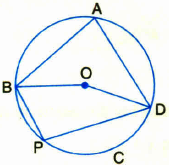
ABCD Is a cyclic quadrilateral. O is the centre of the circle. If \(\angle BOD=160°\), find \(\angle BPD\) .
5.
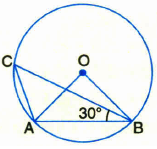
In the figure, \(\angle AOB= 90°\) and, \(\angle ABC= 30°\) then find the measure of \(\angle CAO\).
6.
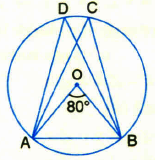
In figure, O is the centre of the circle. If \(\angle AOB= 80°\). then find the measures of \(\angle ABD\) and \(\angle ACB\) .
7.
The path traced by the tip of the second's hand is a
circle
square
rectangle
straight line
8.
The shape of the coin of RS 1 is
triangle
rhombus
circle
trapezium
9.
The wheels of a vehicle are in
rectangular
triangular
circular shape
trapezoidal
10.
The longest chord of a circle is called
radius
diameter
segment
sector.
11.
The centre of a circle lies
outside the circle
inside the circle
on the circle
none of these
12.
Equal chords of a circle subtend equal angles at
the centre
any interior point
any exterior point
any point of a diameter
13.
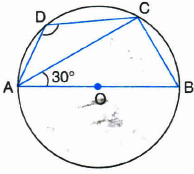
In the following figure, 0 is the centre of the circle. \(\angle BAC=30°\). Then, the measure of \(\angle ADC\) is
60°
45°
90°
120°
14.
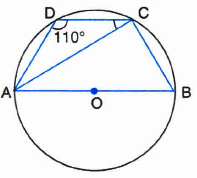
In the given figure, O is the centre of the circle. ABCD is a trapezium in which AB || DC and \(\angle ADC=110°\) The measure of \(\angle ADC\) is equal to:
35°
70°
20°
55°
15.
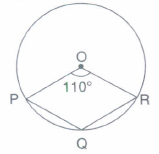
In the given figure, if ㄥPOR is 110, then find the value of ㄥPQR.
16.
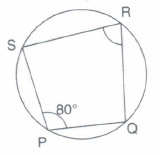
In the figure, quadrilateral PQRS is cyclic. If ㄥP=80°, then R is equal to __________
17.
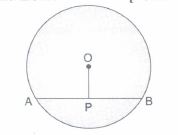
Figure,O is centre of the circle and PA=PB Find ㄥOPA
18.
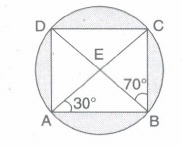
ABCD is a cyclic quadrilateral whose diagonals intersect at E. If \(\angle\)DBC = 70°, \(\angle\)BAC = 30°, find \(\angle\)BCD. Further, if AB = BC, find \(\angle\)ECD.
19.
PQRS is a trapezium with PQ || SR and PS = QR. Prove that the trapezium is cyclic.
20.
D and E are points on equal sides AB and AC of isosceles \(\triangle\)ABC such that AD = AE. Prove that the points B, C, E and D are concyclic.
21.
Prove that the quadrilateral formed by internal angle bisectors of any quadrilateral is cylic.
1.
(i) The centre of circle lies in interior of the circle.
(ii) A point distance from the centre of a circle is greater than its radius lies in exterior of the circle.
(iii) The longest chord of a circle is a diameter of the circle.
(iv) An arc is a semicircle when its ends are the ends of a diameter.
(v) Segment of a circle is the region between an arc and the chord of the circle.
(vi) A circle divides the plane, on which it lies, in three parts.
2.
8 cm
3.
6 cm
4.
100°
5.
\(\angle\)ACB=1/2 * \(\angle\)AOB
=1/2*90o
=45o
In \(\Delta\)ACB, \(\angle\)CAB=180o-(30o+45o)
=105o
\(\angle\)OAB=\(\angle\)OBA
=45o
(Angles opp. to equal sides of triangle are equal as OA = OB radius of same circle)
\(\angle\)CAO = 105°- \(\angle\)OAB
= 105°-45°
= 60°
6.
40°, 40°
7.
(a)
circle
8.
(c)
circle
9.
(c)
circular shape
10.
Definition of diameter
11.
See a circle
12.
Equal chords subtend equal angles at the centre.
13.
(d)
120°
14.
\(\angle ABC=180°-\angle ADC=180°-110°=70°\)
\(\angle ACB=90°\)
\(\therefore \angle BAC=20°\)
\(\angle ACD=\angle BAC\) | Alternate interior angles
15.
()
Reflex angle PQR = 360° - 110°
= 360° - 110°
= 250°
By degree measure theorem,
ㄥPQR=\(\frac{1}{2}\)(reflex angle POR)
=\(\frac{1}{2}\)(250°)
=125°
16.
()
Since, quadrilateral PQRS is cyclic
ஃ ㄥP+ㄥR=180°
⇒ 80°+ㄥR=180°
⇒ ㄥR=100°
17.
()
Given PA=PB
∴ ㄥOPA=90o
18.
Proof: \(\angle\)BAC = \(\angle\)BDC = 30°
(angles in the same segment)
In \(\triangle\)DBC,
\(\angle\)BDC + \(\angle\)DBC + \(\angle\)BCD = 180° (A.S.P.)
30° + 70° + \(\angle\)BCD = 180°
\(\angle\)BCD = 80°
Now, AB = BC
\(\therefore\) \(\angle\)BAC = \(\angle\)BCA
(angles opp. to equal sides)
\(\therefore\) \(\angle\)BCA = 30°
\(\Rightarrow\) ECD = 800- 300 = 500
19.
Construction: Draw RM II SP meeting PQ M.
Proof: PQ||SR (Given)
PS||MR (Construction)
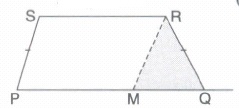
\(\therefore\)PMRS is a parallelogram
\(\therefore\) \(\angle\)S = \(\angle\)PMR
In \(\triangle\)RMQ, RM = RQ (as RM = SP, opp. sides of a parallelogram and PS = QR)
\(\therefore\) \(\angle\)RMQ=\(\angle\)Q
But \(\angle\)RMQ = 180° - \(\angle\)PMR (linear pair)
= 180°- \(\angle\)S. (proved)
\(\therefore\) \(\angle\)Q = 180°- \(\angle\)S
Hence \(\angle\)Q + \(\angle\)S = 180°
Since one pair of opposite angles is supplementary, PQRS is cyclic. Proved.
20.
Given: AB = AC
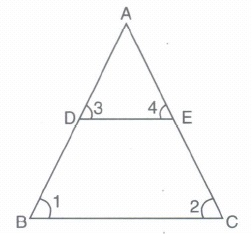
To prove: \(\angle\)ECB + \(\angle\)EDB = 180°
Proof: AB = AC \(\Rightarrow\) \(\angle\)1 = \(\angle\)2
AD=AE\(\Rightarrow\)\(\angle\)3=\(\angle\)4
\(\angle\)A + \(\angle\)1 + \(\angle\)2 = 180° = \(\angle\)A + \(\angle\)3 + \(\angle\)4
2\(\angle\)1 = 2\(\angle\)3
\(\angle\)1 = \(\angle\)3 = \(\angle\)2 = \(\angle\)4
\(\Rightarrow\) DE II BC
(Corresponding angle)
\(\angle\)1 + \(\angle\)BDE = '180°
(\(\angle\)BDE = \(\angle\)CED, as \(\angle\)3 = \(\angle\)4)
\(\angle\)1 + \(\angle\)CEP = 180°
\(\therefore\) B, C, E, Dare concyclic. Proved.
21.
\(\angle\)FEH =\(\angle\)AED = 1800-\(\left( \frac { 1 }{ 2 } \angle A+\frac { 1 }{ 2 } \angle B \right) \)
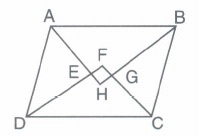
\(\angle\)FGH =\(\angle\)CGB
= 1800-\(\left( \frac { 1 }{ 2 } \angle A+\frac { 1 }{ 2 } \angle B \right) \)
Adding,
\(\angle\)FEH +\(\angle\)FGH = 1800
\(\therefore\) EFGH is a cyclic quadrilateral.

9th Standard CBSE Syllabus & Materials
9th Standard CBSE
CBSE 9th Standard Mathematics Surface Areas and Volumes Sample Question Papers Study Material - QB365 Set B
NEW9th Standard CBSE
CBSE 9th Standard Mathematics Surface Areas and Volumes Sample Question Papers Study Material - QB365 Set A
NEW9th Standard CBSE
CBSE 9th Standard Mathematics Heron's Formula Sample Question Papers Study Material - QB365 Set D
NEW9th Standard CBSE
CBSE 9th Standard Mathematics Heron's Formula Sample Question Papers Study Material - QB365 Set C



NCERT Books

Syllabus

Exam Pattern

Sample Question Papers

Previous year Question Papers

Important Notes

MCQ Practice test

NCERT Exemplers

Case study Questions

Image Based Questions

Passage based Questions

HOT Questions

Value Based Questions

Model Questions Papers
NCERT ( Book Back ) Questions

Assertion and Reason
Important Questions And Answers

CBSE 9th Standard CBSE Subjects
CBSE Standards