
9th Standard CBSE Syllabus & Materials
9th Standard CBSE
CBSE 9th Standard Mathematics Statistics Sample Question Papers Study Material - QB365 Set D
NEW9th Standard CBSE
CBSE 9th Standard Mathematics Statistics Sample Question Papers Study Material - QB365 Set C
NEW9th Standard CBSE
CBSE 9th Standard Mathematics Statistics Sample Question Papers Study Material - QB365 Set B
NEW9th Standard CBSE
CBSE 9th Standard Mathematics Statistics Sample Question Papers Study Material - QB365 Set A
NEW9th Standard CBSE
CBSE 9th Standard Mathematics Surface Areas and Volumes Sample Question Papers Study Material - QB365 Set D
NEW9th Standard CBSE
CBSE 9th Standard Mathematics Surface Areas and Volumes Sample Question Papers Study Material - QB365 Set C

Published on: 29/10/2025
Download CBSE Class 9th Standard CBSE Mathematics question papers, sample papers, important questions, and previous year solved papers in PDF format. Get free study materials, NCERT solutions, and exam preparation resources for Class 9th Standard CBSE Mathematics
Questions + Answers key
Take MCQ Mathematics Test
1.
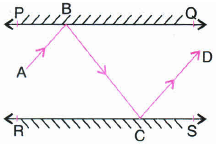
In Figure ,PQ and RS are two mirrors placed parallel to each other An incident ray AB strikes the mirror PQ at B the reflected ray moves along the path BC and strikes the mirror RS at C and again reflects back along CD.Prove that AB|| CD
2.
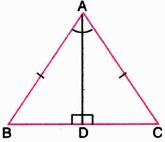
AD is an altitude of an isosceles triangle ABC in which AB = AC Show that
(i) AD bisects BC (ii) AD bisects \(\angle A\)
3.
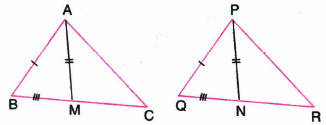
Two sides AB and BC and median AM of one triangle ABC are respectively equal to sides PQ and QR and median PN of \(\angle PQR\) (see figure). Show that:
(i) \(\triangle ABM\cong \triangle PQN\) (ii) \(\triangle ABC\cong \triangle PQR\)
4.
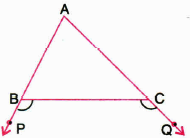
In Fig. sides AB and AC of D ABC are extended to points P and Q respectively. Also, \(\angle\) PBC < \(\)QCB. Show that AC > AB.
5.
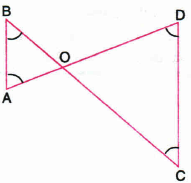
In figure, ㄥB < ㄥA and ㄥC < ㄥD. Show that AD < BC.
6.
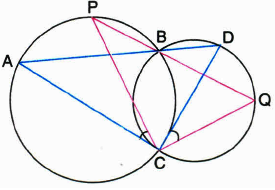
Two circles intersect at two points Band C. Through B, two line segments ABD and PBQ are drawn to intersect the circles at A, D and P, Q respectively (see figure). Prove that \(\angle ACP=\angle QCD\) .
7.
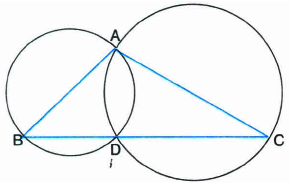
Two circles intersect at two points A and B. AD and AC are diameters to the two circles (see Fig). Prove that B lies on the line segment DC.
8.
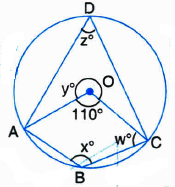
Find the values of x, y, z, w from the figure, where O is the centre of the circle, \(\angle AOC=110°\) and \(\angle OAB=65°\).
9.
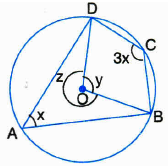
In the given figure, O is the centre of the circle. Find the values of x, y, z.
10.
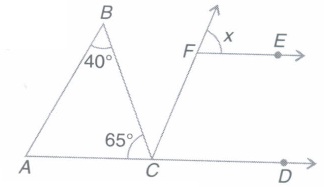
In the figure, if AB||CF and CD||FE, then find the value of x.
11.
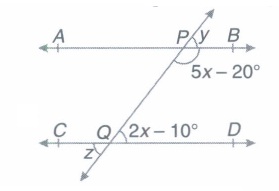
In the given figure, if AB||CD,\(\angle BPQ=(5x-20^o) and \angle PQD=(2x-10^o),\) Find the value of y and z.
12.
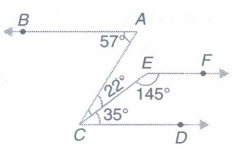
In the figure, prove that AB||EF
13.
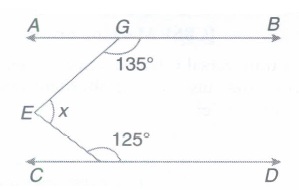
In figure, AB||CD, then find x.
14.
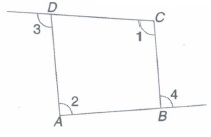
In the given figure \(\angle 3\) and \(\angle 4\) are exterior angles of quadrilateral ABCD at point D and B respectively. and \(\angle A=\angle 2, \angle C=\angle 1.\) Prove that \(\angle 3+\angle 4=\angle1+\angle2\)
15.
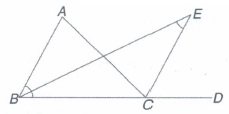
Prove that the angle between internal bisector of one base angle and the external bisector of the other base angle of a triangle is equal to one-half of the vertical angle.
16.
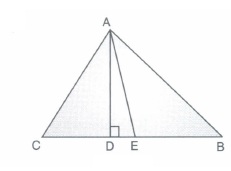
In the figure of \(\triangle ABC, AE\) is the bisector of \(\angle BAC\) and \(AD\bot BC.\) Show that \(\angle DAE=\frac{1}{2}(\angle C-\angle B)\)
17.
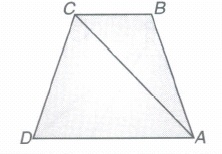
In the figure, prove that CD + DA + AB + BC > 2AC.
18.
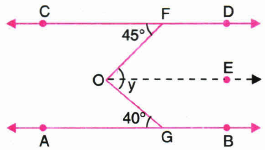
In figure if AB || CD then find the value of y.
19.
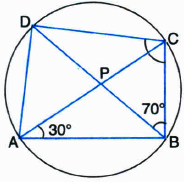
In the given figure, ABCD is a cyclic quadrilateral whose diagonals intersect at P. If \(\angle DBC=70°\) and \(\angle BAC=30°\) , find \(\angle BCD\).
|
20.
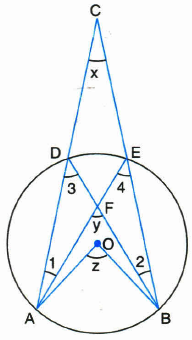
If O is the centre of a circle as shown in figure, then prove x + y = z.
21.
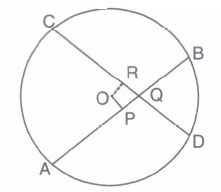
ln figure, equal chords AB and CD intersect each other at Q at right angle. P and R are the midpoints of AB and CD respectively. Show that OPQR is a square.
1.
Construction: Draw ray BL \(\bot \) PQ and ray CM \(\bot \) RS.
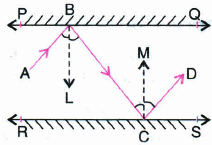
BL \(\bot \) PQ,CM \(\bot \) RS and PQ || RS BL||CM
\(\angle \) LBC=\(\angle \) MCB
|Alternate Interior Angles
\(\angle\)ABL=\(\angle\)LBC
Angle of incidence= Angle of reflection
\(\angle \)MCB=\(\angle \)MCD
Angle of incidence= Angle of reflection
From (1),(2) and (3) we get
\(\angle \)ABL =\(\angle \)MCD
Adding (1) and (4) , we get
\(\angle \) LBC+\(\angle \)ABL =\(\angle \)MCB+\(\angle \)MCD
\(\Rightarrow \) \(\angle \)ABC=\(\angle \)BCD
But these form a pair of equal alternate interior angles
So AB || CD.
2.
Given: AD is an altitude of an isosceles triangle ABC in which AB = AC.
To prove: (i) AD bisects BC (ii) AD bisects \(\angle A\)
Proof: (i) In right \(\triangle ADB\) and right \(\triangle ADC\)
Hyp.AB = Hyp. AC
Side AD = Side AD
\(\triangle ADB\cong \triangle ADC\) | RHS rule
BD = CD | C.P.C.T
AD bisects BC
(ii) \(\triangle ADB\cong \triangle ADC\)
\(\angle BAD=\angle CAD\)
AD bisects \(\angle A\)
3.
Given: Two sides AB and BC and median AM of one triangle ABC are respectively equal to sides PQ and QR and median PN of \(\angle PQR\)
To prove: (i) \(\triangle ABM\cong \triangle PQN\) (ii) \(\triangle ABC\cong \triangle PQR\)
Proof: In \(\triangle ABM\) and \(\triangle PQN\)
AB = PQ
AM = PN
BC = QR
2BM = 2QN | M and Nare the mid-points of BC and QR respectively
BM = QN
In view of (1), (2) and (3)
\(\triangle ABM\cong \triangle PQN\) | SSS rule
(ii) \(\triangle ABM\cong \triangle PQN\)
\(\angle ABM=\angle PQN\) | C.P.C.T
\(\angle ABC=\angle PQR\)
In \(\triangle ABC\) and \(\triangle PQR\)
AB = PQ
BC = QR
\(\angle ABC=\angle PQR\)
\(\triangle ABC=\triangle PQR\) | SAS rule
4.
Given: Sides AB and AC of ΔABC are extended to points P and Q respectively.Also, ㄥPBC < ㄥQCB.
To Prove: AC > AB.
Proof: ㄥPBC < ㄥQCB
- ㄥPBC > -ㄥQCB
1800 - ㄥ PBC > 1800- ㄥQCB
ㄥABC > ㄥACB
AC > AB.
5.
Given: In figure,
ㄥB < ㄥA and ㄥC < ㄥD.
To Prove: AD < BC
Proof: ㄥB < ㄥA
ㄥA > ㄥB
OB> OA ...(1)
ㄥC < ㄥD
ㄥD > ㄥC
OC > OD ..(2)
| Side opposite to greater angle is longer
From (1) and 2), we get
OB+OC > OA+OD
⇒ BC> AD
⇒ AD < Be.
6.
Two circles intersect at two points Band C. Through B, two line segments ABD and PBQ are drawn to intersect the circles at A, D and P, Q respectively.
To Prove:\(\angle ACP=\angle QCD\)
Proof: \(\angle ACP=\angle ABP\) ...(1)
| Angles in the same segment of a circle are equal
\(\angle QCD=\angle QBD\) ...(2)
| Angles in the same segment of a circle are equal
\(\angle ABP=\angle QBD\)
| Vertically Opposite Angles
From (1), (2) and (3),
\(\angle ACP=\angle QCD\).
7.
Given: Circles are drawn with sides AB and AC of a triangle ABC as diameters. They intersect at a point D.
To Prove: D lies on the third side BC of \(\Delta \)ABC
Construction: Join AD
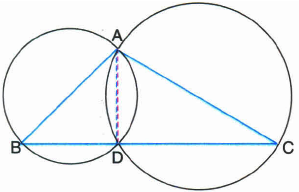
Proof: ∵ Circle drawn on AB as diameter intersects BC in D.
∴ \(\angle ADB=90°\)
| Angle in a semi-circle
But \(\angle ADB+\angle ADC=180°\)
Linear Pair Axiom
∴ \(\angle ADC=90°\)
Hence, the circle described on AC as diameter must pass through D.
Thus, the two circles intersect in D.
Now, \(\angle ADB+\angle ADC=180°\).
∴ Points B, D, C are collinear.
∴ D lies on BC.
8.
125°, 250°, 55°, 60°
9.
45°, 90°, 270°
10.
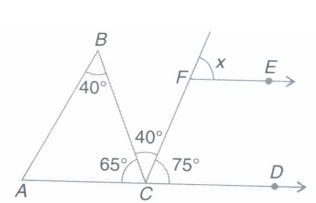
AB||CF
\(\therefore \angle ABC=\angle BCF\)(Alt Int. \(\angle's\))
\(40=\angle BCF\)
Now, \(\angle ACB+\angle BCF+\angle FCD\)
=180o(Linear pair)
\(65^0+40^o+\angle FCD=180^o\)
\(\Rightarrow \angle FCD=180^o-105^o\)
\(\Rightarrow \angle FCD=75^o\)
Now, FE||CD
\(\therefore \angle FCD=\angle x\)(Corresponding angles)
\(\angle x=75^o\)
11.
5x-20o+2x-10o=180o (Corresponding interior angles)
\(\Rightarrow\)7x=180o+30o=210o
\(\Rightarrow\)x=30o
y=180o-(5x-20o)
=180o-(150o-20o)
\(\Rightarrow\)y=180o-130o=50o
z=2x-10o
=60o-10o=50o
12.
\(\angle A=57^o\)
and \(\angle ACD=22^o+35^o=57^o\)
\(\angle A=\angle ACD\)
But these are alternate angles
AB||CD
Again \(\angle FEC+\angle ECD=145^o+35^o=180^o\)
EF||CD
Now AB||CD and EF||CD
AB||EF
13.
Draw, EH||AB
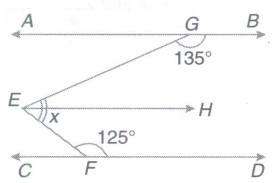
Now, EH||AB and AB||CD,
Therefore, EH||CD
Now, \(\angle BGE+\angle GEH=180^o\) (Co-interior \(\angle S)\)
(AB||EH, Co-interior angles)
\(135^o+\angle GEH=180^o\)
\(\angle GEH=180^o-135^o=45^o...(1)\)
Again, \(\angle DFE+\angle FEH=180^o\)
(CD||EH, Co-interior angles)
\(\Rightarrow 125^o+\angle FEH=180^o\)
\(\Rightarrow \angle FEH=180^o-125^o\)
=55o
Adding (1) and (2), we get
\(\angle GEH+\angle FEH=45^o+55^o\)
x=100o
14.
Join AC,
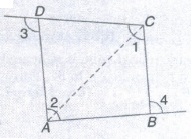
\(In\ \triangle ABC\ Ext\angle 4=\angle ACB+\angle CAB...(i)\)
Again, in \(\triangle ACD\ Ext.\angle 3=\angle DAC+\angle DCA...(ii)\)
Adding (i) and (i), we get
\(\angle 3+\angle 4=(\angle ACB+\angle DCA)+(\angle CAB+\angle DAC)\)
\(=\angle 1+\angle 2\)
\(\therefore \angle 3+\angle 4=\angle 1+\angle 2\)
15.
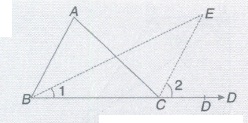
\(\angle ACD=\angle A+\angle B\)
(Exterior angle is the sum of opp. interior angle)
\(\frac{1}{2}ext.\angle ACD=\frac{\angle A}{2}+\frac{\angle B}{2}\)
\(\angle 2=\angle 1+\frac{1}{2}\angle A...(i)\)
Also, \(\angle 2=\angle 1+\angle E\)
(Exterior angle is the sum of opp. interior angle)
From eqn(1) and (2) we get
\(\therefore \angle1+\frac{\angle A}{2}=\angle 1+\angle E\)
\(\Rightarrow \angle E=\frac{\angle A}{2}\)
16.
We have here \(\angle CAE=\angle EAB(given)...(1)\)
Also \(\angle CAD+\angle DAE=\angle CAE=\angle EAB\) [Use(1)]...(2)
Now \(\angle CAD+\angle C=90^o=\angle DAE+\angle EAB+\angle B\)
\(\angle CAD+\angle C=\angle DAE+\angle CAD+\angle DAE+\angle B\)[use(2)]
\(=2\angle DAE=\angle C-\angle B
\)
\(\Rightarrow \angle DAE=\frac{1}{2}(\angle C-\angle B)\)
17.
In \(\triangle\) ABC, as sum of two sides is greater than the 3rd side,
AB + BC>AC ...(1)
In \(\triangle\)ACD, as sum of two sides of a triangle is
greater than the 3rd side,
CD+ DA>AC ....(2)
Adding (1) and (2), we get
CD + DA + AB.+ BC > 2AC.
18.
Through O draw OE || AB || CD
Now y= \(\angle FOG\)
=\(\angle \)FOE + \(\angle GOE\)
=\(\angle \)CFO+\(\angle \) AGO
=\(\angle \)FOE ==\(\angle \) CFO (Alternate Interior angles)
=\(\angle \)GOE=\(\angle \)AGO (Alternate Interior Angles)
=\(45^{ 0 }\)+\(40^{ 0 }\)=\(85^{ 0 }\)
19.
Given: ABCD is a cyclic quadrilateral whose diagonals intersect at P. \(\angle DBC=70°\) and \(\angle BAC=30°\).
Required: To find \(\angle BCD\) .
Determination: \(\angle BDC=\angle BAC(=30°)\)
| Angles in the same segment of a circle are equal
Now, in \(\Delta BCD\) ,
\(\angle BCD+\angle BDC+\angle DBC=180°\)
| ∵ The sum of the three angles of a \(\Delta \) is 180°
⇒ \(\angle BCD+30°+70°=180°\)
⇒ \(\angle BCD+100°=180°\)
⇒ \(\angle BCD=180°-100°=80°\).
20.
Given: O is the centre of a circle.
To Prove: x + y = z
Proof: \(\angle 3=\angle 4\)
| Angles in the same segment of a circle are equal
\(\angle z=2\angle 3\)
⇒ \(\angle z=\angle 3+\angle 3\)
⇒ \(\angle z=\angle 3+\angle 4\) .....(1)
Now \(\angle y=\angle 3+\angle 1\) .....(2)
| An exterior angle of a triangle is equal to the sum of its two interior opposite angles
(1) - (2) gives
\(\angle z-\angle y=\angle 4-\angle 1\)
As \(4=\angle x+\angle 1\Rightarrow \angle 4-\angle 1=\angle x\)
| An exterior angle of a triangle is equal to the sum of its two interior opposite angles
⇒ \(\angle 4-\angle 1=\angle x\) ....(4)
From (3) and (4),
\(\angle z-\angle y=\angle x\)
⇒ \(\angle x+\angle y=\angle z\)
⇒ x+y=z
21.
Given: AB and CD are equal chords intersecting at 90°
To prove: OPQR is a square
Proof: Since P and R are the mid-point of AB and CD respectively
\(\therefore\) \(\angle\) OPB = \(\angle\)ORD = 90°
\(\Rightarrow\)\(\angle\)OPQ = \(\angle\)ORQ = 90°
Since equal chords on a circle are equidistant from the centre.
\(\therefore\) OP= OR
Thus in t10PQ and t10RQ, we have
OP=OR
\(\angle\)OPQ= \(\angle\)ORQ
and OQ= OQ
\(\therefore\) \(\triangle OPB\cong \triangle ORQ\)
Thus in quadrilateral OPQR,
We have
OP = OR, PQ = RQ
and \(\angle\)OPQ = \(\angle\)ORQ = 90°
Hence OPQR is a square.

9th Standard CBSE Syllabus & Materials
9th Standard CBSE
CBSE 9th Standard Mathematics Surface Areas and Volumes Sample Question Papers Study Material - QB365 Set B
NEW9th Standard CBSE
CBSE 9th Standard Mathematics Surface Areas and Volumes Sample Question Papers Study Material - QB365 Set A
NEW9th Standard CBSE
CBSE 9th Standard Mathematics Heron's Formula Sample Question Papers Study Material - QB365 Set D
NEW9th Standard CBSE
CBSE 9th Standard Mathematics Heron's Formula Sample Question Papers Study Material - QB365 Set C



NCERT Books

Syllabus

Exam Pattern

Sample Question Papers

Previous year Question Papers

Important Notes

MCQ Practice test

NCERT Exemplers

Case study Questions

Image Based Questions

Passage based Questions

HOT Questions

Value Based Questions

Model Questions Papers
NCERT ( Book Back ) Questions

Assertion and Reason
Important Questions And Answers

CBSE 9th Standard CBSE Subjects
CBSE Standards