9th Standard CBSE Syllabus & Materials
9th Standard CBSE
CBSE 9th Standard Mathematics Statistics Sample Question Papers Study Material - QB365 Set D
NEW9th Standard CBSE
CBSE 9th Standard Mathematics Statistics Sample Question Papers Study Material - QB365 Set C
NEW9th Standard CBSE
CBSE 9th Standard Mathematics Statistics Sample Question Papers Study Material - QB365 Set B
NEW9th Standard CBSE
CBSE 9th Standard Mathematics Statistics Sample Question Papers Study Material - QB365 Set A
NEW9th Standard CBSE
CBSE 9th Standard Mathematics Surface Areas and Volumes Sample Question Papers Study Material - QB365 Set D
NEW9th Standard CBSE
CBSE 9th Standard Mathematics Surface Areas and Volumes Sample Question Papers Study Material - QB365 Set C

Published on: 29/10/2025
Download CBSE Class 9th Standard CBSE Mathematics question papers, sample papers, important questions, and previous year solved papers in PDF format. Get free study materials, NCERT solutions, and exam preparation resources for Class 9th Standard CBSE Mathematics
Questions + Answers key
Take MCQ Mathematics Test
1.
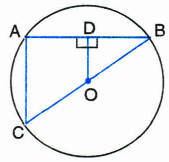
OD is perpendicular to chord AB of a circle whose centre is O. If BC is a diameter, prove that CA = 20D.
2.
AB and CD are equal chords of a circle whose centre is O. When produced, these chords meet at E. Prove that EB = ED and AE = CE.
.png)
3.
ABCD is a cyclic quadrilateral. If AC bisects both the angles A and C then prove that \(\angle ABC=90°\) .
4.
Find the length of a chord which is at a distance of 3 cm from the centre of a circle whose radius is 5 cm.
5.
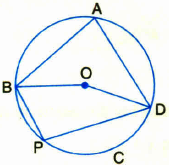
ABCD Is a cyclic quadrilateral. O is the centre of the circle. If \(\angle BOD=160°\), find \(\angle BPD\) .
6.
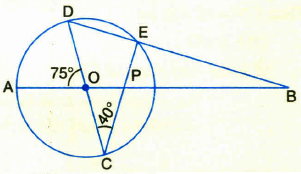
In the figure, straight lines AB and CD pass through the centre O of the circle. If \(\angle OCE=40°\) and \(\angle AOD=75°\), find \(\angle CDE\) and \(\angle OBE\).
7.
Prove that" equal chords of a circle subtend equal angles at the centres."
8.
ABCD is a cyclic quadrilateral in which AB II CD. If ㄥD=70, find all the remaining angles.
9.
If two equal chords of a circle intersect within the circle, prove that the segments of one chord are equal to corresponding segments of the other chord.
10.
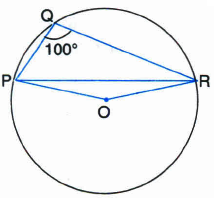
In figure, \(\angle PQR=100°\), where P, Q and R are points on a circle with centre O. Find\(\angle OPR\) .
11.
If diagonals of a cyclic quadrilateral are diameters of the circle through the vertices of the quadrilateral, prove that it is a rectangle.
12.
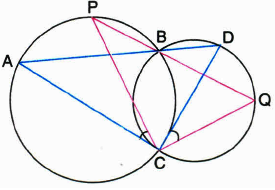
Two circles intersect at two points Band C. Through B, two line segments ABD and PBQ are drawn to intersect the circles at A, D and P, Q respectively (see figure). Prove that \(\angle ACP=\angle QCD\) .
13.
If a line is drawn parallel to the base of an isosceles triangle to intersect its equal sides, prove that the quadrilateral so formed is cyclic.
14.
The shape of the coin of RS 1 is
triangle
rhombus
circle
trapezium
15.
The wheels of a vehicle are in
rectangular
triangular
circular shape
trapezoidal
16.
The centre of a circle lies
outside the circle
inside the circle
on the circle
none of these
17.
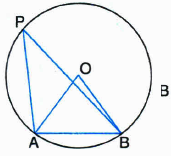
In the following figure, O is the centre of the circle PAB and \(\Delta OAB\) is equilateral. The measure of \(\angle APB\) is equal to
60°
45°
40°
30°
18.
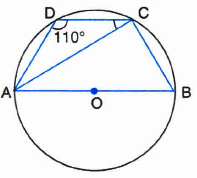
In the given figure, O is the centre of the circle. ABCD is a trapezium in which AB || DC and \(\angle ADC=110°\) The measure of \(\angle ADC\) is equal to:
35°
70°
20°
55°
19.
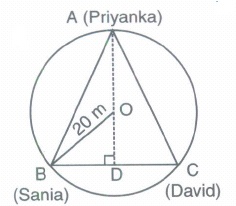
Three students Priyanka, Sania and David are protesting against killing innocent animals for commercial purposes in a circular park of radius 20 m. They are standing at equal distance on its boundary by holding banners in their hands.
(i) Find the distance between each of them?
(ii) Which mathematical concept is used in it?
(iii) How does an act like this reflects their attitude towards society?
1.
Given: OD is perpendicular to chord AB of a circle where centre is O. BC is a diameter of the circle.
To Prove: CA=20D
Proof: OD丄AB
∴ D is the mid-point of AB
|The perpendicular drawn from the centre of a circle to a chord bisects the chord.
In \(\Delta BAC\),
∵ \(OD\parallel AC\) I By mid-point theorem
and \(OD=\frac { 1 }{ 2 } AC\)
⇒ CA=2 OD
2.
Given: AB and CD are equal chords of a circle whose centre is O. When produced, these chords meet at E.
To Prove: EB = ED and AE = CE.
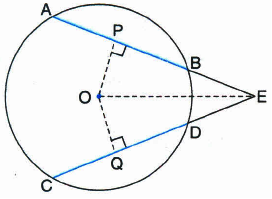
Construction: From O draw OP丄 AB and OQ丄CD. Join OE.
Proof: AB = CD
∴ OP=OQ I ∵ Equal chords of a circle are equidistant from the centre
Now in right \(\quad \Delta s\) OPE and OQE,
Hyp. OE = Hyp. OE I Common
Side OP = Side OQ I Proved above
∴ \(\Delta OPE\cong \Delta OQE\)
I R.H.S. Congruence Axiom
∴ PE= QE I CPCT
⇒ \(PE-\frac { 1 }{ 2 } AB=QE-\frac { 1 }{ 2 } CD\)
| ∵ AB = CD (Given)
⇒ PE-PB = QE-QD
⇒ EB = ED.
⇒ BE + AB = ED + CD I ∵ AB = CD | ∵ AB = CD
⇒ AE=CE
3.
Given: ABCD is a cyclic quadrilateral. AC bisects both the angles A and C.
To Prove: \(\angle ABC=90°\)
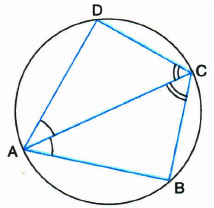
Proof: In \(\Delta ADC\) and \(\Delta ABC\) ,
\(\angle DAC=\angle BAC\) | ∵ AC bisects angle A
\(\angle DCA=\angle BCA\) | ∵ AC bisects angle C
AC=AC | Common
∴ \(\Delta ADC\cong \Delta ABC\) | ASA congruence rule
∴ \(\angle ADC=\angle ABC\) | CPCT
But \(\angle ADC+\angle ABC=180°\)
| ∵ Opposite angles of a cyclic quadrilateral are supplementary
∴ \(\angle ADC=\angle ABC=90°\)
4.
8 cm
5.
100°
6.
\(\angle\)AOD + \(\angle\)BOD = 180° (linear pair)
\(\angle\)BOD = 180°- \(\angle\)AOD
\(\angle\)BOD = 180°- 75° = 105°
\(\angle\)CED =90° (angle in semi-circle)
\(\angle\)CDE =90° - \(\angle\)OCE \(\Rightarrow\) 90° - 40° = 50°
\(\angle\)OBE = \(\angle\)OBD
\(\angle\)OBD = 180°- (105° + 50°)
(In \(\Delta\)DBO, Angle sum property of \(\Delta\))
\(\angle\)OBE = \(\angle\)OBD = 25°
7.
Given AB and CD are the chords of a circle with centre at O such that AB = CD
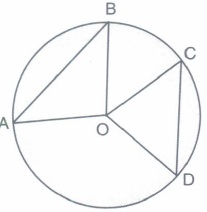
To Prove: \(\angle\)AOB = \(\angle\)COD
Proof: In \(\Delta\)AOB and \(\Delta\)COD
AO = CO (radii of same circle)
AB = CD (given)
BO = DO (radii of same circle)
\(\Delta\)AOB\(\cong \) \(\Delta\)COD (SSS)
\(\angle\)AOB = \(\angle\)COD (c.p.c.t.) 2 Hence Proved.
8.
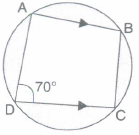
Since sum of the opposite pairs of angles in a cyclic quadrilateral is 180°.
Hence ㄥB+ㄥD=180°
ㄥB=180°-70°
=110°
Again, AB II CD and AD is its transversal, so
ㄥA+ㄥD=180°
ㄥA=180°-70°
=110°
and ㄥA+ㄥC=180°
⇒ 110°+ㄥC=180°
ㄥC=180°-110°
=70°
9.
Given: A circle with centre O. Its two equal chords AB and CD intersect at E.
To prove: AE = DE and CE = BE.
Construction: Draw OM 丄 AB and ON 丄 CD join OE.
Proof: In \(\Delta OME\) and \(\Delta ONE\) ,
OM = ON
| ∵ Equal chords of a circle are equidistant from the centre
OE = OE I Common
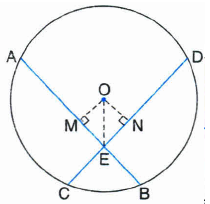
∴\(\Delta OME\cong \Delta ONE\) | RHS Rule
∴ ME = NE I CPCT
⇒AM + ME = DN + NE
∵ \(AB=CD\Rightarrow \frac { 1 }{ 2 } AB=\frac { 1 }{ 2 } CD\Rightarrow AM=DN\)
⇒ AE = DE
⇒ AB - AE = CD - DE | ∵ AB=CD
⇒ B E= CE. | Given
10.
Take a point S in the major arc. Join PS and RS.
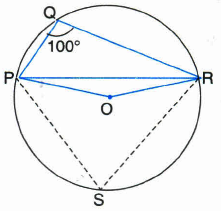
∵ PQRS is a cyclic quadrilateral.
∴ \(\angle PQR+\angle PSR=180°\)
The sum of either pair- of opposite angles of a cyclic quadrilateral is 180°
\(\Rightarrow \ 100°+\angle PSR=180°\)
\(\angle PSR=180°-100°\)
\(\Rightarrow \) \(PSR=80°\) ....(1)
Now, \(\angle POR=2\angle PSR\)
The angle subtended by an arc at the centre is double the angle subtended by it at any point on the remaining part of the circle
\(2\times 80°=160°\) ...(2) Using (1)
In \(\Delta OPR\),
∵ OP = OR | Radii of a circle
∴ \(\angle OPR=\angle OPR\) ....(3)
Angles opposite to equal sides of a triangle are equal
In \(\Delta OPR\),
\(\angle OPR+\angle ORP+\angle POR=180°\)
Sum of all the angles of a triangle is 180°
⇒ \(\angle OPR+\angle OPR+160°=180°\) | Using (2) and (1)
⇒ \(2\angle OPR+160°=180°\)
⇒ \(2\angle OPR=180°-160°=20°\)
⇒ \(\angle OPR=10°\).
11.
In \(\Delta OAB\) and \(\Delta OCD\),
OA = OC | Radii of a circle
OB = OD | Radii of a circle
\(\angle AOB=\angle COD\) | Vertically Opposite Angles
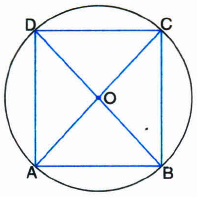
∴ \(\Delta OAB\cong \Delta OCD\) | SAS Rule
∴ AB = CD I CPCT
⇒ Arc AB = Arc CD ....(1)
Similarly, we can show that
Arc AD = Arc CB
Adding (1) and (2), we get
Arc AB + Arc AD = Arc CD + Arc CB ...(2)
⇒ Arc BAD = Arc BCD
⇒ BD divides the circle into two equal parts (each a semicircle)
∴ \(\angle A=90°,\ \angle C=90°\) Angle in semi-circle is 90°
Similarly, we can show that
\(\angle B=90°,\ \angle D=90°\)
∴ \(\angle A=\angle B=\angle C=\angle D=90°\)
∴ ABCD is a rectangle.
12.
Two circles intersect at two points Band C. Through B, two line segments ABD and PBQ are drawn to intersect the circles at A, D and P, Q respectively.
To Prove:\(\angle ACP=\angle QCD\)
Proof: \(\angle ACP=\angle ABP\) ...(1)
| Angles in the same segment of a circle are equal
\(\angle QCD=\angle QBD\) ...(2)
| Angles in the same segment of a circle are equal
\(\angle ABP=\angle QBD\)
| Vertically Opposite Angles
From (1), (2) and (3),
\(\angle ACP=\angle QCD\).
13.
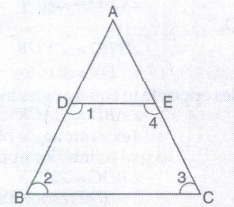
Given ED II BC
AB =AC
\(\Rightarrow\) \(\angle\)2 = \(\angle\)3 ...(i)
(Opp. Ls to opp. side are always equal)
In an isosceles II
\(\angle\)1 + \(\angle\)2 = 180° [Interior \(\angle\)s)
\(\therefore\) \(\angle\)3 + \(\angle\)4 = 1800
\(\therefore\) \(\angle\)1 + \(\angle\)3 = 1800
\(\angle\)2 + \(\angle\)4 = 180°
but these are opp angles of a quad.
\(\therefore\) BCDE is a cyclic quad.
14.
(c)
circle
15.
(c)
circular shape
16.
See a circle
17.
∵ \(\Delta OAB\) is equilateral
∴ \(\angle AOB=60°\)
∴ \(\angle APB=\frac { 1 }{ 2 } \angle AOB=30°\)
18.
\(\angle ABC=180°-\angle ADC=180°-110°=70°\)
\(\angle ACB=90°\)
\(\therefore \angle BAC=20°\)
\(\angle ACD=\angle BAC\) | Alternate interior angles
19.
(i) Let us assume that A, Band C are the position of Priyanka, Sania and David respectively on the boundary of circular park with centre O.
Draw AD\(\bot\) BC
Since the centre of the circle coincides with the centroid of the equilateral \(\triangle\) ABC
\(\therefore\) Radius of circumscribed circle = \(\frac{2}{3}\) AD
\(\Rightarrow 20=\frac { 2 }{ 3 } AD\)
\(\Rightarrow AD=20\times \frac { 2 }{ 3 } \)
\(\Rightarrow AD=30m\)
Now, AD\(\bot\)BC, and let AB=BC=CA=x
\(\Rightarrow BD=CD=\frac { 1 }{ 2 } BC=\frac { x }{ 2 } \)
In rt. \(\triangle\)BDA, D=900
By Pythagoras Theorem, we have
AB2=BD2+AD2
\(\Rightarrow { x }^{ 2 }={ \left( \frac { x }{ 2 } \right) }^{ 2 }+{ (30) }^{ 2 }\)
\(\Rightarrow{ x }^{ 2 }-{ \frac { { x }^{ 2 } }{ 4 } }=90\)
\(\Rightarrow \frac { 3 }{ 4 } { x }^{ 2 }=90\)
\(\Rightarrow { x }^{ 2 }=900\times \frac { 4 }{ 3 } \)
\(\Rightarrow { x }^{ 2 }=1200\)
\(\therefore x=\sqrt { 1200 } =20\sqrt { 3 } \)
Hence, the distance between each of them is \(20\sqrt { 3 } .\)
(ii) Properties of the circle, equilateral triangle and Pythagoras theorem.
(iii) Live and let live.

9th Standard CBSE Syllabus & Materials
9th Standard CBSE
CBSE 9th Standard Mathematics Surface Areas and Volumes Sample Question Papers Study Material - QB365 Set B
NEW9th Standard CBSE
CBSE 9th Standard Mathematics Surface Areas and Volumes Sample Question Papers Study Material - QB365 Set A
NEW9th Standard CBSE
CBSE 9th Standard Mathematics Heron's Formula Sample Question Papers Study Material - QB365 Set D
NEW9th Standard CBSE
CBSE 9th Standard Mathematics Heron's Formula Sample Question Papers Study Material - QB365 Set C



NCERT Books

Syllabus

Exam Pattern

Sample Question Papers

Previous year Question Papers

Important Notes

MCQ Practice test

NCERT Exemplers

Case study Questions

Image Based Questions

Passage based Questions

HOT Questions

Value Based Questions

Model Questions Papers
NCERT ( Book Back ) Questions

Assertion and Reason
Important Questions And Answers

CBSE 9th Standard CBSE Subjects
CBSE Standards