
9th Standard CBSE Syllabus & Materials
9th Standard CBSE
CBSE 9th Standard Mathematics Statistics Sample Question Papers Study Material - QB365 Set D
NEW9th Standard CBSE
CBSE 9th Standard Mathematics Statistics Sample Question Papers Study Material - QB365 Set C
NEW9th Standard CBSE
CBSE 9th Standard Mathematics Statistics Sample Question Papers Study Material - QB365 Set B
NEW9th Standard CBSE
CBSE 9th Standard Mathematics Statistics Sample Question Papers Study Material - QB365 Set A
NEW9th Standard CBSE
CBSE 9th Standard Mathematics Surface Areas and Volumes Sample Question Papers Study Material - QB365 Set D
NEW9th Standard CBSE
CBSE 9th Standard Mathematics Surface Areas and Volumes Sample Question Papers Study Material - QB365 Set C

Published on: 29/10/2025
Download CBSE Class 9th Standard CBSE Mathematics question papers, sample papers, important questions, and previous year solved papers in PDF format. Get free study materials, NCERT solutions, and exam preparation resources for Class 9th Standard CBSE Mathematics
Questions + Answers key
Take MCQ Mathematics Test
1.
Classify the following numbers as rational or irrational: 0.3796
2.
If \(x^2-3x+2\) is a factor of \(x^4-ax^2+b\) then find a and b
3.
Diagonals AC and BD of a quadrilateral ABCD intersect each other at P. Show that\(ar(\Delta APB)\times ar(\Delta CPD)=ar(\Delta APD)\times ar(\Delta BPC)\)
4.
A cubical box has each edge 10 cm and another cuboidal box is 12.5 cm long, 10 cm wide and 8 cm high.
(i) Which box has the greater lateral surface area and by how much?
(ii) Which box has the smaller total surface area and by how much?
5.
For what value of k, the linear equation 2x+ky=8 has x=2 and y=1 as its solution? If x=4, then find the value of y.
6.
If a transversal intersects two parallel lines, then prove that bisectors of alternate interior angles are in parallel.
7.
Prove that the perimeter of a triangle is greater than the sum of its three altitudes.
8.
Rationalize \(\frac { 5 }{ \sqrt { 3 } -\sqrt { 5 } } \left( -\frac { 5 }{ 2 } \right) \)
9.
Factorise: \(a^{12}y^4-a^4y^{12}.\)
10.
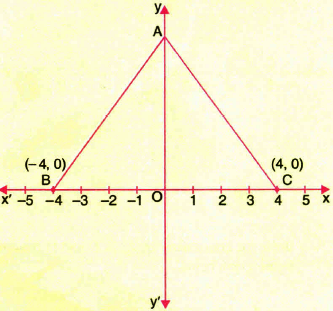
In figure, \(\triangle ABC\) is an equilateral triangle with coordinates of B and C as (-4,0) and (4,0) respectively.Find the coordinates of the vertex.
11.
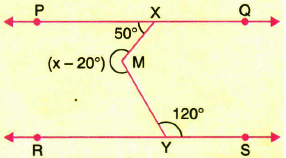
In figure if OQ || RS and \(\angle PXM=50^{ 0 }\) and \(\angle MYS\) =\(120^{ 0 }\) Find the value of x.
12.
Find the length of a chord of a circle which is at a distance of 4 cm from the centre of the circle with radius 5 cm.
13.
Find the area of a parallelogram whose sides are 13 cm and 14 cm and diagonal is 15 cm.
14.
The volume of a right circular cylinder is 1100 cm3 and the radius of its base is 5 m. Find its curved surface area. \(\left( Use\ \pi =\frac { 22 }{ 7 } \right) \)
15.
Find the mode of the following data:
| 1 | 3 | 5 | 7 | 3 |
| 5 | 4 | 7 | 2 | 6 |
| 7 | 12 | 10 | 11 | 3 |
| 7 | 8 | 6 | 7 | 7 |
| 4 | 2 | 11 | 7 | 15 |
16.
Express y in terms of x in equation 2x-3y=12. Find the points where the line represented by this equation cuts x-axis and y-axis.
17.
If \(a=2+\sqrt { 3 } +\sqrt { 5 } \) and \(b=3+\sqrt { 3 } -\sqrt { 5 } \) , find \({ \left( a-2 \right) }^{ 2 }+{ \left( b-3 \right) }^{ 2 }\)
18.
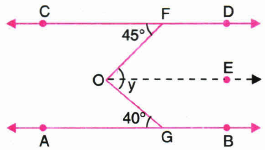
In figure if AB || CD then find the value of y.
19.
A square piece of paper of side 22 cm is rolled to form a cylinder.Find the volume of the cylinder. (Take \(\pi =\frac{22}{7}\))
20.
Factorize: x3-2x2-5x-6.
21.
Show that the bisectors of angles of a parallelogram form a rectangle
22.
What is the degree of polynomial \(\sqrt { 3 } \)?
23.
Is x=4, y=0, the solution of y-4=0?
24.
Calculate the value of 4√28\(\div\)3√7.
25.
How can we identify parallel lines?
26.
Write the complementary angle of 65o.
27.
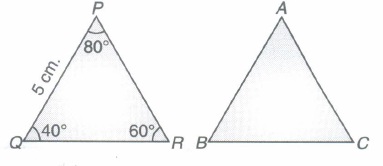
\(\triangle PQR\cong \triangle ABC\), if PQ = 5 cm, \(\angle\)Q = 40° and \(\angle\)P = 80°, calculate the value of \(\angle\)C.
28.
D, E, F are the mid-points of sides BC, CA and AB of ΔABC. If perimeter of ΔABC is 12·8 cm, then perimeter of ΔDEF is: .....
29.
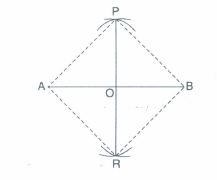
In the figure below,PR is the perpendicular bisectors of a line segment AB=16 cm.Is PA=PB true?
30.
If the number of square centimetres in the surface area of a shpere is equal to the number of cubic cm in its volume. find the diameter of the sphere?
31.
For the given data: 11,15, 17, y+1, 19, y-2, 3; if the mean is 14, find the value of y.
32.
Geetha told her classmate Radha that "\(\sqrt { \frac { \left( \sqrt { 2 } -1 \right) }{ \left( \sqrt { 2 } +1 \right) } } \) is an irrational number." Radha replied that "you are wrong" and further claimed that "If there is a number 'x' such that x3 is an irrational number, then x5 is also irrational". Geetha said, "No Radha, you are wrong". Radha took some time and after verification accepted her mistakes and thanked Geetha for pointing out these mistakes.
(i) Justify both the statements.
(ii) What value is depicted from this question?
33.
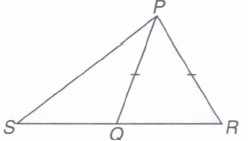
In figure, PQ = PR. Show that PS > PQ.
1.
The decimal expansion is terminating.
0.3796 is a rational number.
2.
a=5, b=4
3.
Given: Diagonals AC and BD of a quadrilateral ABCD intersect each other at P.
To Prove: \(ar(\Delta APB)\times ar(\Delta CPD)=ar(\Delta APD)\times ar(\Delta BPC)\)
Construction: From A and C, draw perpendiculars AE and CF respectively to BD.
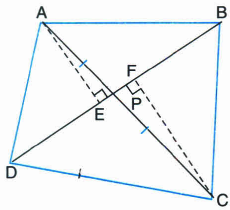
\(ar(\Delta APB)\times ar(\Delta CPD)\)=\(\frac { (PB)(AE) }{ 2 } \times \left( \frac { DP\times CF }{ 2 } \right) \)
|Area of \(\Delta\)=\(\frac { Base\times Corresponding\ altitude }{ 2 } \)
\(=\frac { 1 }{ 4 } (PB)(AE)(DP)(CF)\quad \quad ....(1)\)
\(\\ ar(\Delta APD)\times ar(\Delta BPC)\)
\(\\ =\frac { (DP)(AE) }{ 2 } \times \frac { (PB)(CF) }{ 2 }\)
\( \\ =\frac { 1 }{ 4 } (PB)(AE)(DP)(CF)\quad \quad ....(2)\)
From (1) and (2),
\(ar(\Delta APD)\times ar(\Delta BPC)\)
4.
(i) Each edge of the cubical box (a) = 10 cm
\(\therefore \) Lateral surface area of the cubical box
= 4a2 = 4(10)2 = 400 cm2.
For cuboidal box
l = 12.5 cm, b = 10 cm,
h = 8 cm
\(\therefore \) Lateral surface area of the cuboidal box
= 2(l + b)h
= 2(12.5 + 10)(8) = 360 cm2.
Cubical box has the greater lateral surface area than the cuboidal box by (400 - 360)cm2,
i.e., 40 cm2.
(ii) Total surface area of the cubical box = 6a2
= 6(10)2 = 600 cm2
Total surface area of the cuboidal box
= 2(lb + bh + hl)
= 2[(12.5)(10) + (10)(8) + (8)(12.5)]
= 2[125 + 80 + 100] = 610 cm2.
Cubical box has the smaller total surface area than the cuboidal box by (610 - 600) cm2, i.e., 10 cm2.
5.
The linear equation is 2x+ky=8
At x=2,y=1,
2(2)+k(1)=8
\(\Rightarrow\)4+k=8
k=4
If x=4, then
\(\Rightarrow\) 2(4)+4y=8
\(\Rightarrow\) 8+4y=8
\(\Rightarrow\) 4y=0
\(\therefore y=0\)
6.
Given PQ||Rs are cut by a transversal t at A and B respectively. AC and BD are the trisector of a pair of alterna int \(\angle S,\angle PAB\ and\angle ABS\) respectively.
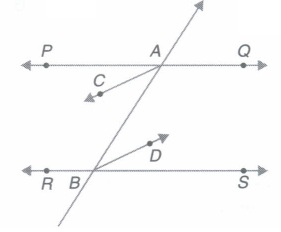
To prove AC||BD
Prove since PQ||RS and t is a traversal we have
\(\angle PAB=\angle ABS [Alt. Int\angle S]\)
\(\Rightarrow \frac{1}{2}\angle PAB=\frac{1}{2}\angle ABS\)
\(\Rightarrow \angle CAB=\angle ABD\)
But these are alternate interior angles formed when the transversal AB cuts AC and BD.
\(\therefore AC||BD\)
7.
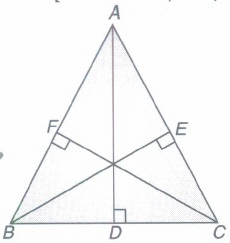
Since from a point \({ \bot }^{ r }\) line is the shortest.
CF\({ \bot }\) AB
\(\therefore\) CF < AC and CF < BC ...(1)
Similarly, BCis a line segment and A does not lie on
it. AD \({ \bot }\) BC
\(\therefore\) AD < AB and AD < AC ...(2)
Also, AC a line segment and B does not lie on it.
BE\({ \bot }\)AC
\(\therefore\) BE < AB and BE < BC ...(3)
Adding (I), (2) and (3), we get
2(AD + BE + CF) < 2(AB + BC + CA)
\(\therefore\) AB + BC + CA > AD + BE + CF
i.e., Perimeter is greater than the sum of three altitudes. Proved.
8.
\(\left( \sqrt { 3 } +\sqrt { 5 } \right) \)
9.
\(a^4y^4(a^2+y^2)(a-y)(a+y)(a^2+y^2-\sqrt{2}ay(a^2+y^2+\sqrt{2}ay)\)
10.
\(\left( 0,4\sqrt { 3 } \right) \)
11.
\(270^{ 0 }\)
12.
6 cm
13.
168 cm2
14.
440 cm2
15.
7
16.
Equation 2x-3y=12
or 3y=2x-12
\(\therefore \ y=\frac{2x-12}{3}\)
On x-axis y=0
\(\Rightarrow x=6 \)
At point(6,0) the given line cuts the x-axis
On y-axis x=0
\(\therefore \ y=\frac{2\times0-12}{3}\)
\(\Rightarrow y=-4\)
At point(0,-4) the given line cuts the y-axis
17.
\(a=2+\sqrt { 3 } +\sqrt { 5 } \quad \)
\(\\ a-2=\sqrt { 3 } +\sqrt { 5 } \)
\(\\ b=3+\sqrt { 3 } -\sqrt { 5 } \)
\(\\ b-3=\sqrt { 3 } -\sqrt { 5 } \)
\(\\ { \left( a-2 \right) }^{ 2 }+{ \left( b-3 \right) }^{ 2 }={ \left( \sqrt { 3 } +\sqrt { 5 } \right) }^{ 2 }{ \left( \sqrt { 3 } -\sqrt { 5 } \right) }^{ 2 }\)
\(\\ =(3+5+2\sqrt { 3 } \sqrt { 5 } )+(3+5-2\sqrt { 3 } \sqrt { 5 } )\)
\(\\ =16\)
18.
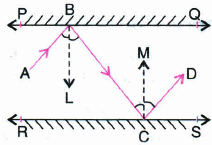
Through O draw OE || AB || CD
Now y= \(\angle FOG\)
=\(\angle \)FOE + \(\angle GOE\)
=\(\angle \)CFO+\(\angle \) AGO
=\(\angle \)FOE ==\(\angle \) CFO (Alternate Interior angles)
=\(\angle \)GOE=\(\angle \)AGO (Alternate Interior Angles)
=\(45^{ 0 }\)+\(40^{ 0 }\)=\(85^{ 0 }\)
19.
Let the base radius and height of the cylinder be r cm and h cm respectively.
Then,
\(2 \pi r=22\)
\(\Rightarrow 2\times \frac{22}{7}\times r=22\)
\(\Rightarrow r=\frac{7}{2}cm\)
h = 22 cm
ஃ Volume of the cylinder
\(=\pi r^2h\)
\(=\frac{22}{7}. \frac{7}{2}.\frac{7}{2}.22\)
= 847 cm3
20.
Factor of 6 = (\(\pm \)1,\(\pm \)2,\(\pm \)3,\(\pm \)6)
p(x)=x3+2x2-5x-6
p(-1)=(-1)3+2(-1)2-5(-1)-6
=-1+2+5-6
=7-7=0
\(\because\) x = -1 is zero of p(x) of (x+1) is a factor of p(x)
\(\therefore\) x3+2x2-5x-6
=x2(x+1)+x(x+1)-6(x+1)
=(x+1)[x2+x-6]
=(x+1)[x2+3x-2x-6]
=(x+1)[x(x+3)-2(x+3)]
=(x+1)(x+3)(x-2)
21.
Let ABCD is a parallelogram
To show LMNO is a rectangle,
ㄥA+ㄥD=180°
\(\frac{1}{2}\)ㄥA+\(\frac{1}{2}\)ㄥD=90°
ㄥOAD+ㄥODA=90°
In ΔOAD,
ㄥOAD+ㄥADO+ㄥDOA=180°
⇒ ㄥDOA = 90°
⇒ ㄥLON = 90°
Similarly, ㄥOLM =ㄥLMN =ㄥMNO = 90°
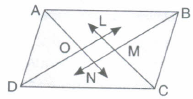
ஃ A quadrilateral with all angles 90° is a rectangle. Also opposite angles are equal. It is rectangle.
22.
()
Degree of a polynomial \(\sqrt { 3 } \) is 0.
23.
()
No(∵ 0-4≠0)
24.
()
4√28\(\div\)3√7 = 4 x 2√7\(\div\)3√7=\(\frac{8}{3}\)
25.
()
Lines are parallel if they do not intersect on being extended.
For example:
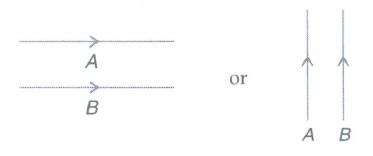
Lines A and B are parallel lines.
26.
()
Complementary angle of 65o
=90o-65o=25o (As sum of complementary angles is 90o )
27.
()
\(\angle\)R= 180° - 80° - 40° = 60°
\(\triangle PQR\cong \triangle ABC\)
\(\therefore\) \(\angle\)R = \(\angle\)C = 60°
28.
()
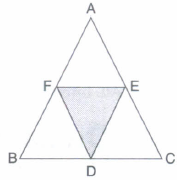
Given, perimeter of ΔABC=12.8 cm
ஃ Perimeter of ΔDEF=\(\frac{12.8}{2}\)=6.4cm
29.
()
AO = BO
= \(\frac { 1 }{ 2 } \) AB = 8 ..(i)
[PR is bisector of AB,given]
∠POA = ∠POB [Each 90o given]...(ii)
In △POA and △POB
AO = BO [From Given (i)]
∠POA = ∠POB
PO = PO[Common]
△POA =△POB [by SAS]
PA = PB [by c.p.c.t]
30.
()
Given, Area of Sphere=Volume of sphere
\(4\pi { r }^{ 2 }=\frac { 4 }{ 3 } \pi { r }^{ 3 }\)
where r is the radius of sphere
\(\Rightarrow\) r = 3 cm [on solving]
\(\therefore\) Diameter = 2r = 6 cm.
31.
()
\(14=\frac{11+15+17+y+1+19+y-2+3}{7}\)
⇒ 98 = 64+2y
⇒ 2y = 34
⇒ y = 17
32.
\(\sqrt { \frac { \left( \sqrt { 2 } -1 \right) }{ \left( \sqrt { 2 } +1 \right) } } \)is an irrational number.
\(\sqrt { \frac { \left( \sqrt { 2 } -1 \right) }{ \left( \sqrt { 2 } +1 \right) } } =\sqrt { \frac { \left( \sqrt { 2 } -1 \right) }{ \left( \sqrt { 2 } +1 \right) } \times \frac { \left( \sqrt { 2 } -1 \right) }{ \left( \sqrt { 2 } -1 \right) } } \)
\(=\sqrt { \frac { { \left( \sqrt { 2 } -1 \right) }^{ 2 } }{ 2-1 } } \)
\(=\sqrt { \frac { { \left( \sqrt { 2 } -1 \right) }^{ 2 } }{ 1 } } =\sqrt { 2 } -1\)
which is an irrational number.
Let, there is a number x such that x3 is an irrational number but x5 is a rational number.
Let, x =\(\sqrt[5]{7}\) be the number.
⇒ x3 = (5√7)3 = (7)3/5
is an irrational number.
But x5 = (\(\sqrt[5]{7}\))5=(7)5/5 = 7
=7 is a rational number.
(ii) Accepting own mistakes gracefully, co-operative learning among the classmates.
33.
Proof: In \(\triangle\) PQR,
PQ =PR
\(\angle\) PQR = \(\angle\)PRQ
(Angles opp. to equal sides are equal) ...(i)
In \(\triangle\)PQS, \(\angle\)PQR > \(\angle\)PSQ
(Ext. angle of a 6 is greater than each of interior opp. angle)
\(\angle\)PRQ > \(\angle\)PSQ, using (i)
\(\Rightarrow\) \(\angle\)PRS >\(\angle\)PSR \(\Rightarrow\) PS > PR
PS>PQ (\(\because\) PR = PQ)
(Side opp. to greater angle is larger)

9th Standard CBSE Syllabus & Materials
9th Standard CBSE
CBSE 9th Standard Mathematics Surface Areas and Volumes Sample Question Papers Study Material - QB365 Set B
NEW9th Standard CBSE
CBSE 9th Standard Mathematics Surface Areas and Volumes Sample Question Papers Study Material - QB365 Set A
NEW9th Standard CBSE
CBSE 9th Standard Mathematics Heron's Formula Sample Question Papers Study Material - QB365 Set D
NEW9th Standard CBSE
CBSE 9th Standard Mathematics Heron's Formula Sample Question Papers Study Material - QB365 Set C



NCERT Books

Syllabus

Exam Pattern

Sample Question Papers

Previous year Question Papers

Important Notes

MCQ Practice test

NCERT Exemplers

Case study Questions

Image Based Questions

Passage based Questions

HOT Questions

Value Based Questions

Model Questions Papers
NCERT ( Book Back ) Questions

Assertion and Reason
Important Questions And Answers

CBSE 9th Standard CBSE Subjects
CBSE Standards