9th Standard CBSE Syllabus & Materials
9th Standard CBSE
CBSE 9th Standard Mathematics Statistics Sample Question Papers Study Material - QB365 Set D
NEW9th Standard CBSE
CBSE 9th Standard Mathematics Statistics Sample Question Papers Study Material - QB365 Set C
NEW9th Standard CBSE
CBSE 9th Standard Mathematics Statistics Sample Question Papers Study Material - QB365 Set B
NEW9th Standard CBSE
CBSE 9th Standard Mathematics Statistics Sample Question Papers Study Material - QB365 Set A
NEW9th Standard CBSE
CBSE 9th Standard Mathematics Surface Areas and Volumes Sample Question Papers Study Material - QB365 Set D
NEW9th Standard CBSE
CBSE 9th Standard Mathematics Surface Areas and Volumes Sample Question Papers Study Material - QB365 Set C
Published on: 29/10/2025
Download CBSE Class 9th Standard CBSE Mathematics question papers, sample papers, important questions, and previous year solved papers in PDF format. Get free study materials, NCERT solutions, and exam preparation resources for Class 9th Standard CBSE Mathematics
Questions + Answers key
Take MCQ Mathematics Test
1.
Find the area of an isosceles triangle, whose equal sides are of length 15 cm each and third side is 12 cm.
2.
Find the area of a triangle whose sides are 6.5 cm. 7 cm and 7.5 cm.
3.
The sides of a triangular plot are in the ratio 3: 5: 7 and its perimeter is 300 m. Find its area
4.
Find the area of a triangle, whose sides are 26 cm, 28 cm, and 30 cm respectively. Find the height corresponding to the longest side.
5.
Find the area of the quadrilateral ABCD where AB = 7 cm, BC = 6 cm, CD = 12 cm, DA = 15 cm and AC = 9 cm.
6.
A traffic signal board, indicating 'SCHOOL AHEAD', is an equilateral triangle with side 'a'.Find the area of the signal board, using Heron's Formula.If its perimeter is 180 cm, what will be the area of the signal board?
7.
The sides of a triangular plot are 50 m, 65 m, and 65 m. Find the cost of laying grass in this plot at the rate Rs.7 per m 2.
8.
\(\triangle \)ABC is an isosceles triangle with AB = AC.The perimeter of the triangle is 36 cm and AB = 10 cm. What is the area of the triangle?
9.
A field is in the shape of a trapezium whose parallel sides are 25 m and 10 m. The non-parallel sides are 14 m and 13 m. Find the area of the field.
10.
Find the area of a quadrilateral ABCD in which AB = 3 cm, BC = 4 cm, CD = 4 cm, DA = 5 cm and AC = 5 cm.
11.
Find the area of a right-angled triangle if the radius of its circumcircle is 3 cm and altitude drawn to the hypotenuse is 2 cm.
12.
A regular hexagon has a side 8 cm. Determine its perimeter and area.
13.
The unequal side of an isosceles \(\Delta \) is 6 cm and its perimeter is 24 cm.Find its area.
14.
An isosceles triangle has perimeter 30 m and each of the equal sides is 12 cm.Find area of the triangle.
15.
Sides of a triangle are in the ratio 13:14:15 and its perimeter is 84 cm.Find its area.
16.
Area of a triangle =
\(\frac { 1 }{ 2 } \times\) Base \( \times\) Height
Base \( \times\) Height
\(\frac { 1 }{ 3} \times\) Base \( \times\) Height
\(\frac { 1 }{ 4 } \times\) Base \( \times\) Height
17.
Area of a triangle having base 6 cm and altitude 8 cm is
48 cm2
24 cm2
64 cm2
36 cm2
18.
Area of a triangle is 60 cm2.Its base is 15 cm.Its altitude is
30 cm
4 cm
8 cm
10 cm
19.
The side of an isosceles right triangle of hypotenuse \(5\sqrt { 2 } \) cm is
10 cm
8 cm
5 cm
\(3\sqrt { 2 } \) cm
20.
Side of an equilateral triangle is 4 cm. Its area is
\(4\sqrt { 3 } \) cm2
\(\frac { \sqrt { 3 } }{ 4 } \) cm2
\(\sqrt { 3 } \) cm2
\(2\sqrt { 3 } \) cm2
1.
\(18\sqrt { 21 } \) cm2
2.
21 cm2
3.
Suppose that the sides, in metres, are 3x, 5x and 7x (see Fig.).
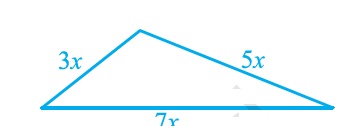
Then, we know that 3x + 5x + 7x = 300 (perimeter of the triangle)
Therefore, 15x = 300, which gives x = 20.
So the sides of the triangle are 3 x 20 m, 5 x 20 m and 7 x 20 m
i.e., 60 m, 100 m and 140 m.
We have s \(=\frac{60+100+140}{2} \mathrm{~m}=150 \mathrm{~m}\)
and area will be \(\sqrt{150(150-60)(150-100)(150-140)} \mathrm{m}^{2}\)
\(=\sqrt{150 \times 90 \times 50 \times 10} \mathrm{~m}^{2}\)
\(=1500 \sqrt{3} \mathrm{~m}^{2}\)
4.
336 cm2 , 22.4 cm
5.
74.97 cm2
6.
'a' = a, 'b' =a, 'c' =a
\(s=\frac { 'a'+'b'+'c' }{ 2 } =\frac { a+a+a }{ 2 } =\frac { 3a }{ 2 } \)
\(\therefore \) Area of the signal board
\(=\sqrt { s(s-'a')(s-'b')(s-'c') } \)
\(\\ =\sqrt { \frac { 3a }{ 2 } \left( \frac { 3a }{ 2 } -a \right) \left( \frac { 3a }{ 2 } -a \right) \left( \frac { 3a }{ 2 } -a \right) } \)
\(\\ =\sqrt { \frac { 3a }{ 2 } \left( \frac { a }{ 2 } \right) \left( \frac { a }{ 2 } \right) \left( \frac { a }{ 2 } \right) } =\sqrt { \frac { { 3a }^{ 4 } }{ 16 } } =\frac { \sqrt { 3 } }{ 4 } { a }^{ 2 }\)
Perimeter = 180 cm
\(\Rightarrow 'a'+'b'+'c'\ =\ 180\)
\(\\ \Rightarrow a+a+a=180\)
\(\\ \Rightarrow 3a=180\)
\(\\ \Rightarrow a=\frac { 180 }{ 3 } \)
\(\Rightarrow \) a = 60 cm
\(\therefore \) Area of the signal board
\(=\frac { \sqrt { 3 } }{ 4 } \) a2 =\( \frac { \sqrt { 3 } }{ 4 } \) (60)2 = \(900\sqrt { 3 } \) cm2
Alternatively,
\(s=\frac { 3a }{ 2 } =\frac { 3 }{ 2 } (60)=90\)cm
Area of the signal board
\(=\sqrt { s(s-'a')(s-'b')(s-'c') } \)
\(=\sqrt { 90(90-60)(90-60)(90-60) } \)
\(\\ =\sqrt { 90(30)(30)(30) } =900\sqrt { 3 } \) cm2.
7.
Rs.10500
8.
48 cm2
9.
Let the given field be in the shape of a trapezium ABCD in which AB=25 m, CD= 10 m, BC = 13 m and AD = 14 m.
From D, draw DE 11 BC meeting AB at E. Also, draw DF \(\bot \) AB.
\(\therefore \) DE = BC =13 m
AE = AB - EB = AB - DC
= 25 - 10 = 15 m
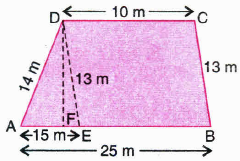
For AED
a = 14 m, b = 13 m, c= 15 m
\(\therefore s=\frac { a+b+c }{ 2 } =\frac { 14+13+15 }{ 2 } =\frac { 42 }{ 2 } =21\) m
\(\therefore \) Area of the \(\Delta \)AED \(=\sqrt { s(s-a)(s-b)(s-c) } \)
\(=\sqrt { 21(21-14)(21-13)(21-15) }\)
\( \\ =\sqrt { 21(7)(8)(6) } =\sqrt { \left( 7\times 3 \right) (7)\left( 4\times 2 \right) \left( 2\times 3 \right) } \)
\(=7\times 3\times 2\times 2=84\) m2
\(\Rightarrow \frac { 1 }{ 2 } \times \)AE\(\times \)DE = 84
\(\Rightarrow \ \frac { 1 }{ 2 } \times \)15\(\times \)DF = 84
\(\Rightarrow \) DF = \(\frac { 84\times 2 }{ 15 } \)
\(\Rightarrow \) DF= \(\frac { 56 }{ 5 } \) m = 11.2 m
\(\Rightarrow\) Height of the trapezium is 11.2 m.
\(\therefore \) Area of parallelogram EBCD = Base \(\times \) Height
= EB\(\times \) DF = 10 \(\times \)\(\frac { 56 }{ 5 } \) = 112 m2
\(\therefore \) Area of the field = Area of AED + Area of parallelogram EBCD = 84 m2 + 112 m2 = 196 m2.
10.
For \(\Delta \)ABC
a = 4 cm, b = 5 cm, c = 3 cm
\(\because \) a2 + c2 = b2
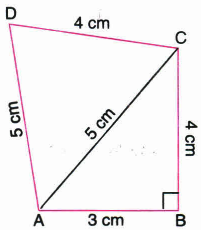
\(\therefore \) \(\Delta \)ABC is right angled with \(\angle B=90°\).
\(\therefore \) Area of right triangle ABC = \(\frac { 1 }{ 2 } \times \)Base \(\times \) Height
\(=\frac { 1 }{ 2 } \times 3\times 4=6\) cm2
For \(\Delta \)ACD
a = 4 cm, b = 5 cm, c = 5 cm
\(\therefore s=\frac { a+b+c }{ 2 } =\frac { 4+5+5 }{ 2 } =\frac { 14 }{ 2 } =7\) cm
\(\therefore \) Area of the ACD \(=\sqrt { s(s-a)(s-b)(s-c) } \)
\(=\sqrt { 7(7-4)(7-5)(7-5) }\)
\( \\ =\sqrt { 7(3)(2)(22) }\)
\(=\ 2\sqrt { 21 } \) cm2
= 2\(\times \) 4.6 cm2 (approx.) =9.2 cm2 (approx.)
\(\therefore \) Area of the equilateral ABCD = Area of \(\Delta \) ABC+Area of \(\Delta \)ACD
= 6 cm2 + 9.2 cm2 = 15.2 cm2 (approx.)
11.
Let ABC be the right angled triangle right angled at B. Let O be the centre of the circumcircle.
Then, O is the midpoint of the hypotenuse AC. I by geometry
OA = OB =OC
= Radius of the circumcircle = 3 cm
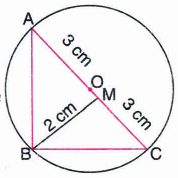
\(\therefore \) Hypotenuse AC = Diameter of the circle
= 2 \(\times \) Radius of the circumcircle
= 2 \(\times \) 3 = 6 cm
Let BM be the perpendicular from B on AC.
\(\therefore \) BM =2 cm
\(\therefore \) Area of the right angled triangle ABC
= \(\frac { 1 }{ 2 } \) \(\times \)Base \(\times \) Altitude
= \(\frac { 1 }{ 2 } \)\(\times \) AC \(\times \) BM = \(\frac { 1 }{ 2 } \)\(\times \) 6\(\times \) 2 = 6 cm2.
12.
\(\therefore \) Side = 8 cm
\(\therefore \) Perimeter = 6\(\times \)8 = 48 cm
Area of equilateral triangle OAB = \(\frac { \sqrt { 3 } }{ 4 } \) (side)2
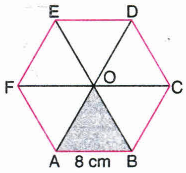
= \(\frac { \sqrt { 3 } }{ 4 } \)(8)2 = 16 \(\sqrt { 3 } \) cm2
\(\therefore \) Area of the regular hexagon = 6 Area of equilateral triangle OAB
= 6\(\times \)16\(\sqrt { 3 } \) = 96\(\sqrt { 3 } \) cm2.
13.
b + b + 6 = 24
\(\Rightarrow \) b = 9 cm
\(\therefore \) Area \(=\frac { 9 }{ 4 } \sqrt { 4{ b }^{ 2 }-{ a }^{ 2 } } =\frac { 6 }{ 4 } \sqrt { 4{ (9) }^{ 2 }-{ (6) }^{ 2 } } \)
\(=\frac { 3 }{ 2 } \sqrt { 288 } =\frac { 3 }{ 2 } .12\sqrt { 2 } \)
\( 18\sqrt { 2 } \) cm2
14.
Let the third side be x cm. Then, 12 + 12 + x = 30
24 + x = 30
x = 6 cm
So, a = 12 cm, b = 12 cms, c = 6 cm
\(\therefore s=\frac { a+b+c }{ 2 } =\frac { 12+12+6 }{ 2 } \)
= 15 cm
\(\therefore \) Area \(=\sqrt { s(s-a)(s-b)(s-c) } \)
\(=\sqrt { 15(15-12)(15-12)(15-6) } \)
\(=9\sqrt { 15 } \) cm2
15.
Let the sides of the triangle be 13k, 14k, and 15k (in cm).Then,
Perimeter = a + b + c = 13K + 14k + 15k = 42k cm
According to the question, 42k = 84
\(\Rightarrow k=\frac { 84 }{ 42 } =2\)
\(\therefore \) Sides are 26 cm, 28 cm, and 30 cm.
\(\therefore s=\frac { a+b+c }{ 2 } =\frac { 26+28+30 }{ 2 } \)
= 42 cm
\(\therefore \) Area \(=\sqrt { s(s-a)(s-b)(s-c) } \)
\(=\sqrt { 42(42-26)(42-28)(42-30) } \)
\(\\ =\sqrt { (42)(16)(14)(12) } \)
= 336 cm2
16.
Formula
17.
Area = \(\frac { Base\times Perpendicular }{ 2 } =\frac { 6\times 8 }{ 2 } \) = 24 cm2
18.
(c)
8 cm
19.
(c)
5 cm
20.
Area \(=\frac { \sqrt { 3 } }{ 4 } { a }^{ 2 }=\frac { \sqrt { 3 } }{ 4 } { \left( 4 \right) }^{ 2 }=4\sqrt { 3 } \) cm2

9th Standard CBSE Syllabus & Materials
9th Standard CBSE
CBSE 9th Standard Mathematics Surface Areas and Volumes Sample Question Papers Study Material - QB365 Set B
NEW9th Standard CBSE
CBSE 9th Standard Mathematics Surface Areas and Volumes Sample Question Papers Study Material - QB365 Set A
NEW9th Standard CBSE
CBSE 9th Standard Mathematics Heron's Formula Sample Question Papers Study Material - QB365 Set D
NEW9th Standard CBSE
CBSE 9th Standard Mathematics Heron's Formula Sample Question Papers Study Material - QB365 Set C



NCERT Books

Syllabus

Exam Pattern

Sample Question Papers

Previous year Question Papers

Important Notes

MCQ Practice test

NCERT Exemplers

Case study Questions

Image Based Questions

Passage based Questions

HOT Questions

Value Based Questions

Model Questions Papers
NCERT ( Book Back ) Questions

Assertion and Reason
Important Questions And Answers

CBSE 9th Standard CBSE Subjects
CBSE Standards