9th Standard CBSE Syllabus & Materials
9th Standard CBSE
CBSE 9th Standard Mathematics Statistics Sample Question Papers Study Material - QB365 Set D
NEW9th Standard CBSE
CBSE 9th Standard Mathematics Statistics Sample Question Papers Study Material - QB365 Set C
NEW9th Standard CBSE
CBSE 9th Standard Mathematics Statistics Sample Question Papers Study Material - QB365 Set B
NEW9th Standard CBSE
CBSE 9th Standard Mathematics Statistics Sample Question Papers Study Material - QB365 Set A
NEW9th Standard CBSE
CBSE 9th Standard Mathematics Surface Areas and Volumes Sample Question Papers Study Material - QB365 Set D
NEW9th Standard CBSE
CBSE 9th Standard Mathematics Surface Areas and Volumes Sample Question Papers Study Material - QB365 Set C

Published on: 09/09/2022
QB365 provides a detailed and simple solution for every Possible Case Study Questions in Class 9th Science Subject - Matter in Our Surroundings, CBSE. It will help Students to get more practice questions, Students can Practice these question papers in addition to score best marks.
Download CBSE Class 9th Standard CBSE Science question papers, sample papers, important questions, and previous year solved papers in PDF format. Get free study materials, NCERT solutions, and exam preparation resources for Class 9th Standard CBSE Science
Questions + Answers key
Take MCQ Science Test
1.
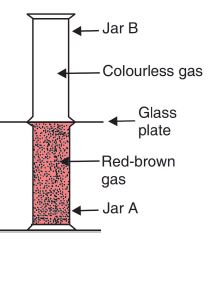
Look at the diagram on the right side. Jar A contains a red-brown gas whereas jar B contains a colourless gas. The two gas jars are separated by a glass plate placed between them. We observe that the red-brown gas will diffuse from jar A into colourless gas in jar B due to which is red-brown colour will also spread into jar B
(i) What name is given to the phenomenon which takes place ?
| (a) distribution | (b) intrusion | (c) diffusion | (d) effusion |
(ii) Name the brown gas which could be in jar A.
| (a) Bromine vapour | (b) carbon vapour |
| (c) sulphur vapour | (d) phosporous vapour |
(iii) Which is the colourless gas most likely to be present in jar B ?
| (a) Bromine vapour | (b) oxygen | (c) air | (d) None of these |
(iv) When a gas jar full of air is placed upside down on a gas jar full of bromine vapours, the red-brown vapours of bromine from the lower jar go upward into the jar containing air. In this experiment :
(a) air is heavier than bromine
(b) both air and bromine have the same density
(c) bromine is heavier than air
(d) bromine cannot be heavier than air because it is going upwards against gravity
(v) When a gas jar containing colourless air is kept upside down over a gas jar full of brown-coloured bromine vapour, then after some time, the brown colour of bromine vapour spreads into the upper gas jar making both the gas jars appear brown in colour. Which of the following conclusion obtained from these observations is incorrect ?
(a) bromine vapour is made of tiny particles which are moving
(b) air is made up of tiny particles which are moving
(c) the particles of bromine are moving but those of air are not moving
(d) even though bromine vapour is heavier than air, it can move up against gravity
1.
(i) (c) diffusion
(ii) (a) Bromine vapour
(iii) (c) air
(iv) (c) bromine is heavier than air
(v) (c) the particles of bromine are moving but those of air are not moving

9th Standard CBSE Syllabus & Materials
9th Standard CBSE
CBSE 9th Standard Mathematics Surface Areas and Volumes Sample Question Papers Study Material - QB365 Set B
NEW9th Standard CBSE
CBSE 9th Standard Mathematics Surface Areas and Volumes Sample Question Papers Study Material - QB365 Set A
NEW9th Standard CBSE
CBSE 9th Standard Mathematics Heron's Formula Sample Question Papers Study Material - QB365 Set D
NEW9th Standard CBSE
CBSE 9th Standard Mathematics Heron's Formula Sample Question Papers Study Material - QB365 Set C



CBSE 9th Standard CBSE Subjects
CBSE Standards