
12th Standard Syllabus & Materials
12th Standard
TN 12th Standard Biology Zoology - Reproduction in Organisms Creative Questions Study Material - QB365 Set D
NEW12th Standard
TN 12th Standard Biology Zoology - Reproduction in Organisms Creative Questions Study Material - QB365 Set C
NEW12th Standard
TN 12th Standard Biology Zoology - Reproduction in Organisms Creative Questions Study Material - QB365 Set B
NEW12th Standard
TN 12th Standard Biology Zoology - Reproduction in Organisms Creative Questions Study Material - QB365 Set A
NEW12th Standard
TN 12th Standard Physics Electronics and Communication Creative Questions Study Material - QB365 Set D
NEW12th Standard
TN 12th Standard Physics Electronics and Communication Creative Questions Study Material - QB365 Set C

Published on: 28/11/2025
Download Tamil Nadu 12th Standard Physics question papers, model tests, one-mark questions, important questions, and public exam papers in PDF format. Free study materials and answer keys for TN State Board students.
Questions + Answers key
Take MCQ Physics Test
Multiple Choice Question
1.
If the velocity and wavelength of light in air is Va and λa and that in water is Vw and λw, then the refractive index of water is______.
\(\frac{V_W}{V_a}\)
\(\frac{V_a}{V_W}\)
\(\frac{\lambda_W}{\lambda_a}\)
\(\frac{{V_a}\lambda_a}{{V_W}\lambda_W}\)
2.
The wavelength λe of an electron and λp of a photon of same energy E are related by _____.
λp ∝ λe
\({ \lambda }_{ p }∝ \sqrt { { \lambda }_{ e } } \)
\({ \lambda }_{ p }∝ \frac { 1 }{ \sqrt { { \lambda }_{ e } } } \)
\({ \lambda }_{ p }∝ { \lambda }_{ e }^{ 2 }\)
3.
4.
Two radiations with photon energies 0.9 eV and 3.3 eV respectively are falling on a metallic surface successively. If the work function of the metal is 0.6 eV, then the ratio of maximum speeds of emitted electrons in the two cases will be _____.
1:4
1:3
1:1
1:9
5.
The threshold wavelength for a metal surface whose photoelectric work function is 3.313 eV is _____.
4125 \(\mathring { A } \)
3750\(\mathring { A } \)
6000\(\mathring { A } \)
2062.5\(\mathring { A } \)
6.
Photons of wavelength λ are incident on a metal. The most energetic electrons ejected from the metal are bent into a circular arc of radius R by a perpendicular magnetic field having magnitude B. The work function of the metal is _____.
\(\frac { hc }{ \lambda } -{ m }_{ e }+\frac { e^{ 2 }{ B }^{ 2 }{ R }^{ 2 } }{ { 2m }_{ e } } \)
\(\frac { hc }{ \lambda } +{ 2m }_{ e }{ \left[ \frac { eBR }{ { 2m }_{ e } } \right] }^{ 2 }\)
\(\\ \frac { hc }{ \lambda } -{ m }_{ e }{ c }^{ 2 }-\frac { e^{ 2 }{ B }^{ 2 }{ R }^{ 2 } }{ { 2m }_{ e } } \)
\(\frac { hc }{ \lambda } -{ 2m }_{ e }{ \left[ \frac { eBR }{ { 2m }_{ e } } \right] }^{ 2 }\)
7.
8.
In a hydrogen atom, the electron revolving in the fourth orbit, has angular momentum equal to _____.
h
\(\frac{h}{\pi}\)
\(\frac{4h}{\pi}\)
\(\frac{2h}{\pi}\)
9.
10.
The electric potential of an electron is given by \(V={ V }_{ 0 } \ In\left( \frac { r }{ { r }_{ 0 } } \right) \), where r0 is a constant. If Bohr atom model is valid, then variation of radius of nth orbit rn with the principal quantum number n is _____.
\({ r }_{ n }∝ \frac { 1 }{ n } \)
\({ r }_{ n }∝ n\)
\({ r }_{ n }∝\frac { 1 }{ { n }^{ 2 } } \)
\({ r }_{ n }∝ { n }^{ 2 }\)
11.
Mp denotes the mass of the proton and Mn denotes mass of a neutron. A given nucleus of binding energy B, contains Z protons and N neutrons. The mass M(N, Z) of the nucleus is given by _____.(where c is the speed of light)
M (N,Z) = NMn + ZMp - Bc2
M (N,Z) = NMn + ZMp + Bc2
M (N,Z) = NMn + ZMp - B/c2
M (N,Z) = NMn + ZMp + B/c2
12.
The materials used in Robotics are _____.
Aluminium and silver
Silver and gold
Copper and gold
Steel and aluminum
13.
Light of wavelength falls on a metal having work function \(\frac { { h }_{ c } }{ { \lambda }_{ 0 } } \). Photo electric effect will place only if __________.
λ ≥ λ0
λ ≥ 2λ0
λ ≤ λ0
λ < λ0/2
14.
When an electron is accelerated with potential difference V, its de Broglie wavelength is directly proportional to _____________.
V
V-1
V1/2
V-1/2
15.
To get three images of a single object, one should have two plane mirror at an angle of ______________.
30°
60o
90°
120°
2 Marks
16.
What are mirage and looming?
17.
How does an endoscope work?
18.
What are coherent sources?
19.
What are cathode rays?
20.
What are the constituent particles of neutron and proton?
21.
A diffraction grating consists of 4000 slits per centimeter. It is illuminated by a monochromatic light. The second order diffraction maximum is produced at an angle of 30°. What is the wavelength of the light used?
22.
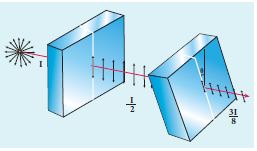
Two polaroids are kept with their transmission axes inclined at 30o. Unpolarised light of intensity I falls on the first polaroid. Find out the intensity of light emerging from the second polaroid.
23.
Why we do not see the wave properties of a baseball?
24.
Write the drawbacks of Rutherford atom model.
3 Marks
25.
Derive the equation for effective focal length for lenses in contact.
26.
Derive the energy expression for an electron is the hydrogen atom using Bohr atom model.
27.
Calculate the time required for 60% of a sample of radon undergo decay. Given T1/2 of radon = 3.8 days.
28.
Explain about compound microscope and obtain the equation for the magnification.
29.
(a) Calculate the disintegration energy when stationary \(_{ 92 }^{ 232 }{ U }\) nucleus decays to thorium \(_{ 90 }^{ 228 }{ Th }\) with the emission of α particle. The atomic masses are of \(_{ 92 }^{ 232 }{ U }\) = 232.037156 u, \(_{ 90 }^{ 228 }{ Th }\) = 228.028741u and \(_{ 2 }^{ 4 }{ He }\) = 4.002603 u
(b) Calculate kinetic energies of \(_{ 90 }^{ 228 }{ Th }\) and α-particle and their ratio.
30.
A thin rod of length f /3 is placed along the optical axis of a concave mirror of focal length f such that one end of image which is real and elongated just touches the respective end of the rod. Calculate the longitudinal magnification.
31.
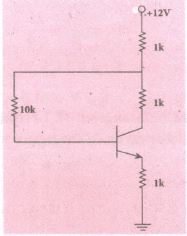
A transistor having α = 0.99 and VBE = 0.7V, is connected in the common-cmiitter configuration as shown in figure. If the transister is in saturation region, find the value of the collector current.
32.
How many photons of frequency 1014 Hz will make up 19.86 J of energy?
33.
Light of wavelength 390 nm is directed at a metal electrode. To find the energy of electrons ejected, an opposing potential difference is established between it and another electrode. The current of photoelectrons from one to the other is stopped completely when the potential difference is 1.10 V. Determine i) the work function of the metal and ii) the maximum wavelength of light that can eject electrons from this metal.
5 Marks
34.
Derive the mirror equation and the equation for lateral magnification.
35.
Discuss the Millikan’s oil drop experiment to determine the charge of an electron.
36.
Derive the equation for refraction at single spherical surface.
37.
Describe the working of nuclear reactor with a block diagram.
38.
Derive the equation for angle of deviation produced by a prism and thus obtain the equation for refractive index of material of the prism.
39.
Explain the Young’s double slit experimental setup and obtain the equation for path difference.
40.
Explain the construction and working of a full wave rectifier
41.
Describe the function of a transistor as an amplifier with the neat circuit diagram. Sketch the input and output wave forms.
42.
Give the quantum concept of energy proposed by Max Planck.
43.
Explain experimentally observed facts of photoelectric effect with the help of Einstein’s explanation.
Multiple Choice Question
1.
Refractive index of water \(=\frac{Velocity \ of \ light \ in \ air(V_s)}{Velocity \ of \ light \ in \ water(V_w)}\)
2.
\(\mathrm{E}_{\mathrm{p}} =\frac{\mathrm{hc}}{\lambda_{\mathrm{p}}} \)
\(\mathrm{E}_{\mathrm{e}} =\frac{\mathrm{h}^2}{2 \mathrm{~m} \lambda_{\mathrm{e}}^2} \)
\(\frac{\mathrm{hc}}{\lambda_{\mathrm{p}}} =\frac{\mathrm{h}^2}{2 \mathrm{~m} \lambda_{\mathrm{e}}^2} \)
\(\lambda_{\mathrm{p}} \propto \lambda_{\mathrm{e}}^{{ }^2}\)
3.
(b)
4.
K.E= hv - Φ
K.E1 = 0.9 - 0.6 = 0.3 eV
K.E2 = 3.3 - 0.6 = 2.7 ev
K.E ∝ v2
\(\frac{0.3}{2.7}=\frac{v^2_1}{v^2_2} \)
\(\frac{v^1}{v^2} =\frac{1}{3}\)
5.
\(\lambda_0 =\frac{h c}{\phi} \)
\(=\frac{6.626 \times 10^{-34} \times 3 \times 10^8}{3.313 \times 1.6 \times 10^{-19}} \)
\( =\frac{19.8782400}{5.3} \times 10^{-7} \)
\(\lambda_0 =3.750 \times 10^{-7} \simeq 3750 \stackrel{o}A\)
6.
\(\text {K.E } =\frac{B^2 q^2 r^2}{2 m} \)
\(\phi =\frac{h c}{\lambda}-K . E \)
\(=\frac{h c}{\lambda}-\frac{B^2 q^2 r^2}{2 m} \)
\(\phi =\frac{h c}{\lambda}-2 m\left(\frac{B q r}{2 m}\right)^2\)
7.
(b)
8.
\(L=\frac{nh}{2\pi}=\frac{4h}{2\pi}=\frac{2h}{\pi}\)
9.
(b)
10.
Electric potential in nth orbit
\(\mathrm{V} =\mathrm{V}_0 \ln \left(\frac{\mathrm{r}_{\mathrm{n}}}{\mathrm{r}_0}\right) \)
\(=\mathrm{V}_0\left(\ln \mathrm{r}_{\mathrm{n}}-\ln \mathrm{r}_0\right) \)
\(=\mathrm{V}_0 \ln \mathrm{r}_{\mathrm{n}}-\mathrm{V}_0 \ln \mathrm{r}_0\)
\(\left|\mathrm{F}_\epsilon\right|=\mathrm{e} \frac{\mathrm{dv}}{\mathrm{dr}} =\mathrm{e} \frac{\mathrm{d}}{\mathrm{dr}}\left(\mathrm{V}_b / n \mathrm{r}_B-\mathrm{V}_0 / m \mathrm{r}_0\right) \)
\(=\mathrm{c}\left(\frac{\mathrm{V}_0}{\mathrm{r}_n}-0\right)=\frac{\mathrm{eV}}{\mathrm{r}_{\mathrm{n}}} \)
Centripetal force = coulomb force
\(\frac{m v^2}{r_n}=\mathrm{c} \frac{V_0}{r_n} \Rightarrow v=\sqrt{\frac{e V_0}{m}}=\text { constant }\)
Angular momentum,
\(\mathrm{mvr}_n=\frac{\mathrm{nh}}{2 \pi}\)
\(\mathrm{m}, \mathrm{v}, \mathrm{h}, 2 \pi\) are constants
hence, rn ∝ n
11.
B = ∆m x c2
∆m = \(\frac{B}{c^2}\)
N Mn + Z Mp - M(N,Z) = \(\frac{B}{c^2}\)
N (N,Z) = N Mn + ZMp - \(\frac{B}{c^2}\)
12.
(d)
Steel and aluminum
13.
(c)
λ ≤ λ0
14.
(d)
V-1/2
15.
(c)
90°
2 Marks
16.
Mirage:
Mirage is an optical illusion caused by atmospheric conditions especially the appearance of sheet of water in a desert caused by total internal reflection (or) refraction of light from the sky by heated air.
Looming:
Looming is an optical illusion caused by bending of light which appear an object floating high above its actual position specially in polar region.
17.
An endoscope is an instrument used by doctors which has a bundle of optical fibres that are used to see inside a patient's body. Endoscopes work on the phenomenon of total internal reflection. The optical fibres are inserted in to the body through mouth, nose or a special hole made in the body.
18.
Two light sources are said to be coherent if they produce waves which have same phase or constant phase difference, same frequency or wavelength (monochromatic), same waveform and preferably same amplitude.
19.
(i) When the pressure of the gas in discharge tube is reduced to around 0.01 mm of Hg, positive column disappears.
(ii) At this time, a dark space is formed between anode and cathode which is called Crooke's dark space.
(iii) The walls of the tube appear with green colour.
(iv) At this stage, some invisible rays emanate from cathode called cathode rays, which are beam of electrons.
20.
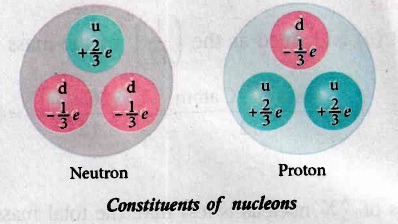
According to quark model,
(i) Proton is made up of two up quarks and one down quark.
(ii) Neutron is made up of one up quark and two down quarks.
21.
Number of lines per cm = 4000 cm-1; m = 2; θ = 30°; λ = ?
Number of lines per unit length
\(N=\cfrac { 4000 }{ 1\times { 10 }^{ -2 } } =4\times { 10 }^{ 5 }\)
Equation for diffraction maximum in grating is, sinθ = Nmλ
After Rewriting, \(\lambda =\cfrac { sin\theta }{ Nm } \)
Substituting,
\(\lambda =\cfrac { { \sin30 }^{ o } }{ 4\times { 10 }^{ 5 }\times 2 } =\cfrac { 0.5 }{ 4\times { 10 }^{ 5 }\times 2 } \)
= \(\cfrac { 1 }{ 2\times 4\times { 10 }^{ 5 }\times 2 } =\cfrac { 1 }{ 16 \times 10^5} \)
λ = 6250 x 10-10 m = 6205 Å
22.
As the intensity of the unpolarised light falling on the first polaroid is I, the intensity of polarized light emerging from will be, \({ I }_{ 0 }=\left( \cfrac { 1 }{ 2 } \right) \)
Let I' be the intensity of light emerging from the second polaroid.
Malus’ law, I' = Io = cos2θ
Substituting,
\({ I }^{ ' }=\left( \cfrac { 1 }{ 2 } \right) { cos }^{ 2 }\left( { 30 }^{ o } \right) =\left( \cfrac { 1 }{ 2 } \right) \left( \cfrac { \sqrt { 3 } }{ 2 } \right) ^{ 2 }=1\cfrac { 3 }{ 8 } \)
\(I'=\left( \cfrac { 3 }{ 8 } \right) I\)
23.
Due to the large mass of a baseball, the de Broglie wavelength (⋋ = h/mv) associated with a moving baseball is very small. Hence, its wave nature is not visible.
24.
(i) Rutherford atom model fails to explain the distritbution of electrons around the nucleus and also stability of the atom.
(ii) Acording to this model, emission of radiation of atoms give continuous emission spectrum but experiment shows atom gives line emission spectrum.
3 Marks
25.
Consider two lenses 1 and 2 of focal length f1 and f2 are placed coaxially in contact with each other so that they have a common principal axis.
O be the object which is placed beyond the focus of the first lens on the principal axis. I' is the image of object O which is formed beyond the lens 2. Then, I' acts as an object for the lens 'P' is the common optical centre of the two lenses.
From the figure, PO =u, PI' = v' for lens I
PI' = v' (object distance) PI = v (image distance) for lens 2
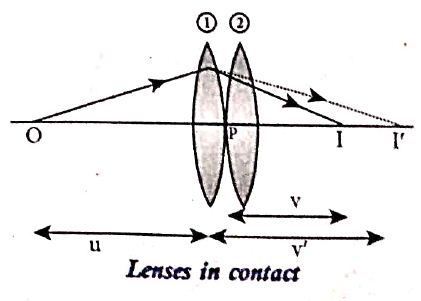
For lens 1,
\(\cfrac { 1 }{ v' } -\cfrac { 1 }{ u } =\cfrac { 1 }{ { f }_{ 1 } } \) .........(1)
For lens 2,
\(\cfrac { 1 }{ v } -\cfrac { 1 }{ u' } =\cfrac { 1 }{ { f }_{ 2 } } \) .........(2)
Adding (1) of (2)
\(\cfrac { 1 }{ v } -\cfrac { 1 }{ u } =\cfrac { 1 }{ f_1 }+\cfrac{1}{f_2} \) .........(3)
(vi) If the combination acts as a single lens of focal length f so that for an object at the position O it forms the image at I,
Then,
\(\cfrac { 1 }{ v } -\cfrac { 1 }{ u } =\cfrac { 1 }{ f } \) .........(4)
Comparing equations (3) and (4) we can write,
\(\cfrac { 1 }{ F } =\cfrac { 1 }{ { f }_{ 1 } } +\cfrac { 1 }{ { f }_{ 2 } } \) .........(5)
The above equation can be extended for any number of lenses in contact as,
\(\cfrac { 1 }{ f } =\cfrac { 1 }{ { f }_{ 1 } } +\cfrac { 1 }{ { f }_{ 2 } } +\cfrac { 1 }{ { f }_{ 3 } }+\cfrac { 1 }{ { f }_{ 4 } } +..........\)
26.
The electrostatic force is a conservative force, the potential energy for the electron in nth orbit is
\(U_{n} =\frac{1}{4 \pi \varepsilon_{0}} \frac{(+Z e)(-e)}{r_{n}}=-\frac{1}{4 \pi \varepsilon_{0}} \frac{Z^{2}}{r_{n}} \) \(\left[ \because r_n=\frac{\varepsilon_{0} h^{2} n^{2}}{\pi m Z e^{2}}\right]\)
\(U_{n} =-\frac{1}{4\varepsilon_{0}} -\frac{Z^{2} \mathrm{me}^{4}}{h^{2} n^{2}} \)
The kinetic energy of electron in nth orbit is
\(\mathrm{KE}_{\mathrm{n}}=\frac{1}{2} \mathrm{mv}_{\mathrm{n}}^{2}=\frac{\mathrm{Z}^{2} m \mathrm{e}^{4}}{8 \varepsilon_{0}^{2} \mathrm{~h}^{2} \mathrm{n}^{2}}\)
This implies that Un = -2KEn
Total energy of electron in the nth orbit is
\(E_{n}=K E_{n}+U_{n}=K E_{n}-2 K E_{n}=-K E_{n} \)
\(E_{n}=-\frac{Z^{2} m e^{4}}{8 \varepsilon_{0}^{2} h^{2} n^{2}} \)
For Hydrogen atom Z = 1
\(E_{n}=-\frac{m e^{4}}{8 \varepsilon_{0}^{2} h^{2} n^{2}} \text { joule }\)
n - principal quantum number
The negative sign indicates that the electron is bound to the nucleus.
Substituting the values of mass and charge of an electron (m and e), permittivity of free space \(\varepsilon^{0}\) and Planck's constant h and expressing in terms of (+(eV)), we get
\(E_{n}=-13.6\left(\frac{1}{n^{2}}\right) e V\)
(i) For the first orbit (ground state), the total energy of electron is E1 = - 13.6 eV.
(ii) For the second orbit (first excited state), the total energy of electron is E2 = -3.4 eV.
(iii) For the third orbit (second excited state), the total energy of electron is E3 = -1.51 eV and so on.
27.
Decayed = 60 %
Left undecayed = 40 %(ie) \(\frac{\mathrm{N}}{\mathrm{N}_{0}}=\frac{40}{100} \)
\(\mathrm{~T}_{\frac{1}{2}}=3.8 \text { days } \)
\(\mathbf{N}=\mathrm{N}_{0} \mathrm{e}^{-\lambda t} \)
\(\frac{\mathrm{N}}{\mathrm{N}_{0}}=\mathrm{e}^{-\lambda t} \)
\(\frac{40}{100}=\mathrm{e}^{-\lambda t} \Rightarrow \frac{100}{40}=2.5=\mathrm{e}^{\lambda t} \)
\(\therefore \mathrm{e}^{\lambda t} \) = 2.5
Taking log on both sides
\(\lambda t=\ln [2.5]=2.3026 \times \log (2.5)=2.3026 \times 0.3974 \)
\(t=\frac{0.9163}{\lambda}=\frac{0.9163}{0.6931} \times T_{1 / 2} \)
\(t=1.322 \times 3.8=5.022 \text { days } \)
28.
(i) It forms a real, inverted and magnified image of the object. This serves as the object for the lens close to the eye called as eyepiece.
(ii) The eyepiece serves as a simple microscope that produces finally an enlarged and virtual image.
(iii) The first inverted image formed by the objective is to be adjusted within the focus of the eyepiece so that the final image is formed nearly at infinity (or) at the near point.
(iv) The final image is inverted with respect to the object
Magnification of compound microscope:
(i) From the ray diagram, the linear magnification due to the objective is,
\({ M }_{ 0 }=\cfrac { h' }{ h } \) ..............(1)
From the Figure,\(tan\beta =\cfrac { h }{ { f }_{ 0 } } =\cfrac { h' }{ L } \) then
\(\cfrac { h' }{ h } =\cfrac { L }{ { f }_{ 0 } } \) ...............(2)
\({ m }_{ 0 }=\cfrac { L }{ { f }_{ 0 } } \) ..............(3)
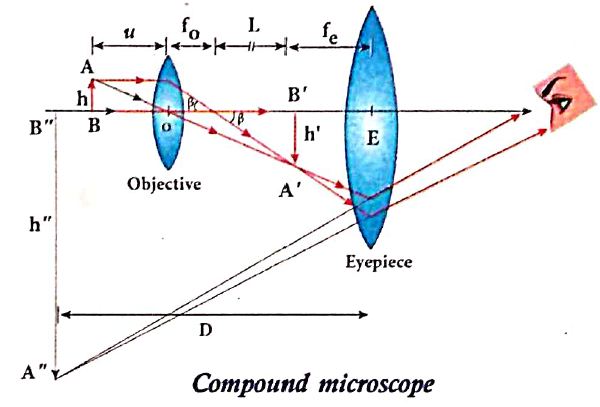
(ii) Here, the distance L is between the first focal point of the eyepiece to the second focal point of the objective. This is called the tube length of the microscope as f0 and fe are comparatively smaller than L.
(iii) If the final image is formed at (near point focussing); the magnification (me) of the eyepiece is,
\({ m }_{ e }=1+\cfrac { D }{ { f }_{ e } } \) ..............(4)
The total magnification m in near point focusing is,
\(m={ m }_{ 0 }{ m }_{ e }\left( \cfrac { L }{ { f }_{ 0 } } \right) \left( 1+\cfrac { D }{ { f }_{ e } } \right) \) ...............(5)
If the final image is formed at infinity (normal focusing), the magnification me of the eyepiece is,
\({ m }_{ e }=\cfrac { D }{ { f }_{ e } } \) ......................(6)
The total magnification m in normal focusing is,
\(m=m_{ 0 }{ m }_{ e }=\left( \cfrac { L }{ { f }_{ 0 } } \right) \left( \cfrac { D }{ { f }_{ e } } \right) \) ....................(7)
29.
The difference in masses
Δm = (mU - mTh - mα)
= (232.037156–228.028741 – 4.002603)u
The mass lost in this decay = 0.005812 u
Since 1u = 931MeV, the energy Q released is
Q = (0.005812 u) x (931 MeV / u)
= 5.41 MeV
This disintegration energy Q appears as the kinetic energy of α particle and the daughter nucleus. In any decay, the total linear momentum must be conserved.
Total linear momentum of the parent nucleus = total linear momentum of the daughter nucleus and α particle. Since before decay, the uranium nucleus is at rest, its momentum is zero. By applying conservation of momentum, we get
0 = \({ m }_{ Th }{ \overrightarrow { \upsilon } }_{ Th }+{ m }_{ \alpha }\overrightarrow { \upsilon } _{ \alpha }\)
\({ m }_{ \alpha }\overrightarrow { \upsilon } _{ \alpha }\) = - \({ m }_{ Th }{ \overrightarrow { \upsilon } }_{ Th }\)
It implies that the alpha particle and daughter nucleus move in opposite directions.
In magnitude mα ሀα = mTh ሀTh
The velocity of α particle ሀα = \(\frac { { m }_{ Th } }{ { m }_{ \alpha } } { \upsilon }_{ Th }\)
Since mTh > mα , ሀα > ሀTh. The ratio of the kinetic energy of α particle to that the daughter nucleus,
\(\frac { K.{ E }_{ \alpha } }{ K.{ E }_{ Th } } =\frac { 1/2{ m }_{ \alpha }{ { \upsilon }_{ \alpha } }^{ 2 } }{ 1/2{ m }_{ Th }{ { \upsilon }_{ Th } }^{ 2 } } \)
By substituting, the value of ሀα into the above equation, we get \(\frac { K.{ E }_{ \alpha } }{ K.{ E }_{ Th } } =\frac { { m }_{ Th } }{ { m }_{ \alpha } } =\frac { 228.02871 }{ 4.002603 } =57\)
The kinetic energy of α particle is 57 times greater than the kinetic energy of the daughter nucleus (\(_{ 90 }^{ 228 }{ Th }\))
The disintegration energy Q = total kinetic energy of products
K.Eα + K.ETh = 5.41 MeV
57K.ETh + K.E Th = 5.41 MeV
K.ETh = \(\frac{5.41}{58}\) MeV = 0.0093 MeV
K.Eα = 57K.ETh = 57 x 0.093 = 5.301 MeV
In fact, 98% of total kinetic energy is taken by the α particle.
30.
\(\text{ longitudinal magnifcation}(m_l)=\frac { length\ of\ image\left( l' \right) }{ length\ of\ object\left( l \right) } \)
Given: length of object, \(l=\cfrac { f }{ 3 } \)
For the given condition, the image formation is shown in the figure.
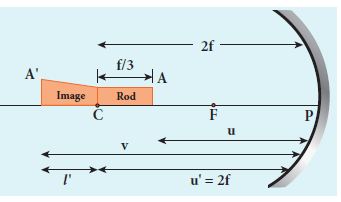
Let, l' be the length of the image, then
\(m=\cfrac { l' }{ l } =\cfrac { l' }{ f/3 } \) (or) \(l=\cfrac { m_lf }{ 3 } \)
Image of one end coincides with the object. Thus, the coinciding end must be at center of curvature.
\(u_B=u_A-\cfrac { f }{ 3 } =2f-\cfrac { f }{ 3 } =\cfrac { 5f }{ 3 } \)
\(v_B=u_B+l+l'\)
\(v_b =\cfrac { 5f }{ 3 } +\cfrac { f }{ 3 } +\cfrac { mf }{ 3 } =\cfrac { f(6+m) }{ 3 } \)
Mirror equation,\(\cfrac { 1 }{ v } +\cfrac { 1 }{ u } =\cfrac { 1 }{ f } \)
\(\cfrac { 1 }{ -\left( \cfrac { f(6+m_l) }{ 3 } \right) } +\cfrac { 1 }{ -\left( \cfrac { 5f }{ 3 } \right) } =\cfrac { 1 }{ -f } \)
After simplifying,
\(\cfrac { 3 }{ f(6+m_l) } +\cfrac { 3 }{ 5f } =\cfrac { 1 }{ f } ;\cfrac { 3 }{ (6+m_l) } =\cfrac { 2 }{ 5 } \)
\(6+m_l=\cfrac { 15 }{ 2 } ;m_l=\cfrac { 15 }{ 2 } -6\)
\(m_l=\cfrac { 3 }{ 2 } =1.5\)
31.
\(\mathrm{V}_{\mathrm{cc}}=12 \mathrm{~V}, \mathrm{R}_{\mathrm{B}}=10 \mathrm{k} \Omega, \mathrm{R}_{\mathrm{E}}=1 \mathrm{k} \Omega, \mathrm{R}_{\mathrm{c}}=1+1=2 \mathrm{k} \Omega, \alpha=0.99, \mathrm{~V}_{\mathrm{BE}}=0.7 \mathrm{~V}, \mathrm{I}_{\mathrm{c}}=?\)
\(\beta=\alpha /(1-\alpha)=0.99 /(1-0.99)=99\)
\(\mathrm{I}_{\mathrm{B}}=\mathrm{I}_{\mathrm{C}} / \beta=\mathrm{I}_{\mathrm{c}} / 99\)
Applying Kirchoff's Voltage law,
\(I_C R_C+I_n R_n+I_E R_E+V_{u t}=V\)
\(2 \times 10^3 \mathrm{I}_{\mathrm{C}}+10 \times 10^3\left(\mathrm{I}_{\mathrm{C}} / 99\right)+1 \times 10^3\left(\mathrm{I}_{\mathrm{C}}+\mathrm{I}_{\mathrm{C}} / 99\right)+0.7=12 \quad\left(\because \mathrm{I}_{\mathrm{E}}=\mathrm{I}_{\mathrm{n}}+\mathrm{I}_{\mathrm{C}}\right)\)
\(\therefore \mathrm{I}_{\mathrm{C}}=\frac{11.3 \times 10^{-3} \times 99}{298}\)
\(\mathrm{I}_{\mathrm{C}}=3.7 \times 10^{-3} \mathrm{~A}=3.7 \mathrm{~mA}\)
32.
\(v=10^{14} \mathrm{~Hz} ; \mathrm{E}=19.86 \mathrm{~J} \)
\(E=nhv \Rightarrow n=\frac{E}{hv}\)
\(=\frac{19.86}{6.626 \times 10^{-34} \times 10^{14}}=2.99 \times 10^{20} \)
\(\mathrm{n} \simeq 3 \times 10^{20} \)
33.
i) The work function is given by
ϕ0 = hv - Kmax = \(\frac { hc }{ \lambda } \) - eV0
since Kmax = eV0
\(=\left[ \frac { 6.626\times { 10 }^{ -34 }\times 3\times { 10 }^{ 8 } }{ 390\times 10^{ -9 } } \right] \) - [1.6 x 10-19 x 1.10]
= 5.10 x 10⁻¹⁹ - 1.76 x 10-19 = 3.34 x 10⁻¹⁹ J
= 2.09 eV
ii) The threshold wavelength is
\(\lambda_{0}=\frac{h c}{\phi_o}=\frac{6.626 \times 10^{-34} \times 3 \times 10^{8}}{3.34 \times 10^{-19}}\)
= 5.951 x 10⁻⁷ m = 5951 \(\mathring { A }\).
5 Marks
34.
Mirror Equation :
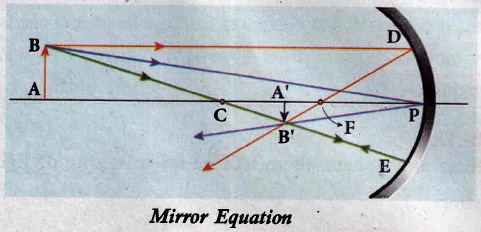
(i) AB is an object which is placed on the principal axis of a concave mirror beyond the center of curvature C. A' B' is an image which is formed between the point pole P, and the centre of curvature.
(ii) From the figure As per law of reflection, the angle of incidence ∠BPA is equal to the angle of reflection ∠B'PA'.
(iii) The triangles ∠BPA and ∠B'PA' are similar. Thus, from the rule of similar triangles,
\(\cfrac { { A }^{ ' }{ B }^{ ' } }{ AB } =\cfrac { { PA }^{ ' } }{ PA } \) ................(1)
(iv) The other set of similar triangles are, ΔDPF and ΔB'A'F. (PD is almost a straight vertical line)
\(\cfrac { { A }^{ ' }B' }{ PD } =\cfrac { A'F }{ PF } \)
(v) As, PD = AB the above equation becomes,
\(\cfrac { A'B' }{ AB } =\cfrac { A'F }{ PF } \) ......(2)
(vi) From equations (1) and (2) we can write,
\(\cfrac { PA' }{ PA } =\cfrac { A'F }{ PF } \)
(vii) As, A'F = PA' - PF, the above equation becomes,
\(\cfrac { PA' }{ PA } =\cfrac { PA'-PF }{ PF } \) .....(3)
(viii) We can apply the sign conventions for the various distances in the above equation
PA = - u, PA' = -v, PF = - f
(ix) All the three distances are negative as per sign convention, because they are measured to the left of the pole. Now, the equation (3) becomes,
\(\cfrac { -v }{ -u } =\cfrac { -v-\left( -f \right) }{ -f } \)
On further simplification,
\(\cfrac { v }{ u } =\cfrac { v-f }{ f } ;\cfrac { v }{ u } =\cfrac { v }{ f } -1 \)
Dividing either side with v,
\(\cfrac { 1 }{ u } =\cfrac { 1 }{ f } -\cfrac { 1 }{ v } \)
After rearranging,
\(\cfrac { 1 }{ v } +\cfrac { 1 }{ u } =\cfrac { 1 }{ f } \)
The above equation is called mirror equation.
Lateral magnification:
The lateral or transverse magnification is defined as the ratio of the height of the image to the height of the object. The height of the object and image are measured perpendicular to the principal axis.
Magnification (m) \(=\frac{\text { height of the image }\left(h^{\prime}\right)}{\text { height of the image }(h)} \)
\(m=\frac{h^{\prime}}{h} \) ....(1)
Applying proper sign conventions for equation,
\(\frac{A^{\prime} B^{\prime}}{A B}=\frac{P A^{\prime}}{P A} \)
\(A^{\prime} B^{\prime}=-h^{\prime}, A B=h, P A^{\prime}=-v, P A=-u \)
\(-\frac{h}{h}=\frac{-v}{-u} \)
On simplifying we get,
\(\mathrm{m}=\frac{\mathrm{h}^{\prime}}{\mathrm{h}}=-\frac{\mathrm{v}}{\mathrm{u}}\) ...(2)
Using mirror equation, we can further write the magnification as,
\(m=\frac{h^{\prime}}{h}=\frac{f-v}{f}=\frac{f}{f-u}\) ..(3)
35.
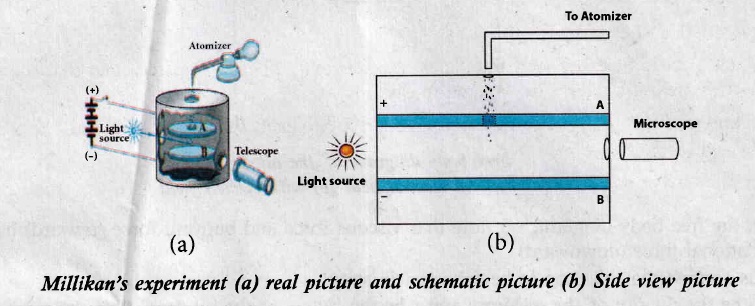
The motion of oil drop inside the chamber can be controlled by adjusting electric field. The oil drop can be moved up or down or even kept balanced in the field of view for sufficiently long time.
Construction:
(i) The apparatus consists of two horizontal circular metal plates A and B each with diameter around 20 cm and are separated by a small distance 1.5 cm.
(ii) These two parallel plates are enclosed in a chamber with glass walls.
(iii) Plates A and B are given a high potential difference around 10 kV such that electric field acts vertically downward
(iv) A small hole is made at the center of the upper plate A.
(v) Atomizer is kept above the hole to spray the liquid.
Working:
(i) When a fine droplet of highly viscous liquid (like glycerine) is sprayed using atomizer, it falls freely downward through the hole under the influence of gravity alone.
(ii) Few oil drops in the chamber can acquire electric charge (negative charge) because of friction with air or passage of x-rays in between the parallel plates.
(iii) The chamber is illuminated by light and oil drops can be seen clearly using microscope.
(iv) These drops can move either upwards or downward.
(v) Let m be the mass of the oil drop and q be its charge. Then the forces acting on the droplet are
(a) gravitational force Fg = mg
(b) electric force Fe = qE
(c) buoyant force Fb
(d) viscous force Fv
(a) Determination of radius of the droplet:
(i) When the electric field is switched off, the oil drop accelerates downwards. Due to presence of air drag forces, the oil drops attain its terminal velocity and moves with constant velocity.
(ii) This velocity can be measured by finding the time taken by the oil drop to fall through a predetermined distance.
.jpg)
(iii) From the free body diagram, we note that viscous force and buoyant force (upward) balance the gravitational force (downward).
(iv) Let us assume that oil drop to be spherical in shape.
(v) Let p be the density of the oil drop, and r be the radius of the oil drop, then the mass of the oil drop, the oil drop can be expressed in terms of its density as, \( \rho=m/v \Rightarrow m=\left(\frac{4}{3} \pi r^{3}\right) \rho\)
∵ (Volume of the sphere, V = \(\frac{4}{3} \pi r^{3})\)
Then gravitational force \(\mathrm{F}_{\mathrm{g}}=\mathrm{mg}=\left(\frac{4}{3} \pi \mathrm{r}^{3}\right) \rho g\)
(vi) Let σ be the density of air, the upthrust force experienced by the oil drop due to displaced air is \(F_{b}=\left(\frac{4}{3} \pi r^{3}\right) σ g\)
(vii) Once the oil drop attains a terminal velocity v, the net downward force acting on the oil drop is equal to the viscous force acting opposite to the direction of motion of the oil drop. From Stokes law, the viscous force on the oil drop is
\(\mathrm{F}_{\mathrm{v}}=6 \pi \eta \mathrm{rv}\)
(ix) From free body diagram, the force balancing equation is,
\(F_{g}=F_{b}+F_{v} \)
\(\left(\frac{4}{3} \pi r^{3}\right) \rho g=\left(\frac{4}{3} \pi r^{3}\right) \sigma g+6 \pi \eta r v \)
\(\frac{4}{3} \pi r^{3}(\rho-\sigma) g=6 \pi \eta r v \)
\(\frac{2}{3} r^{2}(\rho-\sigma) g=3 \eta v \)
Hence radius of the oil drop is \(r=\left[\frac{9 \eta v}{2(\rho-\sigma) g}\right]^{\frac{1}{2}} \ldots\) ........(1)
(b) Determination of electric charge:
(i) Now switch on the electric field.
(ii) Upward electric force on charged oil drops is qE.
(iii) Choose any one drop in the field of view of microscope.
(iv) Strength of the electric field is adjusted to make that particular drop to be stationary.
(v) Being oil drop is at rest, the viscous force acting on the oil drop is zero.
(vi) Then, from the free body diagram.
\(F_{g}=F_{b}+F_{v} \)
\(\left(\frac{4}{3} \pi r^{3}\right) \rho g=\left(\frac{4}{3} \pi r^{3}\right) \sigma g+q E \)
\(\frac{4}{3} \pi r^{3}(\rho-\sigma) g=q E \)
\(q=\frac{4}{3 E} \pi r^{3}(\rho-\sigma) g \ldots \ldots \ldots \ldots \ldots \) (2)
Substituting (1) in (2)
\(q=\frac{18 \pi}{E}\left(\frac{\eta^{3} v^{3}}{2(\rho-\sigma) g}\right)^{\frac{1}{2}}\)
(vii) Millikan repeated this experiment several times and computed the charges on oil drops. He found that the charge of any oil drop can be written as integral multiple of a basic value, -1.6 x 10⁻¹⁹ C which is nothing but the charge of an electron.
36.
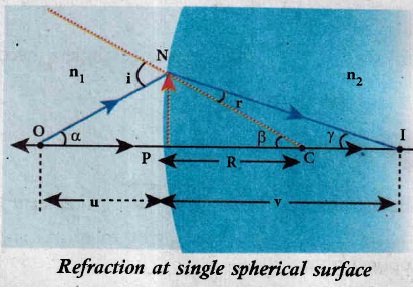
(i) Let us consider two transparent media with refractive indices n, and n, which are separated by a spherical surface. Let C be the centre of curvature of the spherical surface. Let a point object O be in the medium n.
(ii) The line OC cuts the spherical surface at the pole P of the surface. As the rays considered are paraxial rays, the perpendicular dropped for the point of incidence to the principal axis is very close to the pole (or) passes through the pole itself.
(iii) Light from O falls on the refracting surface at N. The normal drawn at the point of incidence passes through the centre of curvature C.
(iv) As n2 > n1 light in the denser medium deviates towards the normal and meets the principal axis at I where the image is formed.
(v) Snell's law in product form for the refraction at the point N can be written from the cquation,
n1 sin i = n2 sin r ...(1)
(vi) As the angles are small, sine of the angle could be approximated to the angle itself,
n1 i = n2r .........(2)
Let the angles be,
\(\angle NOP=\alpha ,\angle NCP=\beta ,\angle NIP=\gamma \)
From the right angle triangles, ∆NOP, ∆NCP and ∆NIP
\(tan\alpha =\cfrac { PN }{ PO } ;tan\beta =\cfrac { PN }{ PC } ;tan\gamma =\cfrac { PN }{ PI } \)
As these angles are small, tan of the angle could be approximated to the angle itself.
\(\alpha =\cfrac { PN }{ PO } ;\beta =\cfrac { PN }{ PC } ;\gamma =\cfrac { PN }{ PI } \) ................(3)
For the triangle, ΔONC,
\(i=\alpha +\beta \) ......(4)
For the triangle, ΔINC,
\(\beta =r+\gamma (or)r=\beta -\gamma \) ...............(5)
Substituting for i and r from equations (4) and (5) in equation (2),
\({ n }_{ 1 }(\alpha +\beta )={ n }_{ 2 }\left( { \beta -\gamma } \right) \)
After rearranging,
\({ n }_{ 1 }a+{ n }_{ 2 }\gamma =\left( { n }_{ 2 }-{ n }_{ 1 } \right) \beta \)
Substituting for α, β and y from equation
\({ n }_{ 1 }\left( \cfrac { PN }{ PO } \right) +{ n }_{ 2 }\left( \cfrac { PN }{ PI } \right) ={ (n }_{ 2 }-{ n }_{ 1 })\left( \cfrac { PN }{ PC } \right) \)
Further simplifying by cancelling PN,
\(\cfrac { { n }_{ 1 } }{ PO } +\cfrac { { n }_{ 2 } }{ PI } =\cfrac { { n }_{ 2 }-{ n }_{ 1 } }{ PC } \) .............(6)
Following sign conventions, PO = -u, PI = +v and PC = +R in equation (6)
\(\cfrac { { n }_{ 1 } }{ -u } +\cfrac { { n }_{ 2 } }{ v } =\cfrac { \left( { n }_{ 2 }-{ { n }_{ 1 } } \right) }{ R } \)
After rearranging, finally we get,
\(\cfrac { { n }_{ 1 } }{ -u } +\cfrac { { n }_{ 2 } }{ v } =\cfrac { \left( { n }_{ 2 }-{ { n }_{ 1 } } \right) }{ R } \) ..................(7)
(vii) If the first medium is air then, n1 = 1 and the second medium is taken just as n2 = n, then the equation (7) is reduced to,
\(\cfrac { n }{ v } -\cfrac { 1 }{ u } =\cfrac { \left( n-1 \right) }{ R } \) ....(8)
37.
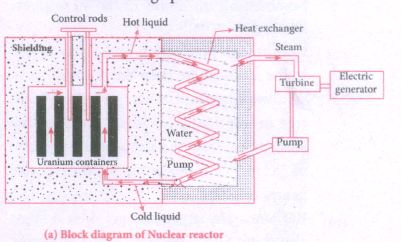
Nuclear reactor is a system in which the nuclear fission takes place in a self-sustained controlled manner.
The main parts of a nuclear reactor :
(a) Fuel (b) Neutron source (c) moderator (d) control rods (e) shielding (f) cooling system
(a) Fuel:
(i) The fuel is fissionable material, usually uranium or plutonium.
(ii) Naturally occurring uranium contains only 0.7% of \(_{ 92 }^{ 235 }{ U }\) and 99.3% \(_{ 92 }^{ 238 }{ U }\).
(iii) So the fuel must be enriched such that it contains at least 2 to 4% of \(_{ 92 }^{ 235 }{ U }\).
b) Neutron Source :
(i) A neutron source is required to initiate the chain reaction for the first time.
(ii) A mixture of beryllium with plutonium or polonium is used as the neutron source.
(iii) During fission only fast neutrons are emitted. But slow neutrons are preferred for sustained nuclear reactions.
(c) Moderators :
(i) The moderator is a material used to convert fast neutrons into slow neutrons. Usually the moderators are chosen in such a way that it must be very light nucleus having mass comparable to that of neutrons.
(ii) Hence, these light nuclei undergo collision with fast neutrons and the speed of the neutron is reduced.
(iii) Most of the reactors use water, heavy water (D2O) and graphite as moderators.
(d) Control rods :
(i) The control rods are used to adjust the reaction rate.
(ii) An average of 2.5 neutrons are emitted in each fission reaction.
(iii) For the controlled chain reactions, only one effort is allowed to produce another fission and the remaining neutrons are absorbed by the control rod.
(iv) Usually cadmium or boron acts as control rod material.
(v) These rods are inserted into the uranium blocks.
(vi) Depending on the insertion depth of control rod into the uranium, the average number of the neutrons produced per fission is set to be equal to one or greater than one.
(vii) If the average number of neutrons produced per fission is equal to one, then reactor is said to be in critical state.
(viii) If it is greater than one, then reactor is said to be in super-critical and it may explode sooner of may cause massive destruction.
(e) Shielding :
For a protection against harmful radiation, the nuclear reactor is surrounded by a concrete wall of thickness of about 2 to 2.5 m.
(f) Cooling system :
(i) The cooling system removes the heat generated in the reactor core.
(ii) Ordinary water, heavy water and liquid sodium are used as coolant.
(iii) They have very high specific heat capacity and have large boiling point under high pressure.
(iv) This coolant passes through the fuel block and carries away the heat to the steam generator through heat exchanger.
(v) The steam runs the turbines which produces electricity in power reactors.
38.
Angle of deviation Produced by Prism:
(i) Let light ray PQ is incident on one of the refracting faces of the prism.
(ii) The angles of incidence and refraction at the first face AB are i1 and rl. The path of the light inside the prism is QR.
(iii) The angle of incidence and refraction at the second face AC is r2 and i2 respectively.
(iv) RS is the ray emerging from the second face. Angle i2 is also caned angle of emergence.
(v) The angle between the direction of the incident ray PQ and the emergent ray RS is called the angle of deviation d.
(vi) The two normals drawn at the point of incidence Q and emergence R meet at point N. They meet at point N.
(vii) The extended incident ray and the emergent ray meet at a point M.
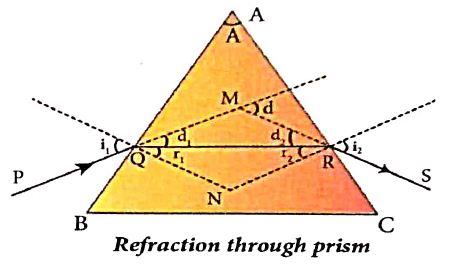
The angle of deviation d1 at the surface AB is,
ㄥRQM = d = i1 - r1 ...(1)
The angle of deviation d2 at the surface AC is
ㄥQRM = d2 = i2 - r2 .......(2)
Total angle of deviation d produced is,
d = d1 + d2 .....(3)
Substituting for d1 and d2 in equation (3)
d = (i1 - r1) + (i2 - r2)
After rearranging,
d = (i1 - r1) + (i2 - r2) ........(4)
In the quadrilateral AQNR, two of the angles (at the vertices Q and R) are right angles. Therefore, the sum of the other angles of the quadrilateral is 180°.
\(\angle A+\angle QNR={ 180 }^{ 0 }\) .........(5)
From the triangle ΔQNR
\({ r }_{ 1 }+{ r }_{ 2 }+\angle QNR={ 180 }^{ o }\) ......(6)
Comparing these two equations (5) and (6) we get,
r1 + r2 = A .......(7)
Substituting this in equation (4) for angle of deviation,
d = i1+ i2 - A .............(8)
(viii) Thus, the angle of deviation depends on the angle of incidence i1, angle of emergence i2 and the angle for the prism A.
(ix) For a given angle of incidence the angle of emergence is decided by the refractive index of the material of the prism. Hence the angle of deviation depends on these following factors.
(i) the angle of incidence
(ii) the angle of the prism.
(iii) the refractive index of the material of the prism (which decides the angle of emergence).
Refractive index of the material of the prism:
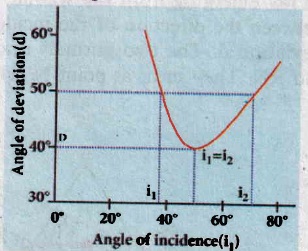
At minimum deviation, i1 = i2 = i and r1 = r2 = r
Now, the equation (8) becomes,
D - i1 + i2 - A = 2i - A (or) \(i=\cfrac { \left( A+D \right) }{ 2 } \)
The equation (7) becomes
r1 + r2 = A ⇒ 2r = A (or) \(r=\cfrac { A }{ 2 } \)
Substituting i and r in Snell's law
\(n=\cfrac { sini }{ sinr } \)
\(n=\cfrac{\cfrac{sin(A+D)}{2}}{sin(A/2)}\)
39.
Experimental setup:
(i) S is a source s1 and s2 the double slits which are at equidistances from 's'. Wavefronts from s1 and s2 spread out and overlap on other side of double slit.
(ii) When a screen is placed at a distance of about 1 meter from the slits, alternate bright and dark fringes which are equally spaced appear on the screen. These are called interference fringes or bands.
(iii) Using an eyepiece the fringes can be seen directly. At the center point O on the screen, waves from s1 and s2 travel equal distances and arrive in-phase as shown in Figure.
(iv) These two waves constructively interfere and bright fringe is observed at O. This is called cental bright fringe.
(v) When one of the slits is closed, The fringes disappear and there in uniform illumination on the screen.
(vi) This shows clearly that the bands are due to interference.
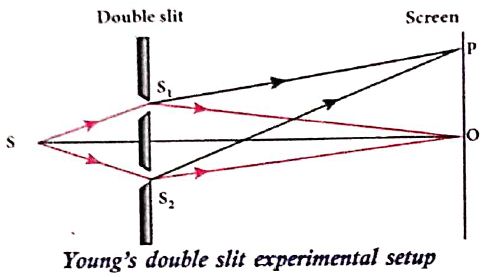
Equation for path difference :
(i) The Let d be the distance between the double slits s1 and s2 which act as coherent sources of wavelength λ.
(ii) A screen is placed parallel to the double slit at a distance D from it.
(iii) P is any point at a distance y from O.
(iv) The waves from S1 and S2 meet at P either in-phase or out-of-phase depending upon the path difference between the two waves.
.JPG)
The path difference \(\delta\) between the light waves from s1 and s2 to the point p is,
\(\delta=\mathrm{S}_{2} \mathrm{P}-\mathrm{S}_{1} \mathrm{P}\)
\(\delta=\mathrm{S}_{2} \mathrm{P}-\mathrm{MP}=\mathrm{S}_{2} \mathrm{M}\) .........(1)
\(\angle \mathrm{OCP}=\angle \mathrm{S}_{2} \mathrm{~S}_{1} \mathrm{M}=\theta\)
In right angle triangle \(\Delta \mathrm{S}_{1} \mathrm{S}_{2} \mathrm{M}\), the path difference S2M = d sin \(\theta\)
\(\delta=d \sin \theta\) ...........(2)
If the angle \(\theta\) is small, \(\sin \theta \approx \tan \theta \approx \theta\)
From the right angle triangle \(\Delta \mathrm{OCP}, \tan \theta=\frac{\mathrm{y}}{\mathrm{D}}\)
The path differences \(\delta=\frac{d y}{D}\) ...........(3)
Based on the condition of the path difference, the point P may have a bright (or) dark fringe
40.
FuIl wave rectifier :
The positive and negative half cycles of the AC input signal pass through the full wave rectifier circuit and hence it is called the full wave rectifier
Construction:
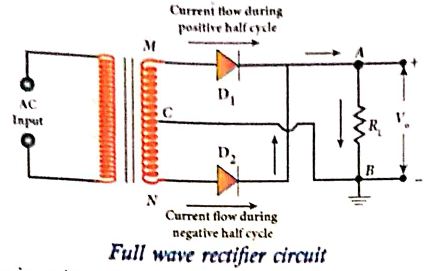
(i) It consists of two p-n junction diodes, a center-tapped transformer, and a load resistor (R1)
(ii) The centre is usually taken as the ground or zero voltage reference point.
(iii) Due to the centre tap transformer, the output voltage rectified by each diode is only one-half of the total secondary voltage.
Working:
During positive half cycle :
(i) When the positive half cycle of the ac input signal passes through the circuit, terminal M is positive, G is at zero potential and N is at negative potential.
(ii) This forward biases diode D1 and reverse biases diode D2.
(iii) Hence, being forward biased, diode D1 conducts and current flows along the path MD1AGC.
During negative half cycle:
(i) When the negative half cycle of the AC input signal passes through the circuit, terminal N becomes positive, C is at zero potential and M is at negative potential.
(ii) This forward biases diode D2 and reverse biases diode D1.
(iii) Hence, being forward biased, diode D2 conducts and current flows along the path ND2BGC.
(iii) During both positive and negative half cycles of the input signal, the current flows through the load in same direction.
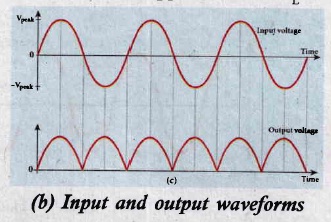
(iv) The output signal corresponding to the input signal is shown in Figure. Though both half cycles of AC input are rectified, the output is still pulsating in nature.
(v) The efficiency (η) of full wave rectifier is twice that of a half wave rectifier and is found to be 81.2 %.
41.
Construction:
(a) The amplification of an electrical signal is explained with a single-stage transistor amplifier as shown in figure.
(b) Single stage indicate that the circuit consists of one transistor with the allied components.
.JPG)
(i) An NPN transistor is connected in the common-emitter configuration
(ii) To start with, the Q point or the operating point of the transistor is fixed, so as to get the maximum signal swing at the output (neither towards saturation point nor towards cut-off).
(iii) A load resistance, RC is connected in series with the collector circuit to measure the output voltage.
The resistance R1, R2, and RE, form the biasing and stabilization circuit.
(iv) The capacitor C, allows only the AC signal to pass through.
(v) The emitter by pass capacitor CE provides a low reactance path to the amplified AC signal
(vi) The coupling capacitor CC is used to couple one stage of the amplifier with the next stage, while constructing multistage amplifiers
Vs is the sinusoidal input signal source applied across the base-emitter. The output is taken across the collector-emitter.
Collector current IC = βIB [∵β = IC/IB]
Applying Kirchhoff's voltage law to the output loop, the collector-emitter voltage is given by
VCE = VCC - ICRC
Working of the amplifier :
During the positive half cycle :
(i) Input signal (Vs) increases the forward voltage across the emitter base. As a result, the base current (IB in μA) increases. consequently the collector current (ICin mA) increases β times.
(ii) This increase the voltage drop across RC(ICRC) which in turn decreases the collector-emitter voltage (vCE). Therefore, the input signal in the positive direction produces an amplified signal in the negative direction at the output. Hence the output signal is reversed by 1800 as shown in figure
.JPG)
During the negative half cycle:
(i) Input signal (Vs) decreases the forward voltage across the emitter base. As a result base current (IB in μA) decreases and in tum increases the collector current (IB in μA).
(ii) The increase in collector current (IC) decreases the potential drop across RC and increases the collector - emitter voltage (VCE).
(iii) Thus the input signal in the negative. direction produces an amplified signal in the positive direction at the output.
(iv) Therefore, 180 phase reverse is observed during the negative half cycle of the input signal as well as shown in figure.
42.
According to Planck, matter is composed of a large number of oscillating particles (atoms) which vibrate with different frequencies. Each atomic oscillator - which vibrates with its characteristic frequency - emits or absorbs electromagnetic radiation of the same frequency. It also says that.
(i) If an oscillator vibrates with frequency v, its energy can have only certain discrete values, given by the equation.
En= nhv; n = 1,2, 3
where h is a constant, called Planck's constant.
(ii) The oscillators emit or absorb energy in small packets or quanta and the energy of each quantum is E = hv.
This implies that the energy of the oscillator is quantized - that is, energy is not continuous as believed in the wave picture. This is called quantization of energy.
Einstein extended Planck's quantum concept to explain the photoelectric effect in 1905. According to Einstein, the energy in light is not spread out over wavefronts but is concentrated in small packets or energy quanta. Therefore, light (or any other electromagnetic waves) of frequency hv from any source can be considered as a stream of quanta and the energy of each light quantum is given by E = hv.
He also proposed that a quantum of .light has linear momentum and the magnitude of that linear momentum is P = hv/C. The individual light quantum of definite energy and momentum can be associated with a particle. The light quantum can behave as a particle and this is called photon. Therefore photon is nothing but particle manifestation of light.
43.
Explanation for the photoelectric effect:
The experimentally observed facts of photoelectric effect can be explained with the help of Einstein's photoelectric equation.
(i) As each incident photon liberates one electron, then the increase of intensity of the light (the number of photons per unit area per unit time) increases the number of electrons emitted thereby increasing the photocurrent. The same has been experimentally observed.
(ii) From Kmax = hv - Φ0, it is evident that Kmax is proportional to the frequency of the light and is independent of intensity of the light.
(iii) As given in equation \({ hv }_{ o }+\cfrac { 1 }{ 2 } { mv }^{ 2 }\) , there must be minimum energy (equal to the work function of the metal) for incident photons to liberate electrons from the metal surface. Below which, emission of electrons is not possible. Correspondingly, there exists minimum frequency called threshold frequency below which there is no photoelectric emission.
(iv) According to quantum concept, the transfer of photon energy to the electrons is instantaneous so that there is no time lag between incidence of photons and ejection of electrons.
Thus, the photoelectric effect is explained on the basis of quantum concept of light.

12th Standard Syllabus & Materials
12th Standard
TN 12th Standard Physics Electronics and Communication Creative Questions Study Material - QB365 Set B
NEW12th Standard
TN 12th Standard Physics Electronics and Communication Creative Questions Study Material - QB365 Set A
NEW12th Standard
TN 12th Standard Physics Wave Optics Creative Questions Study Material - QB365 Set D
NEW12th Standard
TN 12th Standard Physics Wave Optics Creative Questions Study Material - QB365 Set C



Tamilnadu Stateboard 12th Standard Subjects

Maths

Chemistry
Physics

Biology

Computer Science

Business Maths and Statistics

Economics

Commerce

Accountancy

History

Computer Applications
Biology
Computer Technology
Computer Applications
Computer Science
Business Maths and Statistics
Commerce
Economics
Maths
Chemistry
Physics
Computer Technology
History
Accountancy

Tamil

English

French
Tamilnadu Stateboard Standards


