
12th Standard Syllabus & Materials
12th Standard
TN 12th Standard Biology Zoology - Reproduction in Organisms Creative Questions Study Material - QB365 Set D
NEW12th Standard
TN 12th Standard Biology Zoology - Reproduction in Organisms Creative Questions Study Material - QB365 Set C
NEW12th Standard
TN 12th Standard Biology Zoology - Reproduction in Organisms Creative Questions Study Material - QB365 Set B
NEW12th Standard
TN 12th Standard Biology Zoology - Reproduction in Organisms Creative Questions Study Material - QB365 Set A
NEW12th Standard
TN 12th Standard Physics Electronics and Communication Creative Questions Study Material - QB365 Set D
NEW12th Standard
TN 12th Standard Physics Electronics and Communication Creative Questions Study Material - QB365 Set C

Published on: 28/11/2025
Download Tamil Nadu 12th Standard Physics question papers, model tests, one-mark questions, important questions, and public exam papers in PDF format. Free study materials and answer keys for TN State Board students.
Questions + Answers key
Take MCQ Physics Test
1.
Define current density.
2.
State Joule’s law of heating.
3.
Define ‘electric field’
4.
Define ‘capacitance’. Give its unit.
5.
What are electromagnetic waves?
6.
What is meant by excitation energy?
7.
What is isobar? Give an example.
8.
Define work function of a metal. Give its unit.
9.
What is a photo cell? Mention the different types of photocells.
10.
A carbon resistor of (47 ± 4.7 ) k Ω to be marked with rings of different colours for its identification. The colour code sequence will be ______.
Yellow – Green – Violet – Gold
Yellow – Violet – Orange – Silver
Violet – Yellow – Orange – Silver
Green – Orange – Violet - Gold
11.
Two points A and B are maintained at a potential of 7 V and -4 V respectively. The work done in moving 50 electrons from A to B is _______.
8.80 x 10⁻¹⁷ J
-8.80 x 10⁻¹⁷ J
4.40 x 10⁻¹⁷ J
5.80 x 10⁻¹⁷ J
12.
Which of the following is an electromagnetic wave?
α - rays
β - rays
\(\gamma\) - rays
all of them
13.
When the current changes from +2A to −2A in 0.05 s, an emf of 8 V is induced in a coil. The co-efficient of self-induction of the coil is
0.2H
0.4H
0.8H
0.1H
14.
A thin insulated wire forms a plane spiral of N = 100 tight turns carrying a current I = 8 m A (milli ampere). The radii of inside and outside turns are a = 50 mm and b = 100 mm respectively. The magnetic induction at the centre of the spiral is ______.
\(5\mu T\)
\(7\mu T\)
\(8\mu T\)
\(10\mu T\)
15.
Stars twinkle due to, ______.
reflection
total internal reflection
refraction
polarisation
16.
Two coherent monochromatic light beams of intensities I and 4I are superposed. The maximum and minimum possible intensities in the resulting beam are _____.
5I and I
5I and 3I
9I and I
9I and 3I
17.
Light transmitted by Nicol prism is, _____.
partially polarised
unpolarised
plane polarised
elliptically polarised
18.
The threshold wavelength for a metal surface whose photoelectric work function is 3.313 eV is _____.
4125 \(\mathring { A } \)
3750\(\mathring { A } \)
6000\(\mathring { A } \)
2062.5\(\mathring { A } \)
19.
In a hydrogen atom, the electron revolving in the fourth orbit, has angular momentum equal to _____.
h
\(\frac{h}{\pi}\)
\(\frac{4h}{\pi}\)
\(\frac{2h}{\pi}\)
20.
21.
The zener diode is primarily used as ______.
Rectifier
Amplifier
Oscillator
Voltage regulator
22.
The blue print for making ultra durable synthetic material is mimicked from _____.
Lotus leaf
Morpho butterfly
Parrot fish
Peacock feather
23.
The particle which gives mass to protons and neutrons are _____.
Higgs particle
Einstein particle
Nanoparticle
Bulk particle
24.
Fraunhofer lines are an example of ______ spectrum.
line emission
line absorption
band emission
band absorption
25.
Describe the microscopic model of current and obtain general form of Ohm’s law.
26.
Obtain the condition for bridge balance in Wheatstone’s bridge.
27.
Calculate the electric field due to a dipole on its axial line and equatorial plane.
28.
Explain the types of emission spectrum.
29.
Discuss the spectral series of hydrogen atom.
30.
Obtain the law of radioactivity.
31.
Obtain Einstein’s photoelectric equation with necessary explanation.
32.
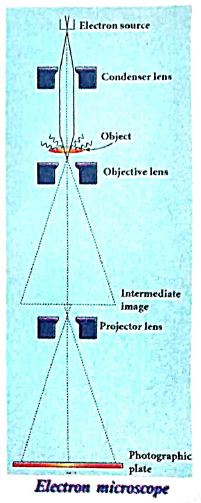
Briefly explain the principle and working of electron microscope.
33.
State and explain Kirchhoff ’s rules
34.
What are Fraunhofer lines? How are they useful in the identification of elements present in the Sun?
1.
Current density is J in a conductor is defined as the current flowing per unit area of cross-section of the conductor
\(\therefore J=\cfrac { I }{ A } \)
Where I - current
A - area of cross section
2.
It states that the heat developed in an electrical circuit due to the flow of current varies directly as
(i) the square of the current
(ii) the resistance of the circuit and
(iii) the time of flow.
3.
Electric field at the point P at a distance r from the point charge q is the force experienced by a unit positive placed at that point P and is given by
\(\vec { E } =\frac { \vec { F } }{ q_{ 0 } } =\frac { kq }{ { r }^{ 2 } } \hat { r } =\frac { 1 }{ 4\pi { \varepsilon }_{ 0 } } \frac { q }{ { r }^{ 2 } } \hat { r } \)
where \(\hat{r}\) is the unit vector pointing from q to the point of interest P.
4.
The capacitance C of a capacitor is defined as the ratio of the magnitude of charge on either of the conductor plates to the potential difference existing between the conductors. \(C=\frac{Q}{V}\)
Its unit is Coulomb per volt or farad (F).
5.
An electromagnetic waves are the waves that are radiated by an accelerated charge which propagates through space as coupled electric and magnetic fields, oscillating perpendicular to each other and to the direction of propagation of the wave.
6.
The energy required to excite an electron from lower energy state to any higher energy state is known as excitation energy.
7.
Isobars are the atoms of different elements having the same mass number A, but different atomic number Z.
Example: \({ }_{16}^{40} \mathrm{~S},{ }_{17}^{40} \mathrm{Cl},{ }_{18}^{40} \mathrm{Ar}\)
8.
The minimum energy needed for an electron to escape from the metal surface is called work function of that metal.
Unit: electron volt (eV).
9.
Photo cell is a device which converts light energy into electrical energy. It works on the principle of photo electric effect. When light is incident on photosensitive materials, their electric properties will get affected, based on which Photo cells are classified into three types. They are
(i) Photo emissive cell
(ii) Photo voltaic cell
(iii) Photo conductive cell
10.
Yellow - 4
Violet - 7
Orange - 103
Silver - Tolerance - 10%
11.
W = qV
V = 7 - (-4) = 11 V
q = ne = 50 x 1.6 x 10-19 = 8 x 10-18C
W = 8 x 10-18 x 11 = 88 x 10-18 = 8.8 x 10⁻¹⁷]
12.
(c)
\(\gamma\) - rays
13.
\(\text {emf } e=8 \mathrm{~V} \)
\(d I=I_1-I_0=2-(-2)=4 \mathrm{~A} \)
\(\text {dt }=0.05 \mathrm{~s} \)
\(L=\frac{-e}{d I / d t}=\frac{-8}{4 / 0.05} \)
\(=\frac{-8 \times 0.05}{4}=\frac{-0.40}{4} \)
=-0.1 H
-ve sign indicates that self-induced emf always opposes the current w.r.t. time.
14.
(b)
\(7\mu T\)
15.
(c)
refraction
16.
I = l1 + l2 + 2\(\sqrt{I_1I_2}\)cos θ
If cos θ = cos 0 = l, I is max
= I+ 4I + 2\(\sqrt{41^2}\) cos 0
= 5I + 4I = 91
If cos π = -1, I is min
Imin = I + 4I + 2\(\sqrt{41^2}\) cos π
= 5I + 4I(-1)
= 5I + 4I = I
(Imax, Imin)= (9I, I)
17.
(c)
plane polarised
18.
\(\lambda_0 =\frac{h c}{\phi} \)
\(=\frac{6.626 \times 10^{-34} \times 3 \times 10^8}{3.313 \times 1.6 \times 10^{-19}} \)
\( =\frac{19.8782400}{5.3} \times 10^{-7} \)
\(\lambda_0 =3.750 \times 10^{-7} \simeq 3750 \stackrel{o}A\)
19.
\(L=\frac{nh}{2\pi}=\frac{4h}{2\pi}=\frac{2h}{\pi}\)
20.
(b)
21.
(d)
Voltage regulator
22.
Parrot fish's source of bite → mimic → Ultra durable synthetic material.
Lotus leaf surface → SEM → Self Cleaning Process
The scales on the wings of a morpho butterfly → mimic → Interaction of colours.
Peacock feathers → mimic → Glowing in different colours.
23.
Proton and neutron are made up of quarks. Later, it was found that Higg's particles or God particles give mass to the particles like protons, neutrons etc.
24.
(b)
line absorption
25.
(i) XY is a conductor of area cross section A. \(\vec { E } \)is the applied electric field. n is the number of electrons per unit volume with same drift velocity (Vd) .
(ii) Let electrons move through a distance dx in time interval dt.
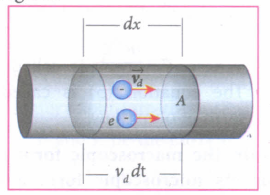
(iii) The drift velocity of the electrons = vd
(iv) If the electrons move through a distance dx within a small interval of time dt,
\({ v }_{ d }=\cfrac { dx }{ dt } ;dx={ v }_{ d }dt\) ..(i)
(v) Since A is the area of cross section of the conductor, the electrons available in the volume of length dx is
= volume x number of electrons per unit volume = A dx x n ...(2)
(vi) Substituting for dx from equation (1) in (2)
= (A vd dt) n
(vii) Total charge in volume element dQ =(charge) x (number of electrons in the volume element)
dQ = (e) (Avddt)n
Hence the current \(I=\cfrac { dQ }{ dt } =\cfrac { ne{ Av }_{ d }dt }{ dt } \)
\(I=ne{ Av }_d\) ..........(3)
Current density (J):
(viii) The current density (J) is defined as the current per unit area of cross section of the conductor.
\(J=\cfrac { I }{ A } \)
(ix) The S.I unit of current density is \({ Am }^{ -2 }\)
\(J=\cfrac { neAv_{ d } }{ A } \) (∵I = nAeVd)
\(J={ nev }_{ d }\) .........(4)
(x) The above expression holds only when the direction of the current is perpendicular to the area A.
In general, the current density is a vector quantity and it is given by,
\(\vec { J } =ne\vec { v_{ d } } \)
Substituting \(\vec { v_{ d } } \) from equation
\(\vec { v_{ d } } =\cfrac { e\tau }{ m } \vec { E } \)
\(\vec { J } =\cfrac { n.{ e }^{ 2 }\tau }{ m } \vec { E } \) ...(5)
\(\vec { J } =\sigma \vec { E } \) ....(6)
(xi) But conventionally, we take the direction of (conventional) current density as the direction of electric field. So, the above equation becomes,
\(\vec { J } =\sigma \vec { E } \) .....(7)
(xii) Where, \(\sigma =\cfrac { { ne }^{ 2 }\tau }{ m } \) is called conductivity. The equation (7) is called microscopic form of ohm's law.
26.
Wheatstone's bridge:
i) An important application of Kirchhoff's rule is Wheatstone's bridge. It is used to compare Resistances and also helps in determining the unknown resistance in electrical network. The bridge consists of four resistances P, Q, R and S connected as shown in Figure.
ii) A galvanometer G is connected between the points B and D. The battery is connected between the points A and C. The current through the galvanometer is IG and its resistance is G.
Applying Kirchhoff's current rule to junction B
I1 - IG - I3 = 0 ..(1)
Applying Kirchhoff's current rule to junction D,
I2 + IG - I4 = 0 ...(2)
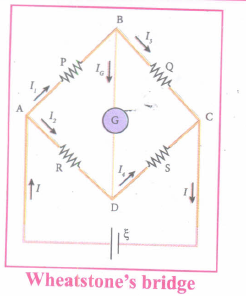
Applying Kirchhoff's voltage rule to loop ABDA,
I1P + IGG - I2R = 0 ...(3)
Applying Kirchhoff's voltage rule to loop ABCDA,
I1P + I3Q - I4S - I2R = 0 ...(4)
(iii) When the points B and D are at the same potential, the bridge is said to be balanced. As there is no potential difference between B and D, no current flows through galvanometer (IG = 0). Substituting IG = 0 in equation (1), (2) and (3), we get
I1 = I3 ..(5)
I2 = I4 ..(6)
I1P = I2R ..(7)
Substituting the equation (7) in equation (4),
I3Q = I4S .....(8)
Dividing equation (7) by equation (8), we get
\(\cfrac { P }{ Q } =\cfrac { R }{ S } \) .....(9)
(iv) This is the bridge balance condition. Only under this condition, galvanometer shows null deflection.
27.
Case (i): Electric field due to an electric dipole at points on the axial Iine:
Consider an electric dipole placed on the x-axis as shown in Figure. A point C is located at a distance of r from the midpoint O (of the dipole) along the axial line.
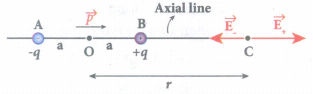
The electric field at a point C due to +q is
\({ \vec { E } }_{ + }=\frac { 1 }{ 4\pi { \varepsilon }_{ 0 } } \frac { q }{ { (r-a) }^{ 2 } } \) along BC
Since the electric dipole moment vector \(\vec { p } \) is from -q to +q and is directed along BC, the above equation is rewritten as
\({ \vec { E } }_{ + }=\frac { 1 }{ 4\pi { \varepsilon }_{ 0 } } \frac { q }{ { (r-a) }^{ 2 } } \hat { p } \) ....(1)
When \(\vec { p } \) is the electric dipole moment unit vector from -q to +q. The electric field at a point C due to -q is
\({ \vec { E } }_{ - }=-\frac { 1 }{ 4\pi { \varepsilon }_{ 0 } } \frac { q }{ { (r+a) }^{ 2 } } \hat { p } \) ....(2)
Since +q is located closer to the point C than -q, \({ \vec { E } }_{ + }\) is stronger than \({ \vec { E } }_{ - }\). Therefore, the length of the \({ \vec { E } }_{ + }\) vector is drawn larger than that of \({ \vec { E } }_{ - }\) vector.
The total electric field at point C is calculated using the superposition principle of the electric field.
\({ \vec { E } }_{ tot }={ \vec { E } }_{ + }+{ \vec { E } }_{ - }\)
\(=\frac { 1 }{ 4\pi { \varepsilon }_{ 0 } } \frac { q }{ { (r-a) }^{ 2 } } \hat { p } -\frac { 1 }{ 4\pi { \varepsilon }_{ 0 } } \frac { q }{ { (r+a) }^{ 2 } } \hat { p } \)
\({ \vec { E } }_{ tot }=\frac { q }{ 4\pi { \varepsilon }_{ 0 } } \left( \frac { 1 }{ { (r-a) }^{ 2 } } -\frac { 1 }{ { (r+a) }^{ 2 } } \right) \hat { p } \) ....(3)
\({ \vec { E } }_{ tot }=\frac { 1 }{ 4\pi { \varepsilon }_{ 0 } } q\left( \frac { 4ra }{( { r }^{ 2 }-{ a }^{ 2 })^2 } \right) \hat { p } \) ...(4)
Note that the total electric field is along \({ \vec { E } }_{ + }\), since +q is closer to C than -q.
If the point C is very far away from the dipole then (r >> a). Under this limit the term \(({ r }^{ 2 }-{ a }^{ 2 })\approx { r }^{ 2 }\).
Substituting this into equation (4), we get
\({ \vec { E } }_{ tot }=\frac { 1 }{ 4\pi { \varepsilon }_{ 0 } } \left( \frac { 4aq }{ { r }^{ 3 } } \right) \hat { p } (r>>a)\)
\(since\quad 2aq\hat { p } =\vec { p } \)
\({ \vec { E } }_{ tot }=\frac { 1 }{ 4\pi { \varepsilon }_{ 0 } } \frac { 2\vec { p } }{ { r }^{ 3 } } (r>>a)\) ...(5)
The direction \({ \vec { E } }_{ tot }\) is shown in Figure.
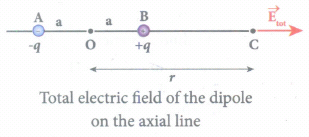
NOTE: If the point C is chosen on the left side of the dipole, the total electric field is still in the direction of \(\vec { p } \).
Case (ii) Electic field due to an electric dipole at a point on the equatorial plane:
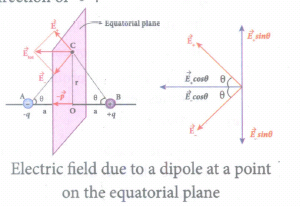
Consider a point C at a distance r from the midpoint O of the dipole on the equatorial plane. Since the point C is equidistant from +q and -q, the magnitude of the electric fields of +q and -q are the same. The direction of \({ \vec { E } }_{ + }\) is along BC and the direction of \({ \vec { E } }_{ - }\) is along CA. \({ \vec { E } }_{ + }\) and \({ \vec { E } }_{ - }\) are resolved into two components; one component parallel to the dipole axis and the other perpendicular to it. The perpendicular components \(|{ \vec { E } }_{ + }|\) sinθ and \(|{ \vec { E } }_{ -}|\) sinθ are equal in magnitude and oppositely directed and cancel each other. The magnitude of the total electric field at point C is the sum of the parallel components of \({ \vec { E } }_{ + }\) and \({ \vec { E } }_{ - }\) and its direction is along \(-\hat{p}\) as shown in the Figure.
\({ \vec { E } }_{ tot }=-|{ \vec { E } }_{ + }|cos\theta \hat { p } -|{ \vec { E } }_{ - }|cos\theta \hat { p } \) ...(6)
The magnitudes \({ \vec { E } }_{ + }\) and \({ \vec { E } }_{ - }\) are the same and given by,
\(|{ \vec { E } }_{ + }|=|{ \vec { E } }_{ - }|=\frac { 1 }{ 4\pi { \varepsilon }_{ 0 } } \frac { q }{ (r^2+a^2) } \) ...(7)
By substituting equation (7) into equation (6), we get
\({ \vec { E } }_{ tot }=\frac { 1 }{ 4\pi { \varepsilon }_{ 0 } } \frac { 2qcos\theta }{ ({ r }^{ 2 }+{ a }^{ 2 }) } \hat { p } ....(8)\)
\(=-\frac { 1 }{ 4\pi { \varepsilon }_{ 0 } } \frac { 2qa }{ ({ r }^{ 2 }+{ a }^{ 2 })^{ \frac { 3 }{ 2 } } } \hat { p } \)
Since \(cos \theta =\frac { a }{ \sqrt { { r }^{ 2 }+{ a }^{ 2 } } } \)
\({ \vec { E } }_{ tot }=\frac { 1 }{ 4\pi { \varepsilon }_{ 0 } } \frac { \vec { p } }{ ({ r }^{ 2 }+{ a }^{ 2 })^{ \frac { 3 }{ 2 } } } \)
Since \(\vec { p } \) = 2qa\(\hat { p } \) ...(9)
At very large distances (r >> a), the equation (9) becomes
\({ \vec { E } }_{ tot }=\frac { 1 }{ 4\pi { \varepsilon }_{ 0 } } \frac { \vec { p } }{ { r }^{ 3 } } (r>>a)\) ...(10)
Negative sign shows that direction of Electric field is opposite to the direction of dipole moment vector.
28.
Emission spectra:
When the spectrum of self luminous source is taken, we get emission spectrum. Each source has its own characteristic emission spectrum. The emission spectrum can be divided into three types:
(i) Continuous emission spectra (or continuous spectra) :
(a) If the light from incandescent lamp (filament bulb) is allowed to pass through prism (simplest spectroscope), it splits into seven colours.
(b) Thus, it consists of wavelengths containing all the visible colours ranging from violet to red (in the figure). Examples: spectrum obtained from carbon arc, incandescent solids.
(ii) Line emission spectrum (or line spectrum) :
(a) Suppose light from hot gas is allowed to pass through a prism, line spectrum is observed. Line spectra are also known as discontinuous spectra. The line spectra consists of sharp lines of definite wavelengths or frequencies.
(b) Such spectra arise due to excited atoms of elements. These lines are the characteristics of the element and are different for different elements. Examples: spectra of atomic hydrogen, helium, etc.
(iii) Band emission spectrum (or band spectrum) :
(a) Band spectrum consists of several number of very closely spaced spectral lines which overlapped together forming specific bands which are separated by dark spaces.
(b) This spectrum has a sharp edge at one end and fades out at the other end. Such spectra arise when the molecules are excited.
(c) Band spectrum is the characteristic of the molecule hence, the structure of the molecules can be studied using their band spectra. Examples, spectra of hydrogen gas, ammonia gas in the discharge tube, etc.
29.
When electron jumps from higher energy stationary orbit (m) to lower energy stationary orbit (n), emit radiation.
Wave number (or) Wave length of the emitted radiation is given by,
\(\frac{1}{\lambda}=R\left[\frac{1}{n^{2}}-\frac{1}{m^{2}}\right]=\bar{v}\)
V - Ware number; R- Rydberg constant = 1.09737 x 10⁷ m-1
m > n (where m, n are integers)
(a) Lyman series:
When electron jumps from any outer orbit to first orbit, (n = 1 and m = 2,3,4.......) the wave number or wavelength of spectral lines lies in ultra-violet region is
\(\bar{v}=\frac{1}{\lambda}=\mathrm{R}\left[\frac{1}{1^{2}}-\frac{1}{\mathrm{~m}^{2}}\right]\)
(b) Balmer series:
Wher electron jumps from any outer orbit to second orbit, (n = 2 and m = 3, 4, 5.......) the wave number or wavelength of spectral lines lies in visible region is,
\(\bar{v}=\frac{1}{\lambda}=R\left[\frac{1}{2^{2}}-\frac{1}{m^{2}}\right]\)
(c) Paschen series:
When electron jumps from any outer orbit to third orbit, (n = 3 and m = 4, 5, 6.......) the wave number or wavelength of spectral lines lies in infra red (Near IR) region is
\(\bar{v}=\frac{1}{\lambda}=R\left[\frac{1}{3^{2}}-\frac{1}{m^{2}}\right]\)
(d) Bracket series:
When electron jumps from any outer orbit to fourth orbit, (n = 4 and m = 5, 6, 7.......) the wave number or wavelength of spectral lines lies in infra red (Middle IR) region is
\(\bar{v}=\frac{1}{\lambda}=R\left[\frac{1}{4^{2}}-\frac{1}{m^{2}}\right]\)
(e) Pfund series:
When electron jumps from any outer orbit to fifth orbit, (n - 5 and m = 6, 7, 8.......) the wave number or wavelength of spectral lines lies in infra red (far IR) region is
\(\bar{v}=\frac{1}{\lambda}=R\left[\frac{1}{5^{2}}-\frac{1}{m^{2}}\right]\)
30.
(i) At any instant t, the number of decays per unit time, called rate of decay \(\left( \frac { dN }{ dt } \right) \) is proportional to the number of nuclei (N) at the same instant.
\(\left( \frac { dN }{ dt } \right) \propto N\)
\(\frac { dN }{ dt } =-\lambda N\) ...(1)
(ii) Here, proportionality constant \( \lambda\) is called decay constant which is different for different radioactive sample and the negative sign in the equation implies that the N is decreasing with time. From (1)
\(\frac{\mathrm{dN}}{\mathrm{N}}=-\lambda \mathrm{dt}\) ...(2)
(iii) Here, dN represents number of nuclei decaying in the time interval dt.
(iv) Let us assume that at time t = 0 s, the number of nuclei present in the radioactive sample is No.
(v) By integrating the equation (2), we can calculate the number of undecayed nuclei N at any time t.
\(\int_{N_{0}}^{N} \frac{d N}{N}=-\int_{0}^{t} \lambda d t \)
\({[\ln N]_{N_{0}}^{N}=-\lambda t} \)
\(\ln \left[\frac{N}{N_{0}}\right]=-\lambda t \)
Taking exponential on both sides, we get
\(\mathrm{N}=\mathrm{N}_{0} \mathrm{e}^{-\lambda t}\) .....(3)
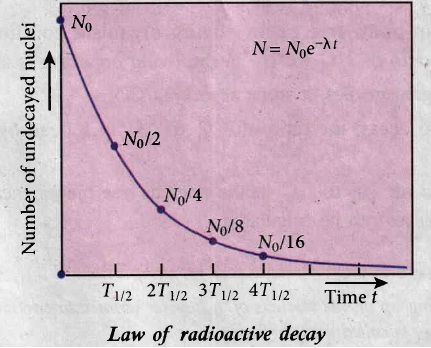
(vi) Equation (3) is called the law of radioactive decay.
(vii) Here N denotes the number of undecayed nuclei present at any time t and No denotes the number of nuclei present initially time t = 0.
(viii) From equation (3) the number of atoms is decreasing exponentially over the time. This implies that the time taken for all the radioactive nuclei to decay will be infinite.
31.
(i) When a photon of energy hv is incident on a metal surface, it is completely absorbed by a single electron and the electron is ejected.
(ii) In this process, a part of the photon energy is used for the ejection of the electrons from the metal surface (photoelectric work function Φ0) and the remaining energy as the kinetic energy of the ejected electron. From the law of conservation of energy,
\(\\ \\ \\ hv=\phi { _{ 0 }+\cfrac { 1 }{ 2 } { mv }^{ 2 } }\) ......(1)
(iii) where m is the mass of the electron and v its velocity.
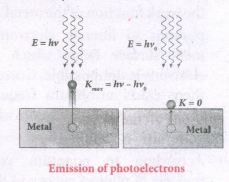
(iv) If we reduce the frequency of the incident light is reduced, the speed or kinetic energy of photo electrons is also reduced. At some frequency v0 of incident radiation, the photo electrons are ejected with almost zero kinetic energy.
Then the equation becomes.
\({ hv }_{ 0 }=\phi _{ 0 }\) ......(2)
(v) Where v0 is the threshold frequency. B rewriting the equation, we get
\(hv={ hv }_{ o }+\cfrac { 1 }{ 2 } { { mv }^{ 2 } }\) ......(3)
The equation is known as einstein's photoelectric equation.
(vi) If the electron does not lose energy by internal collisions, then it is emitted with maximum kinetic energy Kmax. Then
\({ K }_{ max }=\cfrac { 1 }{ 2 } { mv }^{ 2 }_{ max }\) ......(4)
(vii) where vmaxis the maximum velocity of max the electron ejected. The equation (1) is rearranged as follows:
\({ K }_{ max }=hv-{ \phi }_{ 0 }\)
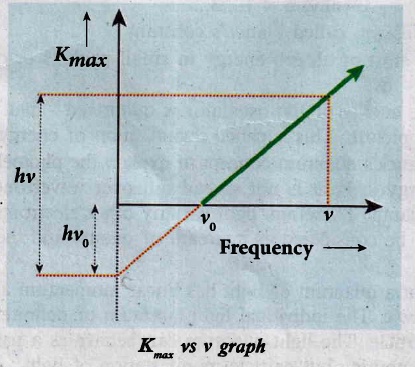
A graph between maximum kinetic energy Kmax of the photoelectron and frequency v of the incident light is a straight line.
32.
Principle:
(i) The wave nature of the electron is used in the construction of microscope called electron microscope.
(ii)The resolving power of a microscope is inversely proportional to the wavelength of the radiation used for illuminating the object under study.
(iii) Higher magnification as well as higher resolving power can be obtained by employing the waves of shorter wavelengths.
(iv) De Broglie's wavelength of electron is very much less than (a few thousand less) that of the visible light being used in optical microscopes.
(v) As a result, the microscopes employing de Broglie waves of electrons have very much higher resolving power than optical microscope.
(vi) Electron microscopes giving magnification more than 2,00,000 times are common in research laboratories.
Working:
(i) The construction and working of an electron microscope is similar to that of an optical microscope except that in electron microscope focussing of electron beam is done by the electrostatic or magnetic lenses.
(ii) The electron beam passing across a suitably arranged either electric or magnetic fields undergoes divergence or convergence thereby focussing of the beam is done.
(iii) The electrons emitted from the source are accelerated by high potentials.
(iv) The beam is made parallel by magnetic condenser lens; When the beam passes through the sample whose magnified image is needed, the beam carries the image of the sample.
(v) With the help of magnetic objective lens and magnetic projector lens system, the magnified image is obtained on the screen. These electron microscopes are being used in almost all brands of science.
33.
Kirchhoff's First rule: (current rule)
(i) It states that the algebraic sum of the currents at any junction of a circuit is zero. It is a statement of law of conservation of electric charge.
(ii) All charges that enter a given junction in a circuit must leave that junction since charge cannot build up or disappear at a junction. By convention current entering the junction is taken as positive and current leaving the junction is taken as negative.
Applying law to the junction A in Figure.
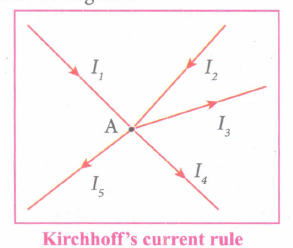
\({ I }_{ 1 }+{ I }_{ 2 }-{ I }_{ 3 }-{ I }_{ 4 }-{ I }_{ 5 }=0\)
(or)
\({ I }_{ 1 }+{ I }_{ 2 }=I_{ 3 }+{ I }_{ 4 }+{ I }_{ 5 }\)
Kirchhoff's Second rule (Voltage rule or Loop rule)
(i) It states that in a closed circuit the algebraic sum of the products of the current and resistance of each part of the circuit is equal to the total emf included in the circuit.
(ii) This rule follows from the law of conservation of energy for an isolated system (The energy supplied by the emf sources is equal to the sum of the energy delivered to all resistors).
(iii) Kirchhof's voltage rule has to be applied only when all currents in the circuit reach a steady state condition.
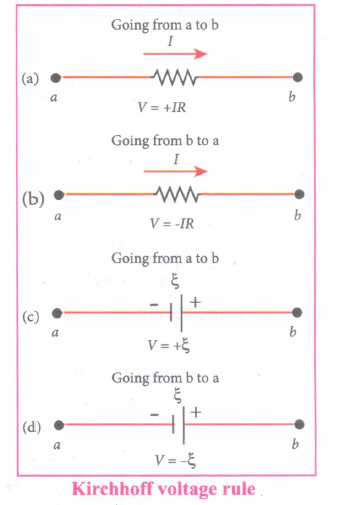
(iv) The current in the various branches are constant. The product of current and resistance is taken as positive when the direction of the current is followed.
(v) Suppose if the direction of current is opposite to the direction of the loop, then product of current and voltage across the resistor is negative. It is shown in Figure (a) and (b).
(vi) The emf is considered positive when proceeding from the negative to the positive terminal of the cell.
34.
(i) When the spectrum obtained from the Sun is examined, it consists of large number of dark lines . These dark lines in the solar spectrum are called Fraunhofer lines.
(ii) The Absorption spectra for various materials are compared with the Fraunhofer lines in the solar spectrum, which helps in identifying elements present in the Sun's atmosphere.

12th Standard Syllabus & Materials
12th Standard
TN 12th Standard Physics Electronics and Communication Creative Questions Study Material - QB365 Set B
NEW12th Standard
TN 12th Standard Physics Electronics and Communication Creative Questions Study Material - QB365 Set A
NEW12th Standard
TN 12th Standard Physics Wave Optics Creative Questions Study Material - QB365 Set D
NEW12th Standard
TN 12th Standard Physics Wave Optics Creative Questions Study Material - QB365 Set C



Tamilnadu Stateboard 12th Standard Subjects

Maths

Chemistry
Physics

Biology

Computer Science

Business Maths and Statistics

Economics

Commerce

Accountancy

History

Computer Applications
Biology
Computer Technology
Computer Applications
Computer Science
Business Maths and Statistics
Commerce
Economics
Maths
Chemistry
Physics
Computer Technology
History
Accountancy

Tamil

English

French
Tamilnadu Stateboard Standards


