
12th Standard Syllabus & Materials
12th Standard
TN 12th Standard Biology Zoology - Reproduction in Organisms Creative Questions Study Material - QB365 Set D
NEW12th Standard
TN 12th Standard Biology Zoology - Reproduction in Organisms Creative Questions Study Material - QB365 Set C
NEW12th Standard
TN 12th Standard Biology Zoology - Reproduction in Organisms Creative Questions Study Material - QB365 Set B
NEW12th Standard
TN 12th Standard Biology Zoology - Reproduction in Organisms Creative Questions Study Material - QB365 Set A
NEW12th Standard
TN 12th Standard Physics Electronics and Communication Creative Questions Study Material - QB365 Set D
NEW12th Standard
TN 12th Standard Physics Electronics and Communication Creative Questions Study Material - QB365 Set C

Published on: 28/11/2025
Download Tamil Nadu 12th Standard Physics question papers, model tests, one-mark questions, important questions, and public exam papers in PDF format. Free study materials and answer keys for TN State Board students.
Questions + Answers key
Take MCQ Physics Test
I. choose the best answer
1.
The speed of light in an isotropic medium depends on, ______.
its intensity
its wavelength
the nature of propagation
the motion of the source w.r.t medium
2.
A rod of length 10 cm lies along the principal axis of a concave mirror of focal length 10 cm in such a way that its end closer to the pole is 20 cm away from the mirror. The length of the image is, ______.
2.5 cm
5cm
10 cm
15cm
3.
An object is placed in front of a convex mirror of focal length off and the maximum and minimum distance of an object from the mirror such that the image formed is real and magnified.
2f and c
c and \(\infty\)
f and O
None of these
4.
5.
If the velocity and wavelength of light in air is Va and λa and that in water is Vw and λw, then the refractive index of water is______.
\(\frac{V_W}{V_a}\)
\(\frac{V_a}{V_W}\)
\(\frac{\lambda_W}{\lambda_a}\)
\(\frac{{V_a}\lambda_a}{{V_W}\lambda_W}\)
6.
Stars twinkle due to, ______.
reflection
total internal reflection
refraction
polarisation
7.
When a biconvex lens of glass having refractive index 1.47 is dipped in a liquid, it acts as plane sheet of glass. This implies that the liquid must have refractive index, ______.
less than one
less than that of glass
greater than that of glass
equal to that of glass
8.
The radius of curvature of curved surface at a thin planoconvex lens is 10 cm and the refractive index is 1.5. If the plane surface is silvered, then the focal length will be, ______.
5 cm
10 cm
15 cm
20 cm
9.
An air bubble in glass slab of refractive index 1.5 (near normal incidence) is 5 cm deep when viewed from one surface and 3 cm deep when viewed from the opposite face. The thickness of the slab is ______.
8 cm
10 cm
12 cm
16 cm
10.
A ray of light travelling in a transparent medium of refractive index n falls, on a surface separating the medium from air at an angle of incidents of 45o . The ray can undergo total internal reflection for the following n, ______.
n = 1.25
n = 1.33
n = 1.4
n = 1.5
11.
A plane glass is placed over a various coloured letters (violet, green, yellow, red) The letter which appears to be raised more is _____.
red
yellow
green
violet
12.
Two point white dots are 1 mm apart on a black paper. They are viewed by eye of pupil diameter 3 mm approximately. The maximum distance at which these dots can be resolved by the eye is_____. [take wavelength of light, λ = 500 nm]
1 m
5 m
3 m
6 m
13.
In a Young’s double-slit experiment, the slit separation is doubled. To maintain the same fringe spacing on the screen, the screen-to-slit distance D must be changed to, _____.
2D
\(\frac{D}{2}\)
\(\sqrt{2}\)D
\(\frac{D}{\sqrt2}\)
14.
Two coherent monochromatic light beams of intensities I and 4I are superposed. The maximum and minimum possible intensities in the resulting beam are _____.
5I and I
5I and 3I
9I and I
9I and 3I
15.
When light is incident on a soap film of thickness 5 x 10⁻⁵ cm, the wavelength of light reflected maximum in the visible region is 5320 Å. Refractive index of the film will be, _____.
1.22
1.33
1.51
1.83
16.
17.
A ray of light strikes a glass plate at an angle 60o. If the reflected and refracted rays are perpendicular to each other, the refractive index of the glass is, _____.
\(\sqrt3\)
\(\frac{3}{2}\)
\(\sqrt{\frac{3}{2}}\)
2
18.
One of the of Young’s double slits is covered with a glass plate as shown in figure. The position of central maximum will,_____.
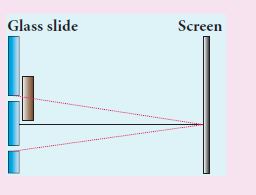
get shifted downwards
get shifted upwards
will remain the same
data insufficient to conclude
19.
Light transmitted by Nicol prism is, _____.
partially polarised
unpolarised
plane polarised
elliptically polarised
20.
21.
The wavelength λe of an electron and λp of a photon of same energy E are related by _____.
λp ∝ λe
\({ \lambda }_{ p }∝ \sqrt { { \lambda }_{ e } } \)
\({ \lambda }_{ p }∝ \frac { 1 }{ \sqrt { { \lambda }_{ e } } } \)
\({ \lambda }_{ p }∝ { \lambda }_{ e }^{ 2 }\)
22.
In an electron microscope, the electrons are accelerated by a voltage of 14 kV. If the voltage is changed to 224 kV, then the de Broglie wavelength associated with the electrons would _____.
increase by 2 times
decrease by 2 times
decrease by 4 times
increase by 4 times
23.
The wave associated with a moving particle of mass 3 x 10⁻⁶ g has the same wavelength as an electron moving with a velocity 6 x 10⁶ ms-1. The velocity of the particle is _____.
1.82 x 10⁻¹⁸ms-1
9 x 10⁻²ms-1
3 x 10-31ms-1
1.82 x 10⁻¹⁵ms-1
24.
When a metallic surface is illuminated with radiation of wavelength λ, the stopping potential is V. If the same surface is illuminated with radiation of wavelength 2λ, the stopping potential is \(\frac{V}{4}\). The threshold wavelength for the metallic surface is _____.
4λ
5λ
\(\frac{5}{2}λ\)
3λ
25.
26.
A photoelectric surface is illuminated successively by monochromatic light of wavelength λ and λ /2. If the maximum kinetic energy of the emitted photoelectrons in the second case is 3 times that in the first case, the work function of the material is _____.
\(\frac{hc}{\lambda}\)
\(\frac{2hc}{\lambda}\)
\(\frac{hc}{3\lambda}\)
\(\frac{hc}{2\lambda}\)
27.
28.
Two radiations with photon energies 0.9 eV and 3.3 eV respectively are falling on a metallic surface successively. If the work function of the metal is 0.6 eV, then the ratio of maximum speeds of emitted electrons in the two cases will be _____.
1:4
1:3
1:1
1:9
29.
A light source of wavelength 520 nm emits 1.04 x 10¹⁵ photons per second while the second source of 460 nm produces 1.38 x 10¹⁵ photons per second. Then the ratio of power of second source to that of first source is _____.
1.00
1.02
1.5
0.98
30.
If the mean wavelength of light from sun is taken as 550 nm and its mean power as 3.8 x 1026 W, then the number of photons emitted per second from the sun is of the order of _____.
1045
1042
1054
1051
31.
The threshold wavelength for a metal surface whose photoelectric work function is 3.313 eV is _____.
4125 \(\mathring { A } \)
3750\(\mathring { A } \)
6000\(\mathring { A } \)
2062.5\(\mathring { A } \)
32.
A light of wavelength 500 nm is incident on a sensitive metal plate of photoelectric work function 1.235 eV. The kinetic energy of the photoelectrons emitted is_____. (Take h = 6.6 x 10⁻³⁴ Js)
0.58 eV
2.48 eV
1.24 eV
1.16 eV
33.
Photons of wavelength λ are incident on a metal. The most energetic electrons ejected from the metal are bent into a circular arc of radius R by a perpendicular magnetic field having magnitude B. The work function of the metal is _____.
\(\frac { hc }{ \lambda } -{ m }_{ e }+\frac { e^{ 2 }{ B }^{ 2 }{ R }^{ 2 } }{ { 2m }_{ e } } \)
\(\frac { hc }{ \lambda } +{ 2m }_{ e }{ \left[ \frac { eBR }{ { 2m }_{ e } } \right] }^{ 2 }\)
\(\\ \frac { hc }{ \lambda } -{ m }_{ e }{ c }^{ 2 }-\frac { e^{ 2 }{ B }^{ 2 }{ R }^{ 2 } }{ { 2m }_{ e } } \)
\(\frac { hc }{ \lambda } -{ 2m }_{ e }{ \left[ \frac { eBR }{ { 2m }_{ e } } \right] }^{ 2 }\)
34.
The work functions for metals A, B and C are 1.92 eV, 2.0 eV and 5.0 eV respectively. The metal/metals which will emit photoelectrons for a radiation of wavelength 4100 Å is/are _____.
A only
both A and B
all these metals
none
35.
Emission of electrons by the absorption of heat energy is called ______ emission.
photoelectric
field
thermionic
secondary
36.
37.
In a hydrogen atom, the electron revolving in the fourth orbit, has angular momentum equal to _____.
h
\(\frac{h}{\pi}\)
\(\frac{4h}{\pi}\)
\(\frac{2h}{\pi}\)
38.
Atomic number of H-like atom with ionization potential 122.4 V for n = 1 is _____.
1
2
3
4
39.
The ratio between the radius of first three orbits of hydrogen atom is _____.
1:2:3
2:4:6
1:4:9
1:3:5
40.
The charge of cathode rays particle is _____.
Positive
negative
neutral
not defined
41.
42.
The ratio of the wavelengths radiation emitted for the transition from n = 2 to n = 1 in Li++, He+ and H is _____.
1:2:3
1:4:9
3:2:1
4:9:36
43.
The electric potential of an electron is given by \(V={ V }_{ 0 } \ In\left( \frac { r }{ { r }_{ 0 } } \right) \), where r0 is a constant. If Bohr atom model is valid, then variation of radius of nth orbit rn with the principal quantum number n is _____.
\({ r }_{ n }∝ \frac { 1 }{ n } \)
\({ r }_{ n }∝ n\)
\({ r }_{ n }∝\frac { 1 }{ { n }^{ 2 } } \)
\({ r }_{ n }∝ { n }^{ 2 }\)
44.
If the nuclear radius of 27Al is 3.6 fermi, the approximate nuclear radius of 64Cu, in femi is _____.
2:4
1.2
4.8
3.6
45.
The nucleus is approximately spherical in shape. Then the surface area of nucleus having mass number A varies as _____.
A2/3
A4/3
A1/3
A5/3
46.
The mass of a 37Li nucleus is 0.042 u less than the sum of the masses of all its nucleons. The binding energy per nucleon of 37Li nucleus is nearly _____.
46 MeV
5.6 MeV
3.9 MeV
23 MeV
47.
Mp denotes the mass of the proton and Mn denotes mass of a neutron. A given nucleus of binding energy B, contains Z protons and N neutrons. The mass M(N, Z) of the nucleus is given by _____.(where c is the speed of light)
M (N,Z) = NMn + ZMp - Bc2
M (N,Z) = NMn + ZMp + Bc2
M (N,Z) = NMn + ZMp - B/c2
M (N,Z) = NMn + ZMp + B/c2
48.
A radioactive nucleus (initial mass number A and atomic number Z) emits two α-particles and 2 positons. The ratio of number of neutrons to that of proton in the final nucleus will be _____.
\(\frac{A-Z-4}{Z-2}\)
\(\frac{A-Z-2}{Z-6}\)
\(\frac{A-Z-4}{Z-6}\)
\(\frac{A-Z-12}{Z-4}\)
49.
The half-life period of a radioactive element A is same as the mean life time of another radioactive element B. Initially both have the same number of atoms. Then _____.
A and B have the same decay rate initially
A and B decay at the same rate always
B will decay at faster rate than A
A will decay at faster rate than B
50.
51.
The barrier potential of a silicon diode is approximately, ______.
0.7 V
0.3 V
2.0 V
2.2 V
52.
If a small amount of antimony (Sb) is added to germanium crystal,______.
it becomes a p-type semiconductor
the antimony becomes an acceptor atom
there will be more free electrons than hole in the semiconductor
its resistance is increased
53.
If a positive half-wave rectified voltage is fed to a load resistor, for which part of a cycle there will be current flow through the load?
00–900
900–1800
00–1800
00–3600
54.
The zener diode is primarily used as ______.
Rectifier
Amplifier
Oscillator
Voltage regulator
55.
The principle based on which a solar cell operates is______.
Diffusion
Recombination
Photovoltaic action
Carrier flow
56.
The light emitted in an LED is due to ______.
Recombination of charge carriers
Reflection of light due to lens action
Amplification of light falling at the junction
Large current capacity
57.
58.
If the input to the NOT gate is A = 1011, its output is ______.
0100
1000
1100
0011
59.
Which one of the following represents forward bias diode?
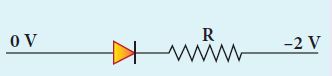
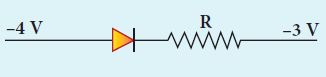


60.
The given electrical network is equivalent to ______.

AND gate
OR gate
NOR gate
NOT gate
61.
The output of the following circuit is 1 when the input ABC is______.
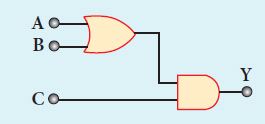
101
100
110
010
62.
The variation of frequency of carrier wave with respect to the amplitude of the modulating signal is called ______.
Amplitude modulation
Frequency modulation
Phase modulation
Pulse width modulation
63.
The frequency range of 3 MHz to 30 MHz is used for ______.
Ground wave propagation
Space wave propagation
Sky wave propagation
Satellite communication
64.
The particle size of ZnO material is 30 nm. Based on the dimension it is classified as _____.
Bulk material
Nanomaterial
Soft material
Magnetic material
65.
Which one of the following is the natural nanomaterial.
Peacock feather
Peacock beak
Grain of sand
Skin of the Whale
66.
The blue print for making ultra durable synthetic material is mimicked from _____.
Lotus leaf
Morpho butterfly
Parrot fish
Peacock feather
67.
The method of making nanomaterial by assembling the atoms is called _____.
Top down approach
Bottom up approach
Cross down approach
Diagonal approach
68.
69.
The materials used in Robotics are _____.
Aluminium and silver
Silver and gold
Copper and gold
Steel and aluminum
70.
The alloys used for muscle wires in Robots are _____.
Shape memory alloys
Gold copper alloys
Gold silver alloys
Two dimensional alloys
71.
The technology used for stopping the brain from processing pain is _____.
Precision medicine
Wireless brain sensor
Virtual reality
Radiology
72.
The particle which gives mass to protons and neutrons are _____.
Higgs particle
Einstein particle
Nanoparticle
Bulk particle
73.
The gravitational waves were theoretically proposed by _____.
Conrad Rontgen
Marie Curie
Albert Einstein
Edward Purcell
74.
The barrier potential of a p-n junction depends on
i) type of semiconductor material
ii) amount of doping
iii) temperature. Which one of the following is correct?
(i) and (ii) only
(ii) only
(ii) and (iii) only
(i) (ii) and (iii)
75.
In an unbiased p-n junction, the majority charge carriers (that is, holes) in the p-region diffuse into n-region because of ______.
the potential difference across the p-n junction
the higher hole concentration in p-region than that in n-region
the attraction of free electrons of n-region
the higher concentration of electrons in the n-region than that in the p-region
I. choose the best answer
1.
v = nג
In an isotropic medium, there is no change in the frequency of the light. So, the speed of light depends on wavelength of light.
2.
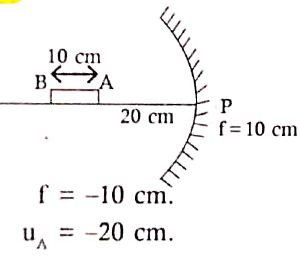
At end A,
\(\frac{1}{f} =\frac{1}{u_A}+\frac{1}{v_A} \)
\(\therefore \frac{1}{v_A} =\frac{1}{-10}-\frac{1}{-20} \)
\(\frac{1}{v_A} =-\frac{1}{10}+\frac{1}{20}=\frac{-2+1}{20}=-\frac{1}{20} \)
\(v_A =-20 \mathrm{~cm} \)
\(\left|v_{\wedge}\right|=20 \mathrm{~cm}\)
At end B,
\(\frac{1}{f} =\frac{1}{u_B}+\frac{1}{v_B} \)
\(\frac{1}{v_B} =\frac{1}{f}-\frac{1}{u_B}, \)
\(u_B =-30 \mathrm{~cm} \)
\(\frac{1}{v_B} =-\frac{1}{10}+\frac{1}{30} \)
\(=\frac{-3+1}{30}=\frac{-2}{30}=\frac{-1}{15} \)
\(v_B =-15 \mathrm{~cm} \)
\(\left|v_B\right| =15 \mathrm{~cm} \)
\(\therefore \quad\left|\mathrm{v}_{\mathrm{A}}\right|-\left|\mathrm{v}_{\mathrm{B}}\right| \) is the length of the image
= 20 - 15 = 5 cm
3.
Convex Mirror is diverging in nature and for all positions of objects, convex mirror forms virtual and erect image.
4.
(a)
5.
Refractive index of water \(=\frac{Velocity \ of \ light \ in \ air(V_s)}{Velocity \ of \ light \ in \ water(V_w)}\)
6.
(c)
refraction
7.
\(\frac{I}{f}=\left(\frac{\mu_{\mathrm{L}}}{\mu_L}-1\right)\left(\frac{1}{R_1}-\frac{1}{R_2}\right)\)
When the biconvex lens of glass dipped in liquid, it acts as a plane sheet of glass.
\(\therefore \mathrm{f}=\infty, \frac{1}{\mathrm{f}}=0 \quad \frac{\mu_g}{\mu_{\mathrm{L}}}-1=0 ; \frac{\mu_{\mathrm{s}}}{\mu_{\mathrm{L}}}=1, \mu_{\mathrm{s}}=\mu_{\mathrm{L}}\)
8.
\(\frac{1}{f} =(n-1)\left(\frac{1}{R_1}-\frac{1}{R_2}\right) \)
\(=(1.5-1)\left(\frac{1}{\infty}-\frac{1}{(-10)}\right)\)
(Since plano convex lens)
\(=0.5\left[\frac{1}{10}\right]=\frac{1}{20} \)
\(\mathrm{f}_t =20 \mathrm{~cm}\)
Formula for silvered lenses
\(\frac{1}{\mathrm{~F}} =\frac{2}{\mathrm{f}_1}+\frac{1}{\mathrm{f}_m} \)
\(\frac{1}{\mathrm{~F}} =\frac{2}{20}+\frac{1}{\infty} \)
\(\therefore \mathrm{F} =\frac{20}{2}=10 \mathrm{~cm}\)
9.
Apparent depth = 3 + 5 = 8 cm
Real depth = thickness of the slab = t
n = 1.5
\(n=\frac{Real \ depth}{Apparent \ depth}\)
\(\therefore 1.5=\frac{t}{8}\)
t = 1.5 x 8
t = 12 cm
10.
For total internal reflection,
sin i > sin c
\(n=\frac{1}{sin \ c}\)
\(sin \ c=\frac{1}{n}\)
\(sin \ i>\frac{1}{n}\)
\(n>\frac{1}{sin \ i}\)
n >\(\sqrt{2}\)
n >1.414 = 1.5
11.
Refractive index for violet is more and wavelength for violet is very low comparing other colours. So, the letter which appears to be raised more is violet.
12.
λ = 500 nm = 500 x 10-9 m
x = 3 mm = 3 x 10⁻³ m
a = 1 mm = 1 x 10⁻³ m
\(d=\frac{xa}{1.22 \lambda}\)
\(d=\frac{3 \times1\times10^{-6}}{1.22 \times500\times10^{-9}}\)
\(=\frac{3 \times1\times10^{-6}}{6.10 \times 10^{-7}}\)
\(d=\frac{30}{6.1}=5 m\)
13.
d' = 2d, β' = β, D' = ?
W.K.T, Fringe width
\(\beta = \frac{D\lambda}{d} \Rightarrow D' = \frac{Dd'}{d}\)
\(D' = \frac{D2d}{d}=2D\)
14.
I = l1 + l2 + 2\(\sqrt{I_1I_2}\)cos θ
If cos θ = cos 0 = l, I is max
= I+ 4I + 2\(\sqrt{41^2}\) cos 0
= 5I + 4I = 91
If cos π = -1, I is min
Imin = I + 4I + 2\(\sqrt{41^2}\) cos π
= 5I + 4I(-1)
= 5I + 4I = I
(Imax, Imin)= (9I, I)
15.
2n t cos r = (2m + 1) \(\frac{\lambda}{2}\)
For maximum
m = 2 (For visible region), n - refractive index.
cos r = cos 0 = 1
t = 5 x 10-5 x 10-2 = 5 x 10⁻⁷ m
\(n=\frac{(2m+1)\frac{\lambda}{2}}{2t}=\frac{5\lambda}{2 \times 2 \times t}\)
\(=\frac{5 \times5320\times10^{-10}}{4 \times 5 \times 10^{-7}}\)
\(=\frac{5 \times5320\times10^{-10}}{20}=1330 \times 10^3\)
n = 1.330
16.
(b)
17.
n = tan ip = tan 60o = \(\sqrt{3}\)
18.
(b)
get shifted upwards
19.
(c)
plane polarised
20.
(d)
21.
\(\mathrm{E}_{\mathrm{p}} =\frac{\mathrm{hc}}{\lambda_{\mathrm{p}}} \)
\(\mathrm{E}_{\mathrm{e}} =\frac{\mathrm{h}^2}{2 \mathrm{~m} \lambda_{\mathrm{e}}^2} \)
\(\frac{\mathrm{hc}}{\lambda_{\mathrm{p}}} =\frac{\mathrm{h}^2}{2 \mathrm{~m} \lambda_{\mathrm{e}}^2} \)
\(\lambda_{\mathrm{p}} \propto \lambda_{\mathrm{e}}^{{ }^2}\)
22.
\(\lambda\propto \frac{1}{\sqrt{V}}\)
\(\frac{\lambda_1}{\lambda_2}=\frac{\sqrt{224\times10^3}}{\sqrt{14\times 10^3}}\)
\(=\sqrt{16}=4\)
\(\lambda_{\mathrm{2}}= \frac{\lambda_1}{4}\)
23.
\(\lambda_{\mathrm{i}} \frac{1}{\mathrm{mv}} \)
\(\frac{\lambda_p}{\lambda_e} =\frac{m_e v_e}{m_P v_P} \)
\(1 =\frac{9.1 \times 10^{-31} \times 6 \times 10^6}{3 \times 10^{-9} \times v_p} \)
\(\mathrm{v}_{\mathrm{p}} =9.1 \times 10^{-16} \times 2 \)
\(\mathrm{v}_{\mathrm{p}} =18.2 \times 10^{-16} \)
\(\mathrm{v}_{\mathrm{p}} =1.82 \times 10^{-15} \mathrm{~m} \mathrm{~s}^{-1}\)
24.
\(\frac{\mathrm{hc}}{\lambda}=\phi+\mathrm{eV} \) .....(1)
\(\frac{\mathrm{hc}}{2 \lambda}=\phi+\frac{\mathrm{eV}}{4}\) .....(2)
multiply (2) eqn by 4
\(\frac{2 h c}{\lambda}=4 \phi+\mathrm{eV}\) .....(3)
subtract eqn (1) from (3), we get
\(\frac{ h c}{\lambda}=3 \phi \Rightarrow \phi = \frac{ h c}{3\lambda}\)
\(\frac{ h c}{\lambda_o}=\frac{ h c}{3\lambda}\)
⋋o = 3⋋
25.
(b)
26.
\(\frac{\mathrm{hc}}{\lambda} =\phi+\mathrm{K} . \mathrm{E} .....(1) \)
\(\frac{2 \mathrm{hc}}{\lambda} =\phi+3 \mathrm{~K} . \mathrm{E}......(2)\)
multiply eqn. (1) by 3, we get
\(\frac{3 \mathrm{hc}}{\lambda} =3\phi+3 \mathrm{~K} . \mathrm{E} .....(3)\)
Subtract eqn. (2) from (3), we get
\(\frac{\mathrm{hc}}{\lambda} =2\phi \)
\(\phi=\frac{ \mathrm{hc}}{2\lambda} \)
27.
(b)
28.
K.E= hv - Φ
K.E1 = 0.9 - 0.6 = 0.3 eV
K.E2 = 3.3 - 0.6 = 2.7 ev
K.E ∝ v2
\(\frac{0.3}{2.7}=\frac{v^2_1}{v^2_2} \)
\(\frac{v^1}{v^2} =\frac{1}{3}\)
29.
\(P =\frac{E}{t}=\frac{n h v}{t}=\frac{n h c}{\lambda t} \Rightarrow P \propto n / t \)
\(\frac{P_1}{P_2} =\frac{1.38 \times 10^{15}}{460} \times \frac{520}{1.04 \times 10^{15}}=1.5\)
30.
\(\mathrm{P} =\frac{\mathrm{n}}{\mathrm{t}} \frac{\mathrm{hc}}{\lambda} \)
\(\frac{\mathrm{n}}{\mathrm{t}} =\frac{\mathrm{P} \lambda}{\mathrm{hc}} \)
\(\frac{\mathrm{n}}{\mathrm{t}} =\frac{3.8 \times 10^{26} \times 550 \times 10^{-9}}{6.6 \times 10^{-3} \times 3 \times 10^8}=1 \times 10^{-15}\)
31.
\(\lambda_0 =\frac{h c}{\phi} \)
\(=\frac{6.626 \times 10^{-34} \times 3 \times 10^8}{3.313 \times 1.6 \times 10^{-19}} \)
\( =\frac{19.8782400}{5.3} \times 10^{-7} \)
\(\lambda_0 =3.750 \times 10^{-7} \simeq 3750 \stackrel{o}A\)
32.
\(K .E_{\max } =\mathrm{hv}-\phi \)
\(=\frac{\mathrm{hc}}{\lambda}-\phi \)
\(\mathrm{E} =\frac{6.6 \times 10^{-34} \times 3 \times 10^8-1.235}{500 \times 10^{-9} \times 1.6 \times 10^{-19}} \)
\(=2.475-1.235 \)
\(\text {K. } \mathrm{E}_{\max } =1.24 \mathrm{eV}\)
33.
\(\text {K.E } =\frac{B^2 q^2 r^2}{2 m} \)
\(\phi =\frac{h c}{\lambda}-K . E \)
\(=\frac{h c}{\lambda}-\frac{B^2 q^2 r^2}{2 m} \)
\(\phi =\frac{h c}{\lambda}-2 m\left(\frac{B q r}{2 m}\right)^2\)
34.
\(E=\frac{12400 \stackrel{o}A}{4100 \stackrel{o}A}=3.02 eV\)
35.
(c)
thermionic
36.
(b)
37.
\(L=\frac{nh}{2\pi}=\frac{4h}{2\pi}=\frac{2h}{\pi}\)
38.
\(V_{ionisation}=\frac{13.6}{n^2}Z^2 volt\)
\(Z=\sqrt\frac{V\times n^2}{13.6}=\sqrt\frac{122.4 \times I^2}{13.6}=\sqrt{9}=3\)
39.
rn ∞ n2
r1: r2: r3 = 1: 4: 9
40.
Cathode rays are stream of negatively charged electron.
41.
(b)
42.
\(\frac{1}{\lambda}=\mathrm{RZ}^2\left[\frac{1}{\mathrm{n}_1^2}-\frac{1}{\mathrm{n}_2^2}\right] \)
\(\frac{1}{\lambda}=\mathrm{RZ} ^2\left[\frac{1}{1}-\frac{1}{4}\right]=\frac{3}{4} \mathrm{RZ}^2 \)
\(\lambda \propto \frac{1}{Z^2} \)
\(\lambda_{\mathrm{Li}}: \lambda_{\mathrm{H} c}: \lambda_{\mathrm{H}}=\frac{1}{9}: \frac{1}{4}: \frac{1}{1}=4: 9: 36\)
43.
Electric potential in nth orbit
\(\mathrm{V} =\mathrm{V}_0 \ln \left(\frac{\mathrm{r}_{\mathrm{n}}}{\mathrm{r}_0}\right) \)
\(=\mathrm{V}_0\left(\ln \mathrm{r}_{\mathrm{n}}-\ln \mathrm{r}_0\right) \)
\(=\mathrm{V}_0 \ln \mathrm{r}_{\mathrm{n}}-\mathrm{V}_0 \ln \mathrm{r}_0\)
\(\left|\mathrm{F}_\epsilon\right|=\mathrm{e} \frac{\mathrm{dv}}{\mathrm{dr}} =\mathrm{e} \frac{\mathrm{d}}{\mathrm{dr}}\left(\mathrm{V}_b / n \mathrm{r}_B-\mathrm{V}_0 / m \mathrm{r}_0\right) \)
\(=\mathrm{c}\left(\frac{\mathrm{V}_0}{\mathrm{r}_n}-0\right)=\frac{\mathrm{eV}}{\mathrm{r}_{\mathrm{n}}} \)
Centripetal force = coulomb force
\(\frac{m v^2}{r_n}=\mathrm{c} \frac{V_0}{r_n} \Rightarrow v=\sqrt{\frac{e V_0}{m}}=\text { constant }\)
Angular momentum,
\(\mathrm{mvr}_n=\frac{\mathrm{nh}}{2 \pi}\)
\(\mathrm{m}, \mathrm{v}, \mathrm{h}, 2 \pi\) are constants
hence, rn ∝ n
44.
\(r \propto A^{\frac{1}{3}} \)
\(\frac{r_{\mathrm{Cu}}}{\mathrm{r}_{\mathrm{Al}}}=\frac{\mathrm{A}_{\mathrm{Cu}}^\frac{1}{3}}{\mathrm{~A}_{\mathrm{Al}}^{\frac{1}{3}}}=\frac{4}{3} \)
\(\mathrm{r}_{\mathrm{Cu}}=\frac{4}{3} \times 3.6 \mathrm{~F}=4.8 \mathrm{~F}\)
45.
r ∝ A1/3
Surface Area = 4πr2
Hence, Surface Area ∝ A2/3
46.
\(\frac{BE}{A}=\frac{\Delta\times931MeV}{V}=\frac{0.042 \times931}{7}\)
= 5.586 = 5.6 MeV
47.
B = ∆m x c2
∆m = \(\frac{B}{c^2}\)
N Mn + Z Mp - M(N,Z) = \(\frac{B}{c^2}\)
N (N,Z) = N Mn + ZMp - \(\frac{B}{c^2}\)
48.
AZX = 242He + 201e + Ai2iY
\(\frac{N_i}{Z_i}=\frac{(A_i-Z_i)}{Z_i} =\frac{A-8-(Z-6)}{Z-6}=\frac{A-Z-2}{Z-6}\)
49.
TA1/2 = ፒB
\(\frac{0.6931}{\lambda_{\mathrm{A}}}=\frac{1}{\lambda_{\mathrm{B}}} \)
\(\lambda_{\mathrm{B}}=\frac{\lambda_{\mathrm{A}}}{0.6931}=1.44 \lambda_{\mathrm{A}}\)
Hence, B will decay at faster rate than A
50.
(b)
51.
(a)
0.7 V
52.
(c)
there will be more free electrons than hole in the semiconductor
53.
(c)
00–1800
54.
(d)
Voltage regulator
55.
(c)
Photovoltaic action
56.
(a)
Recombination of charge carriers
57.
(d)
58.
\(y=\overline{A}=\overline{1011}=0100\)
The Boolean expression for NOT gate, \(y=\bar{A}\)
59.
(a)
60.
\(Y_1=\overline{A+B}, y_2=\overline{A+B}=A+B, y=\overline{A+B}\)
61.
A = 1, B = 0, C = 1
y = A + B, y = (A + B).C
y = (1 + 0).1 ⇒ y = 1
62.
(b)
Frequency modulation
63.
Ground wave propagation: frequency less than 2 MHz
Sky wave propagation: 3 to 30 MHz
Space wave propagation: Above 30 MHz to 400 GHz
Satellite communication: uplink communication 6 GHz band downlink communication 4 GHz band
64.
Size of the particle is between
1-100 nm - Nano.
Size of the particle is greater
than-100 nm - Bulk.
65.
Wings of a morpho butterfly, peacock feathers, lotus leaf surface and sources of parrot fish's bite are some of the natural nano particles.
66.
Parrot fish's source of bite → mimic → Ultra durable synthetic material.
Lotus leaf surface → SEM → Self Cleaning Process
The scales on the wings of a morpho butterfly → mimic → Interaction of colours.
Peacock feathers → mimic → Glowing in different colours.
67.
There are two type of Synthesis of nano materials:
(i) Bottom up - Assembling atoms together.
(ii) Top down Breaking down bulk solid.
68.
(c)
69.
(d)
Steel and aluminum
70.
They are thin strands of wire made of shape memory alloys. They can contract by 5% when electric current is passed through them.
71.
Medical virtual reality is effectively used to stop the brain from processing pain and cure soreness.
72.
Proton and neutron are made up of quarks. Later, it was found that Higg's particles or God particles give mass to the particles like protons, neutrons etc.
73.
Albert Einstein theoretically proposed the existence of gravitational waves in the year 1915.
74.
(d)
(i) (ii) and (iii)
75.
(d)
the higher concentration of electrons in the n-region than that in the p-region

12th Standard Syllabus & Materials
12th Standard
TN 12th Standard Physics Electronics and Communication Creative Questions Study Material - QB365 Set B
NEW12th Standard
TN 12th Standard Physics Electronics and Communication Creative Questions Study Material - QB365 Set A
NEW12th Standard
TN 12th Standard Physics Wave Optics Creative Questions Study Material - QB365 Set D
NEW12th Standard
TN 12th Standard Physics Wave Optics Creative Questions Study Material - QB365 Set C



Tamilnadu Stateboard 12th Standard Subjects

Maths

Chemistry
Physics

Biology

Computer Science

Business Maths and Statistics

Economics

Commerce

Accountancy

History

Computer Applications
Biology
Computer Technology
Computer Applications
Computer Science
Business Maths and Statistics
Commerce
Economics
Maths
Chemistry
Physics
Computer Technology
History
Accountancy

Tamil

English

French
Tamilnadu Stateboard Standards


